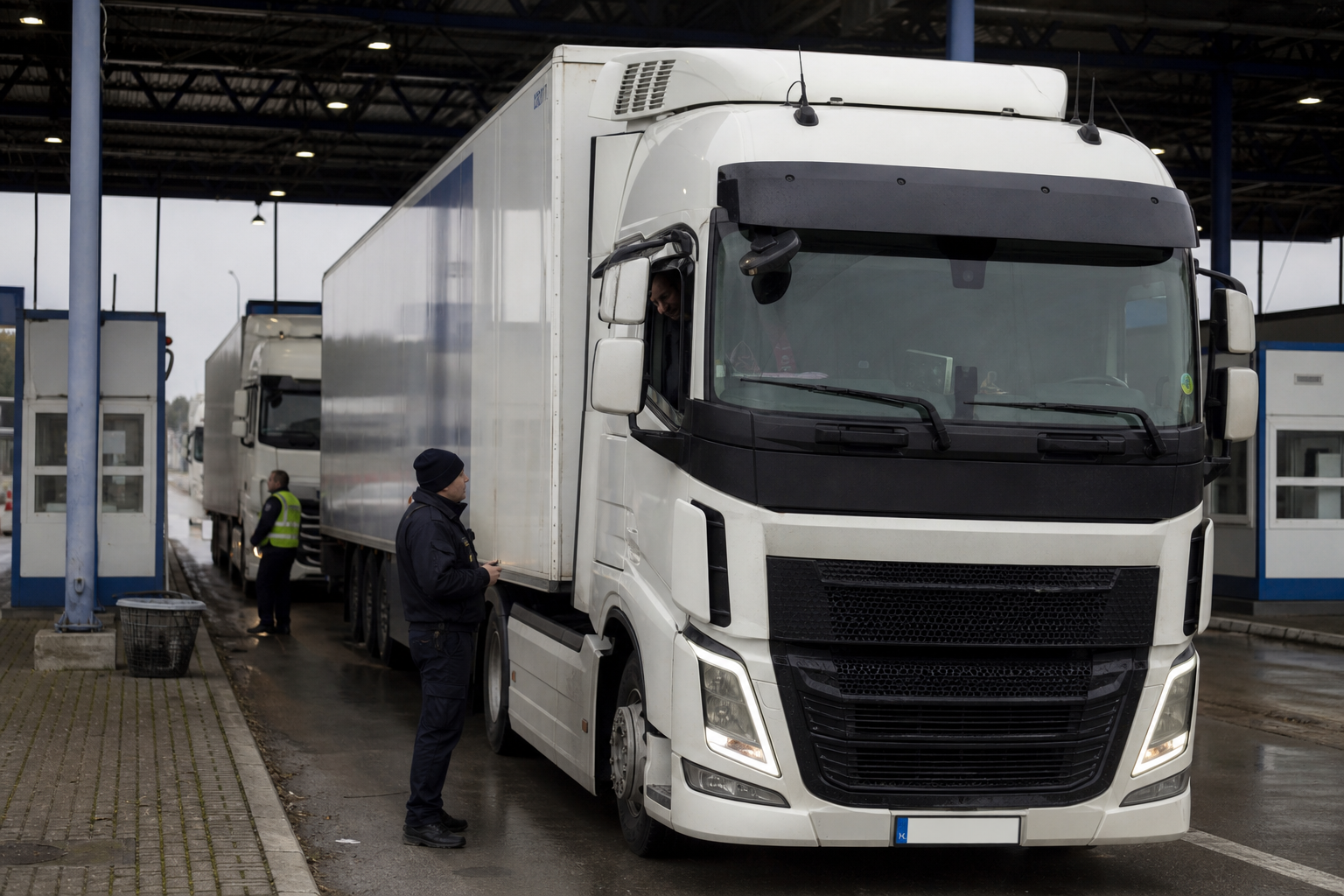
For Western Balkan hauliers and freight buyers, EES driver compliance is now a deployable-labour issue rather than launch preparation for the EU Entry/Exit System. EES has been fully operational at external Schengen border-crossing points since 10 April 2026. It did not create the 90-days-in-180 short-stay limit; it makes each qualifying traveller’s entry, exit and overstay compliance digitally traceable across the participating area, turning personal stay capacity into a dispatch input.
Operators should therefore approve Schengen rotations against the named driver’s immigration status and remaining lawful stay, not only vehicle availability, driving hours and route capacity. An alternative border may change processing exposure, but it cannot reset an individual’s area-wide short-stay clock. Relief arrangements also need a replacement driver who has both sufficient remaining days and a compliant route to the vehicle.
EES driver compliance after full rollout
The European Commission’s EES guidance confirms that the phased rollout ended on 10 April 2026 and that the system is fully operational. Dispatch planning should no longer depend on rollout-stage inconsistency between external border-crossing points as an operating margin.
A later Commission update published on 6 August 2026 reported more than 150 million entries and exits recorded since launch. That scale matters because EES is no longer a pilot condition at a handful of crossings; it is a mature control layer across the external Schengen border. The figure should not be misread as evidence of a standard truck-delay time: it measures registered movements, not freight queues.
EES applies to non-EU nationals making short stays in 29 participating European countries, whether they travel visa-free or use a short-stay visa. Under the regulation establishing EES, a short stay is no more than 90 days in any 180-day period. The system is designed to record border movements, calculate authorised stay and help detect overstays.
The allowance is shared across the participating Schengen/EES area. A driver who has used most of it during rotations through several countries does not receive another 90 days by choosing a different external border. Moving a route from Croatia to Hungary, Romania, Bulgaria or Greece may change where and how the border check occurs, but it does not change the driver’s accumulated stay.
EES records the movement of people. It does not replace customs declarations, transit procedures, cargo inspections, cabotage requirements or other road-transport controls. A vehicle and consignment may be operationally ready while the assigned driver lacks enough remaining short-stay capacity to complete the rotation lawfully.
Which freight drivers are within EES scope
Qualifying non-EU short-stay travellers include professional drivers. The EU’s published list of people to whom EES does not apply includes residence-permit and long-stay-visa holders, together with specified categories such as international train crew. It does not provide a class-wide exemption for road-freight drivers.
Eligibility consequently requires an individual assessment. One driver travelling under the short-stay regime may be subject to EES, while another with an applicable residence permit or long-stay visa may be outside its scope. That status must be examined as an immigration and employment-compliance matter, not manufactured as a dispatch workaround. Exclusion from EES does not, by itself, establish every right needed to work or provide transport services across the relevant countries.
The Commission’s July 2026 exemption guidance adds an important document-level nuance: residence permits and long-stay visas issued by countries operating EES generally remove the holder from EES registration, while permits or long-stay visas issued by Cyprus or Ireland are treated differently. Fleet HR teams should therefore record the issuing state and document type rather than storing a simple yes/no “EU residence” flag.
Croatia is a material interface for Bosnia and Herzegovina supply chains. The Agency for Statistics of Bosnia and Herzegovina’s Q4 2025 transport release shows that 70.8% of freight motor vehicles exiting Bosnia and Herzegovina used crossings with Croatia. The figure measures vehicle exits rather than cargo value or tonnage, but it demonstrates the scale of operational exposure at that border. BalkansNetwork’s analysis of Romania and Bulgaria in full Schengen provides context for other regional routes, although live procedures still require confirmation from the responsible entry-state authority.
Biometric registration and the rolling 90/180 clock
At first EES registration, the traveller’s record includes travel-document data, a live facial image and, where physically possible, four fingerprints. The EU’s border-check explanation states that later crossings still create entry or exit records and involve identity verification. It is therefore incorrect to assume either that complete fingerprint enrolment starts again at every crossing or that later movements cease to be recorded.
First biometric enrolment can create crossing-time uncertainty, particularly when combined with traffic and local operating conditions. The longer-running compliance exposure is cumulative stay consumption. Dispatchers need to assess whether the driver can remain within the 90/180 limit for the entire expected assignment, including travel, loading or waiting periods, delivery, repositioning and the return journey.
A relief-driver plan has two independent conditions. The replacement must possess sufficient lawful stay capacity and must have a compliant, operationally realistic way to reach the vehicle. Merely naming a substitute in a contract does not resolve the exposure if that person’s own rolling balance is inadequate or the transfer depends on an unverified border procedure.
The EES stay-checking tool carries published transition caveats until 6 October 2026. During that period, operators should not treat one unchecked calculation as the sole dispatch control. Company travel records, available documentary evidence and the EU tool should be reconciled, with ambiguous cases referred to the competent border or immigration authority before deployment.
National facilitation programmes must also be distinguished from exemptions. The EU description of national facilitation programmes indicates that eligible frequent travellers may receive eased elements of border checking. Facilitation does not add lawful stay days, waive the 90/180 threshold or create a cross-Schengen work right. The supplied evidence does not establish a current uniform operational programme on which hauliers can rely across the relevant freight borders.
Delivery exposure without a standard queue estimate
No verified comparative dataset supports a standard EES queue duration or a dependable ranking of Western Balkan–Schengen freight crossings. Carriers should not price contracts or promise delivery windows on the basis of an asserted universal delay. Processing exposure can vary by crossing, traffic level, traveller, first-registration status and national operating conditions.
There is nevertheless an official warning of potential disruption. Slovenia’s government advised that longer waits could occur at Croatian land borders with Serbia, Bosnia and Herzegovina and Montenegro because of EES. The notice identifies a risk; it does not provide a fixed or standard waiting-time forecast.
The commercial effects of EES driver compliance are company-specific and may include missed delivery slots, driver substitution, repositioning, additional administration or an available vehicle being unusable with its nominated driver. Contracts should separate border-processing contingencies from the more fundamental eligibility problem: a driver who lacks enough remaining days to perform the assignment cannot solve that constraint through rerouting.
ETIAS is separate from EES. The Commission’s comparison of EES and ETIAS describes different functions for the two systems. As verified on 5 September 2026, ETIAS is still not operating. The Commission continues to schedule it for the final quarter of 2026 and has not published an exact start date. Operators should monitor it as a separate requirement rather than treating it as part of current EES registration.
Dispatch controls for carriers and freight buyers
Carriers and buyers should put the named driver’s legal status and rolling stay balance at the beginning of the assignment decision:
| Decision point | Required check | Operating implication |
|---|---|---|
| Legal status | Determine whether the driver is a qualifying short-stay traveller or has documented status outside EES scope. | Do not infer an exemption from occupation, nationality or route frequency. |
| Rolling balance | Reconcile previous entries and exits across the participating area. | Approve work only when the expected rotation fits within the remaining lawful stay. |
| Border readiness | Identify whether first biometric registration may be required and verify the procedure with the entry-state authority. | Allow a contingency without assuming a standard queue duration. |
| Relief cover | Check the substitute’s legal status, remaining days and route to the vehicle. | Use executable relief-driver and missed-delivery provisions. |
| Route change | Confirm live procedures at the alternative external border. | Reroute to manage crossing exposure, not to reset the 90/180 calculation. |
DG HOME is the principal EU policy-communication counterpart, and eu-LISA is a relevant EU systems actor. Border procedures are administered nationally. Operators should obtain current confirmation from the authority responsible for the intended entry point rather than transferring assumptions or informal reports from another crossing.
National haulage associations and chambers can consolidate documented operating problems and raise them with border, transport and EU-level counterparts. They cannot grant immigration rights, but evidence showing dates, crossings, driver status and the procedure encountered can help distinguish a recurring administrative problem from an individual short-stay-compliance failure.
The immediate EES driver compliance test is whether the named driver can lawfully complete the whole Schengen rotation with a reasonable operating margin. If status documents and a reconciled rolling-day record do not support that conclusion, the load should be reassigned, restructured or declined pending authoritative confirmation.
Sources and verification notes
- European Commission — Entry/Exit System
- European Commission — EES exemptions, 27 July 2026
- European Commission — EES operating update, 6 August 2026
- Regulation (EU) 2017/2226
- Agency for Statistics of Bosnia and Herzegovina — Q4 2025 road-freight crossings
- Government of Slovenia — EES travel notice
- European Commission — EES and ETIAS differences
Verification date: 5 September 2026. Border procedures and individual immigration status can change; operational decisions should be reconfirmed with the competent authority for the intended entry point.