Finding distributors in Serbia is relatively easy if the goal is simply to collect company names. Finding a local partner that can actually sell, support and develop a foreign supplier’s products is considerably harder.
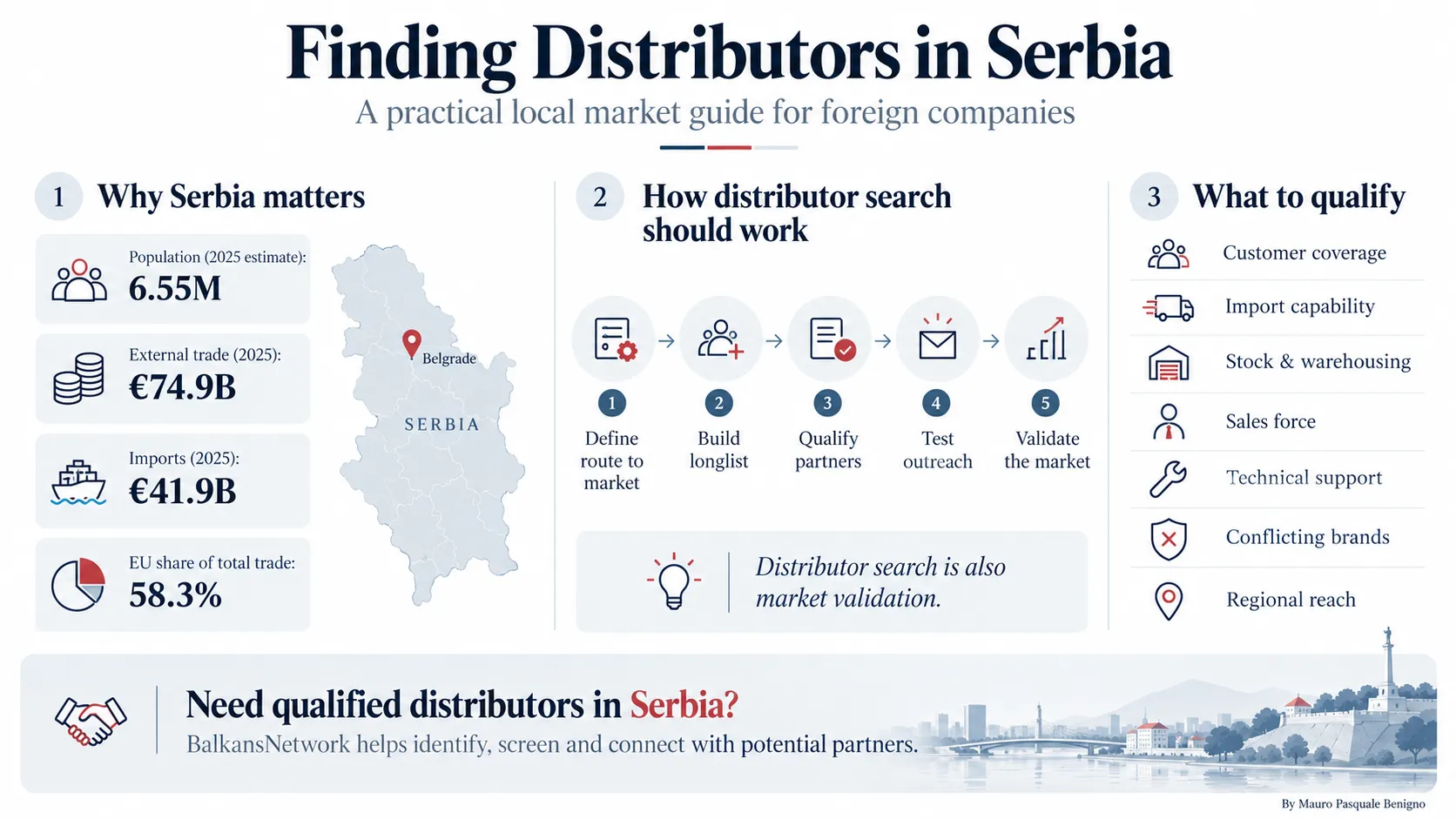
Serbia is a compact but commercially active market. Its estimated population was around 6.55 million in 2025, while total foreign trade in goods reached approximately €74.9 billion. Imports were about €41.9 billion, and EU member states accounted for 58.3% of Serbia’s total foreign trade. Those figures make Serbia relevant not only as a domestic market, but also as part of a wider Southeast European commercial strategy.
How to find distributors in Serbia: start with the route to market
Before building a list of Serbian companies, define what the partner actually needs to do. A distributor may be expected to import and resell, maintain stock, provide technical support, install equipment, manage after-sales service, cover key accounts, develop dealers or participate in projects and tenders. These are very different roles.
In some B2B sectors, the company that controls customer access may not describe itself as a distributor at all. It could be an importer, wholesaler, engineering company, system integrator, specialised dealer, contractor or technical service provider. Starting from the route to market rather than from the word “distributor” usually produces a much stronger shortlist.
Serbia is small enough to map, but fragmented enough to require local knowledge
One advantage of Serbia is that a specialised B2B market can often be mapped relatively quickly. A limited number of companies may account for a meaningful share of a niche sector. But that does not mean the market is simple.
Formal distribution structures vary by industry. Consumer products may depend on importers, wholesalers and retail chains. Industrial products may move through engineering companies, OEM suppliers, integrators or specialised technical dealers. Construction-related products may reach the end customer through contractors, installers, architects or project developers. Healthcare and technical equipment can add regulatory, service and certification requirements.
The practical question is therefore not only “Who distributes this product?” but “Who influences the purchase and already has access to the right customers?”
Define the ideal Serbian distributor before contacting anyone
A distributor search should begin with a clear partner profile. At minimum, a foreign supplier should decide:
- which customer segments the partner should already serve;
- whether import capability is required;
- whether the distributor should hold stock locally;
- whether technical sales or after-sales service is necessary;
- whether direct access to factories, retailers, contractors or public-sector buyers matters;
- whether Serbia alone is the territory, or whether neighbouring markets are also relevant;
- which competing or complementary brands would create a conflict;
- what level of sales effort and market development is expected.
This step prevents one of the most common mistakes in international expansion: spending time with companies that look credible online but are commercially irrelevant for the product.
Belgrade matters, but the market is not only Belgrade
Belgrade naturally contains a high concentration of headquarters, importers, professional services firms and decision-makers. For many sectors it will be the first place to search.
However, the strongest partner may be elsewhere. Novi Sad and the wider Vojvodina region are particularly important for agriculture, food processing, manufacturing and logistics. Central Serbia has significant industrial and automotive activity, while Niš is an important economic centre for southern Serbia.
Sector fit is more important than postcode. A distributor’s real customer coverage should be verified rather than assumed from the address of its headquarters.
What to qualify before appointing a distributor
An established company with an impressive website and a long list of brands is not automatically the best partner. A useful qualification process should examine commercial capability in detail.
| Area | What to verify |
|---|---|
| Customer coverage | Which customer segments and key accounts does the company actually serve? |
| Portfolio fit | Are there competing brands, and how important would your product be inside the portfolio? |
| Import capability | Does the company regularly import, handle customs and work with international suppliers? |
| Stock and logistics | Can it hold inventory, manage lead times and support the expected service level? |
| Sales force | How many relevant salespeople are active, and do they have relationships with the target customers? |
| Technical support | Can the partner install, service, troubleshoot or provide after-sales support where required? |
| Commercial commitment | Is the company prepared to invest time, sales resources and market-development effort? |
| Regional reach | If wider Balkan coverage is claimed, which countries and customers are actually served? |
There is also a less obvious but important question: how important will your product be to the distributor? A very large distributor representing dozens of international manufacturers may devote little attention to a new supplier. A smaller specialist with strong access to the right customers can sometimes produce a much better result.
Serbia can be a regional platform — but verify the evidence
Serbia also matters because of its commercial links with neighbouring markets. In 2025, Serbia exported approximately €4.88 billion of goods to CEFTA countries while importing about €1.92 billion, resulting in a substantial trade surplus with the region.
For some foreign companies, a Serbian partner can therefore become part of a wider Western Balkans strategy. But claims such as “we cover the Balkans” should never be accepted at face value. Ask which countries the distributor actively sells into, whether it has local employees or partners, how logistics are organised and which customers it serves outside Serbia.
Regional reach should be demonstrated by business activity, not by a map in a presentation.
Be careful with exclusivity
Potential distributors may request exclusive rights for Serbia — and sometimes for several Balkan countries — early in the discussion. Exclusivity can make commercial sense, but normally only when it is tied to measurable commitments.
Those commitments can include minimum purchases, sales targets, agreed customer coverage, market-development activities, reporting obligations and periodic performance reviews. During an initial validation period, non-exclusive cooperation or a limited trial period is often safer for both sides.
The objective is not to make the partner uncomfortable. It is to ensure that territory rights reflect actual market investment and performance.
A good shortlist should be short
A distributor search is not a numbers exercise. A spreadsheet containing 150 loosely matched Serbian companies is usually less useful than a carefully researched shortlist of 10–20 plausible partners.
The search can start broadly, but potential companies should then be screened by sector fit, portfolio, customer base, commercial capability and likely interest. Only the strongest candidates should move into direct outreach.
The first conversation should also be used to learn, not simply to sell. Instead of immediately asking a company to “become our distributor”, it is often more productive to understand its current portfolio, customer base, view of the market, competitive landscape and appetite for the category.
Distributor search is also market validation
This is one of the most useful ways to think about the process. A distributor search should not only produce company names. It should help answer a more fundamental question: is there a commercially credible route into the Serbian market?
If several well-qualified distributors raise the same objection about pricing, certification, product positioning, service requirements or customer demand, that feedback has real value even if none signs an agreement immediately. It can prevent a foreign company from investing more money in the wrong market-entry model.
Conversely, strong interest from several credible partners can be an early indication that the market deserves greater investment. This is why partner search and market validation often work best together.
A practical process for entering Serbia through distributors
- Define the route to market. Decide who buys, who influences the purchase and what the local partner must do.
- Build the partner profile. Set sector, customer, technical, geographic and commercial criteria.
- Create a longlist. Identify importers, distributors, wholesalers, integrators, contractors and other relevant operators.
- Screen the longlist. Remove companies with weak fit, conflicts or insufficient capability.
- Research the shortlist. Examine portfolios, customers, decision-makers, financial/corporate background and market reach.
- Approach the strongest candidates. Use a clear business case rather than a generic partnership message.
- Compare feedback. Use conversations to validate pricing, channel structure, objections and demand.
- Negotiate the commercial model. Only then decide on exclusivity, targets, territory, stock and market-development commitments.
Do you need qualified distributors or business partners in Serbia?
BalkansNetwork helps international companies identify, screen and connect with potential distributors, buyers and business partners in Serbia and the wider Balkans.
Rather than providing an unqualified database, the process can include defining the ideal partner profile, market mapping, candidate research, preliminary qualification and direct introductions where appropriate. For companies still testing the market, partner search can also be combined with an initial market-validation phase before a larger commitment is made.
Contact BalkansNetwork and tell us your sector, target customers and the type of Serbian partner you are looking for.
By Mauro Pasquale Benigno
Founder, BalkansNetwork