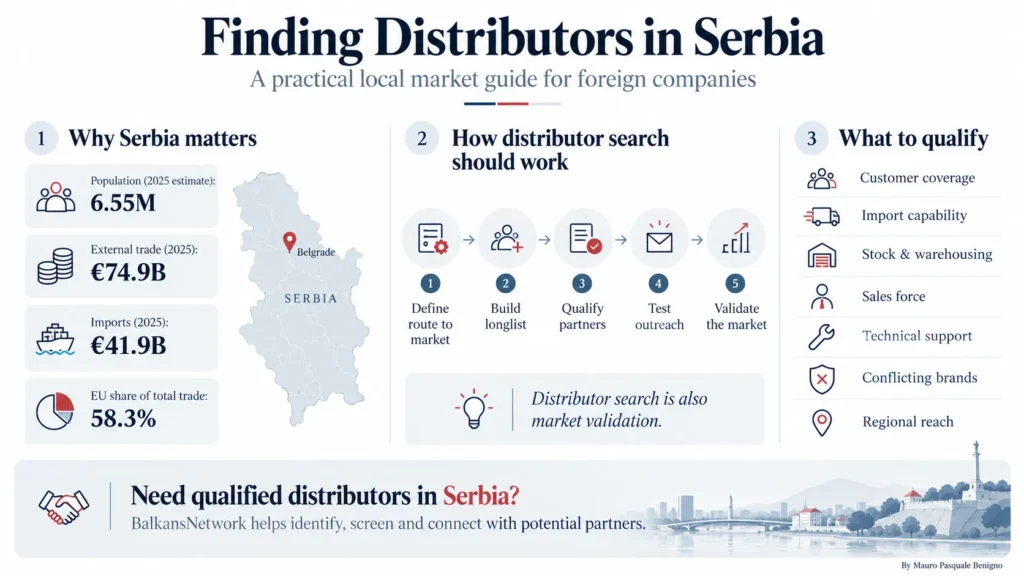
Italy is one of the most attractive nearby markets for Western Balkan companies — but proximity can be misleading. The country is geographically close, commercially familiar and deeply connected to Southeast Europe, yet successful entry depends on much more than finding an Italian buyer. A company must decide who imports, who carries compliance risk, how customs and VAT are handled, which sales channel fits the product, and whether the first partner should be an agent, distributor, importer, direct customer or local subsidiary.
This 2026 guide is designed for companies from Serbia, Bosnia and Herzegovina, Montenegro, North Macedonia, Albania and Kosovo that want to sell goods or build a commercial presence in Italy. It focuses on the operating decisions that determine whether a market-entry project scales — or becomes trapped between attractive enquiries and poor execution.
Why Italy deserves attention in 2026
Italy remains one of Europe’s largest industrial and consumer markets, and trade activity is still expanding. Istat reported that in the first half of 2026 Italian exports increased by 4.5% year on year and imports by 4.3%. In June alone, imports were 13.2% higher than a year earlier. That does not mean every category is growing, but it confirms that Italy is not a stagnant import market.
The wider EU–Western Balkans relationship also matters. According to the European Commission, trade in goods between the EU and the Western Balkans reached more than €87.7 billion in 2025, up around 5.2% year on year. Machinery and appliances, base metals, mineral and chemical products are among the main categories moving from the region into the EU.
For exporters in the Balkans, this creates a useful combination: a large nearby customer base, mature industrial supply chains, strong logistics across the Adriatic and road corridors, and preferential trade arrangements for many originating products. But preferential access does not remove the need to get origin, customs, product compliance and commercial responsibility right.
Key takeaway: treat Italy as a market-entry project, not as a one-off export destination. The commercial model, importer role and compliance structure should be decided before price negotiations begin.
1. Choose the route to market before choosing the partner
The first mistake is often to search for “an Italian distributor” before deciding what the company actually needs. Different models solve different problems.
| Model | Best for | Advantages | Main risk |
|---|---|---|---|
| Direct B2B sales | Industrial products, components, project sales | Higher control, direct customer knowledge, better margin potential | You must manage lead generation, contracts, logistics and after-sales support |
| Commercial agent | Products needing local relationships but not local stock | Lower fixed cost, local market access, company retains invoicing | Performance depends heavily on one individual or agency |
| Distributor | Products requiring local stock, retail coverage or frequent replenishment | Local inventory, customer network, easier fulfilment | Lower margin and less control over end customers |
| Importer-distributor | Non-EU goods needing a local operator to import and resell | Can absorb customs and product-import responsibilities | Partner becomes operationally difficult to replace if exclusivity is too broad |
| Italian subsidiary | Validated markets with recurring sales, staff or strategic contracts | Maximum control over pricing, hiring and customer development | Higher tax, accounting, compliance and management burden |
A Balkan manufacturer that sells €200,000 of engineered components to three Italian OEMs does not need the same structure as a food producer targeting national retail chains. The first may be able to sell directly with a local agent. The second may need an importer-distributor with warehousing, retailer access, labelling capability and recall procedures.
Before contacting partners, define five points internally: target customer, expected annual volume, required local stock, who will be importer of record, and who is responsible for after-sales service or complaints.
2. Understand the customs advantage — and its conditions
Western Balkan exporters often assume that “preferential access to the EU” automatically means zero duty. That is too simplistic.
The EU has Stabilisation and Association Agreements with Albania, Bosnia and Herzegovina, Montenegro, North Macedonia, Serbia and Kosovo. These agreements created free-trade areas and eliminated duties on most bilateral trade in goods, with limited exceptions, particularly in parts of agriculture and fisheries. The European Commission also notes that the Western Balkans participate in the Pan-Euro-Mediterranean rules-of-origin system.
The crucial word is origin. A product shipped from Serbia is not automatically Serbian-origin for preferential customs purposes. The exporter must verify the applicable rule of origin for the HS code and provide the correct proof. If the origin rule is not met or the documentation is wrong, the Italian importer may lose the preferential tariff treatment.
Use the EU’s Access2Markets portal before quoting. It provides tariffs, rules of origin, taxes, customs procedures, product requirements and trade statistics. For preferential origin, the ROSA self-assessment tool can help determine whether the product qualifies.
A practical pre-quotation customs checklist
- confirm the correct HS/CN classification;
- check the tariff for the exact country of origin and destination Italy;
- verify the preferential rule of origin, not only the country of shipment;
- confirm which origin document or statement is required;
- identify the importer and its EORI number;
- calculate customs value, duty, VAT and clearance costs before fixing the final selling price.
3. The importer of record is a commercial decision, not a paperwork detail
Every physical shipment entering the EU needs a clear importer structure. The European Commission states that an EORI number is mandatory for customs clearance for import, export and transit operations in the EU customs territory.
The importer is not simply the company whose name appears on a customs form. For regulated products, the importer may also carry product-compliance obligations. The Commission’s guidance on CE-marked goods requires importers from non-EU countries to verify that the manufacturer has completed the necessary conformity steps, that the required technical documentation and declaration of conformity are available, and that the manufacturer can be contacted.
This distinction matters when negotiating with an Italian distributor. Ask directly: Will you act as importer of record? If the answer is yes, the contract should state which documentation you must provide, who keeps compliance records, who handles market-surveillance requests, and who bears the cost of non-compliance, recalls or rejected shipments.
If the Italian partner is only an agent and your Balkan company still needs a separate importer, that must be solved before the first shipment.
4. Product compliance should be validated before commercial scale
Italy applies EU product law, but market-entry execution also has Italian-language, sector and enforcement dimensions. The exact requirements depend on the product.
For machinery, electrical equipment, pressure equipment, PPE and other CE-regulated categories, confirm the applicable EU legislation, technical file, declaration of conformity, labelling and instructions. For food, cosmetics, medical devices, chemicals, construction products and other regulated categories, additional sector-specific rules may apply.
Do not rely on a distributor saying “we already sell similar products”. The legal status of your exact product, claims, packaging and intended use must be checked independently.
Language also matters. Safety information, instructions, warnings and consumer-facing information may need Italian. A technically compliant product with poor or incomplete Italian documentation can still create commercial and enforcement risk.
For carbon-intensive goods, companies should also verify whether the EU Carbon Border Adjustment Mechanism affects the transaction. BalkansNetwork’s 2026 CBAM guide for Western Balkan exporters explains the new operational reality for covered sectors.
5. Calculate landed cost before promising the Italian price
A price that looks competitive at the factory gate can become uncompetitive after transport, customs, VAT financing, warehousing, distributor margin and commercial discounts.
Build a landed-cost model with at least these elements:
- ex-works or FCA product price;
- export documentation and origin documentation;
- international freight and insurance;
- customs brokerage and terminal charges;
- customs duty, if any;
- import VAT and its financing effect;
- Italian warehousing and last-mile delivery;
- agent commission or distributor margin;
- returns, warranty and after-sales reserve;
- marketing, listing or retailer fees where relevant.
Italy’s standard VAT rate is 22%, with reduced rates applying to specified categories. Import VAT is calculated on the customs value plus duties, taxes and certain incidental expenses, including transport and insurance to the first destination where applicable. This is why the Incoterm and the importer structure materially affect cash flow even when the VAT is ultimately recoverable by a VAT-registered importer.
Be careful with DDP
Some Balkan exporters offer DDP because buyers ask for a single delivered price. DDP can make the commercial offer simpler, but it can also move import, tax and compliance responsibilities back to the seller. Before agreeing to DDP, confirm whether your company can legally and operationally act in the required role in Italy and how VAT registration, customs representation and importer obligations will be handled.
In many first-market-entry projects, FCA or DAP with a clearly identified Italian importer can be operationally cleaner than promising DDP without a complete tax and customs structure.
6. Logistics: distance is short, but border friction still exists
Italy and the Western Balkans are geographically close, but the logistics design depends strongly on the origin country and product.
Road freight is the default for many industrial and consumer goods from Serbia, Bosnia and Herzegovina, North Macedonia and Montenegro. Adriatic ferry routes can be useful for Albania, Montenegro and parts of the wider region. For time-sensitive or high-value goods, air freight through major Italian hubs may be justified.
A new operational point in 2026 is the EU’s Import Control System 2. The European Commission states that from 1 June 2026 consignments entering the EU by all modes of transport should have a valid Entry Summary Declaration filed through ICS2 or, in participating cases, through the combined transit declaration. Exporters do not always file the ENS themselves, but poor shipment data can delay the carrier or importer.
Before the first shipment, test the full logistics chain with your freight forwarder: documents, origin proof, commodity description, consignee/importer data, EORI, delivery point, customs office and responsibility for any inspection or storage cost.
7. Do not give exclusivity before the partner proves execution
Italian distributors can open doors quickly, but exclusivity is one of the most common sources of failed market entry. A partner may ask for exclusive rights to Italy before investing in stock, salespeople or customer development.
A safer structure is to make exclusivity conditional on measurable performance. The agreement can define minimum annual purchases, minimum active accounts, target channels, reporting frequency, marketing obligations and a review point after six or twelve months.
Also separate territory from channel. A distributor that is strong in traditional retail may not deserve exclusivity for e-commerce, industrial accounts or public procurement. A foodservice importer may not be the right operator for supermarket chains.
The lesson is similar to what we highlighted in our case study on Nelt’s regional distribution model: distribution is an operating system, not just a list of customer contacts.
8. Payment terms and credit risk need local discipline
Winning an order is not enough. Decide how payment risk will be managed before offering open-account terms.
For a first transaction, consider advance payment, partial advance, documentary collection, letter of credit for suitable transactions, credit insurance, or a deliberately limited open-account exposure. Once a relationship is established, payment terms can become more competitive.
Check the counterparty’s legal identity, VAT number, ownership, filed accounts where available, commercial references and litigation or insolvency signals. If the buyer and importer are different companies, assess both.
Contract currency also matters. The euro reduces FX complexity for many Western Balkan exporters whose pricing or banking is already euro-linked, but the company should still define who absorbs freight, raw-material and exchange-rate changes between quotation and delivery.
9. Adapt the commercial package to Italian buyers
Italy is a relationship-driven market, but professional buyers still expect disciplined documentation. A strong first-contact package should be short, specific and technically complete.
Prepare:
- a one-page company profile in English and, where useful, Italian;
- a product range or technical catalogue with clear specifications;
- certificates and declarations relevant to the category;
- indicative pricing logic and Incoterms;
- production capacity and realistic lead times;
- references in comparable markets;
- MOQ, sample policy and warranty terms;
- the intended importer/distribution model;
- Italian-language customer-facing material for consumer products.
Do not send a 40-page generic company presentation before understanding the buyer. Italian SMEs, distributors and purchasing managers respond better when the first approach makes the commercial fit obvious: what you sell, why it is relevant to their portfolio, what margin or technical advantage it creates, and what you are asking for next.
10. Where to look for customers and partners
The right channel depends on sector. Industrial exporters should map manufacturers, OEMs, engineering companies, system integrators and specialised distributors. Consumer brands may need importers, category distributors, retailers, marketplaces and 3PL operators. Food companies should distinguish horeca, retail, specialist importers and regional wholesalers.
Trade fairs can accelerate validation, but attending without a pre-built meeting list rarely produces enough value. Use events as a deadline to qualify 20–40 target companies before travelling, schedule meetings in advance and follow up within days.
Regional clusters are also relevant. Northern Italy remains critical for advanced manufacturing and industrial supply chains, while other regions are stronger in food, fashion, furniture, logistics, tourism, energy or specific engineering niches. “Italy” should therefore be segmented by sector and geography, not treated as one homogeneous buyer list.
11. A 90-day market-entry plan
| Period | Actions | Decision output |
|---|---|---|
| Weeks 1–2 | Classify product, verify origin, tariff, compliance, importer role and landed cost. Select 2–3 target customer segments. | Commercial and regulatory feasibility |
| Weeks 3–4 | Build a list of 30–50 Italian buyers, agents or distributors. Benchmark local competitors and pricing. | Qualified market map |
| Month 2 | Direct outreach, samples, technical calls and partner interviews. Test at least two route-to-market models. | Evidence of real demand and partner quality |
| Month 3 | Negotiate a pilot order or representation structure. Validate logistics, customs documents, payment terms and after-sales process. | Go / revise / stop decision based on execution data |
The purpose of the first 90 days is not to “conquer Italy”. It is to remove uncertainty quickly and cheaply. A company should know whether customers respond, whether the price survives landed-cost analysis, whether the product can be imported compliantly, and which partner model produces the best balance of control and speed.
12. Red flags before signing an Italian partner
- the partner asks for nationwide exclusivity before placing a meaningful order;
- it cannot explain whether it will act as importer or only distributor/agent;
- it asks you to invoice one company while goods are imported by another without clear documentation;
- it promises access to large retailers or public buyers without verifiable references;
- it refuses minimum purchase targets but insists on exclusivity;
- it treats product compliance as “your problem” while acting as importer;
- it cannot show current customers, warehouse capability or relevant sales staff;
- the agreement does not define channels, territory, online sales, stock, returns and termination;
- payment terms become materially longer only after the first order is agreed.
13. What a Balkan company should have ready before entering Italy
A practical market-entry file should contain the product HS code, proof-of-origin logic, technical and compliance documents, pricing model, Incoterms, lead time, sample policy, production capacity, warranty process, importer model, Italian or English commercial material and a draft agent/distributor agreement.
If the company cannot answer those points internally, it is too early to grant exclusivity or commit to a large trade-fair budget.
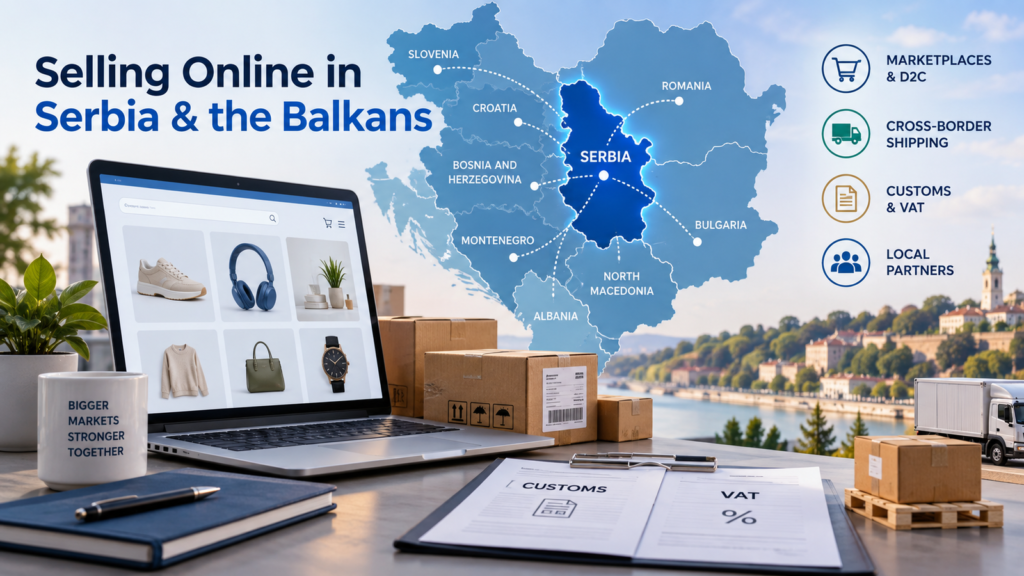
Companies that sell online should also compare the Italian model with the operational issues in non-EU Balkan markets. Our 2026 guide to selling online in Serbia shows how quickly customs, VAT, fulfilment and returns can change the economics of cross-border sales when the destination sits outside the EU customs territory.
Official sources to check before execution
- European Commission — EU trade relations with the Western Balkans
- Access2Markets — tariffs, origin, procedures and product requirements
- European Commission — EORI
- European Commission — importer and distributor obligations
- European Commission — Import Control System 2
- Istat — current Italian foreign-trade data
This guide is an operational market-entry framework, not legal or tax advice. Product-specific customs, VAT and compliance treatment should be verified before shipment.
Planning to enter the Italian market from Southeast Europe?
A useful first step is to validate demand, landed cost, route to market and the partner structure before committing to exclusivity or a local entity. Inspira supports companies with market validation, distributor and partner identification, route-to-market strategy and hands-on business development.