The Balkans are easy to underestimate when viewed from a headquarters spreadsheet. A dozen relatively small markets can look like one regional opportunity. On the ground, they are separate retail systems, legal environments, customer networks and logistics problems. Nelt Group’s growth shows what it takes to connect them.
Regional scale is not created by appointing one distributor and drawing a large territory on a map. It is built through local operating companies, shared standards, logistics infrastructure and disciplined execution.
From Serbian wholesaler to regional business system
Nelt was founded in Serbia in 1992 and developed from a small wholesaler into a distribution and logistics group active across Southeast Europe and Sub-Saharan Africa. The group describes its model through three pillars: distribution of international and domestic brands, complete supply-chain services and development of its own brands.
By 2026, Nelt reported more than 5,500 employees, 14 companies and operations in 12 markets. Its network included Serbia, Bosnia and Herzegovina, Montenegro, North Macedonia, Albania, Kosovo, Croatia, Slovenia and Romania, alongside African operations.
| Capability | Nelt example | Lesson for a foreign brand |
|---|---|---|
| Local market companies | Operating entities across multiple Balkan markets | A regional contract still needs local commercial execution. |
| Dense route-to-market | More than 60,000 delivery locations across channels | Coverage means reaching small stores, pharmacies, petrol stations and kiosks—not only key accounts. |
| Logistics infrastructure | Warehousing, delivery fleets and two intermodal terminals | Distribution quality depends on physical capacity and exception management. |
| Brand management | Inventory planning, sales, trade marketing and customer service | A distributor should build demand, not merely move cartons. |
| Own manufacturing and brands | Baby Food Factory, Neoplanta and other investments | Distribution data can support product development and portfolio strategy. |
Why local depth matters more than a regional label
A supermarket structure in Serbia is not identical to one in Albania. Bosnia and Herzegovina requires different administrative and territorial thinking. Montenegro has a small market with strong seasonality. North Macedonia has its own retail, language and logistics realities.
Nelt’s model addresses this through local companies and teams while maintaining group-level systems. For foreign brands, that is the difference between nominal coverage and active market development. A distributor may claim five countries but have meaningful sales capacity in only one.
Distribution is a data and planning business
Nelt presents inventory planning, sales, trade marketing and customer service as interconnected functions. That matters because the most expensive distribution failures often begin before the product reaches a truck.
Poor forecasting creates stockouts or expiry. Weak master data creates invoicing and listing problems. A launch without trade marketing produces warehouse inventory instead of consumer demand. Customer-service failures turn small operational errors into lost accounts.
A foreign principal should therefore evaluate the distributor’s planning process, not only its customer list. Ask how forecasts are built, how promotional volumes are agreed, how slow stock is managed and how sell-out information reaches the brand owner.
Infrastructure changes the distributor’s strategic role
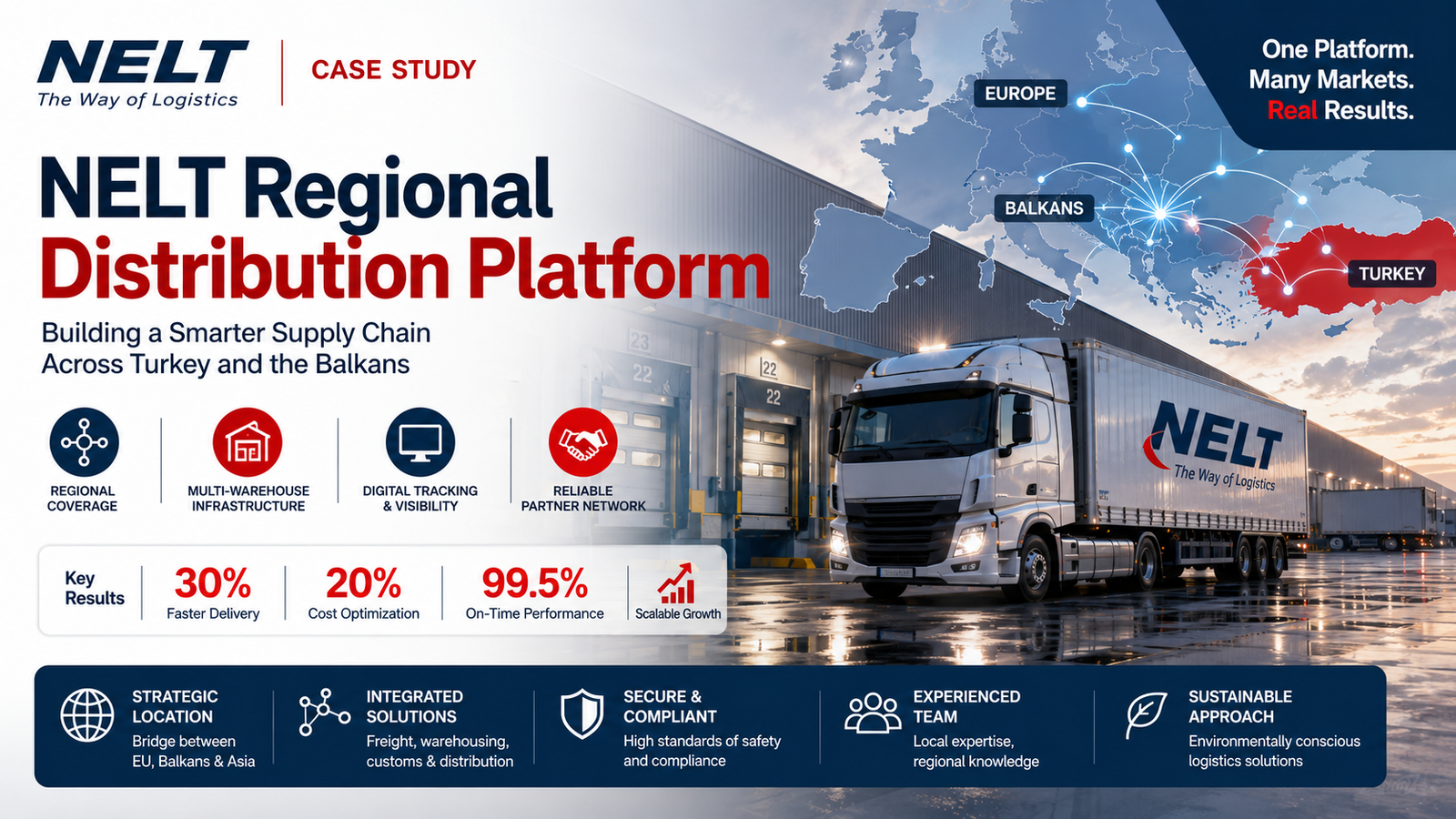
Nelt reports more than 200,000 square metres of storage, over 550 delivery vehicles and two intermodal terminals. It has also announced a €100 million investment programme in logistics infrastructure and warehouse automation for 2024–2027.
The terminals in Dobanovci and Kruševac connect road, rail, ports and industrial corridors. That turns the company from a last-mile distributor into a wider supply-chain partner. For manufacturers, the value is not simply transport capacity. It is the ability to combine customs, warehousing, regional distribution and value-added services through one operating system.
The question foreign brands should ask
Do not ask only, “How many outlets do you cover?” Ask how the distributor converts market data, inventory, trade marketing, logistics and local relationships into repeatable growth.
Digital distribution is becoming part of the model
Nelt Market, the group’s B2B ordering platform, expanded into Bosnia and Herzegovina and Montenegro in the first half of 2026. The company reported €11.3 million in revenue, 48,804 completed orders and 6,647 customers during that period, with strong year-on-year growth.
The important point is not that digital ordering replaces field sales. In fragmented retail markets, it can complement sales representatives, improve order frequency, reduce manual errors and give smaller customers better access to the portfolio.
What foreign principals should verify before appointing a distributor
Channel fit. A strong FMCG distributor may not be the right partner for industrial equipment, medical devices or premium horeca products.
Portfolio conflict. Existing principals can create category expertise, but also competing priorities. Understand how sales teams, incentives and trade budgets are separated.
Country-by-country capability. Request local organisation charts, outlet coverage, warehouse locations and key-account access for every market in the proposed territory.
Working capital. Distribution growth consumes cash. Review credit policy, inventory funding, bad-debt controls and the financial capacity to support a launch.
Governance and reporting. Agree on sell-in, sell-out, inventory, promotional execution, returns and forecast accuracy before the first shipment.
The broader lesson for Balkan market entry
Nelt’s development reflects a regional truth: scale in Southeast Europe is assembled, not inherited. The markets are close enough to share infrastructure and management standards, but different enough to require local teams and judgement.
A foreign brand can use a regional partner to reduce complexity. It cannot outsource strategic attention. The best results come when the principal brings clear positioning, disciplined decision-making and investment, while the distributor brings local execution, data and trust.