Exporting from the Balkans to the European Union in 2026 is not mainly a question of finding a buyer. It is a question of whether a manufacturer can prove, before shipment, that the product, documentation, origin, packaging, emissions data, pricing and after-sales process are ready for an EU importer to accept and defend internally.
The commercial opportunity is significant. According to the European Commission, EU–Western Balkans trade in goods reached more than €87.7 billion in 2025, up around 5.2% year on year. The EU’s main imports from the Western Balkans included machinery and appliances, base metals, and mineral and chemical products. For manufacturers in Serbia, Bosnia and Herzegovina, North Macedonia, Albania, Montenegro and Kosovo*, this means the EU is not a distant market: it is already the region’s most important commercial reference point.
But proximity does not remove complexity. A buyer may like the product and still reject the supplier because the CN code is wrong, preferential origin cannot be proven, technical documentation is incomplete, packaging obligations are unclear, CBAM data are unusable, Incoterms are badly chosen, or the export price does not survive the real cost of delivery.
The practical test is simple: can an EU buyer purchase the product repeatedly, compliantly and profitably without having to rebuild the supplier’s documentation from scratch?
Why export readiness matters more than commercial interest
Manufacturers often begin with the commercial side: price list, catalogue, samples, trade fairs and distributor meetings. In EU sales, however, the purchasing decision increasingly depends on whether the supplier can reduce operational and compliance risk.
An EU importer, distributor or industrial buyer may need to verify product conformity, customs classification, origin, packaging, sustainability data, labelling, warranty exposure and traceability before approving the supplier. Procurement, quality, finance, customs, legal and ESG teams can all influence the decision.
This is why “we already export” is not the same as “we are ready for the EU.” Export readiness is a system, not a certificate.
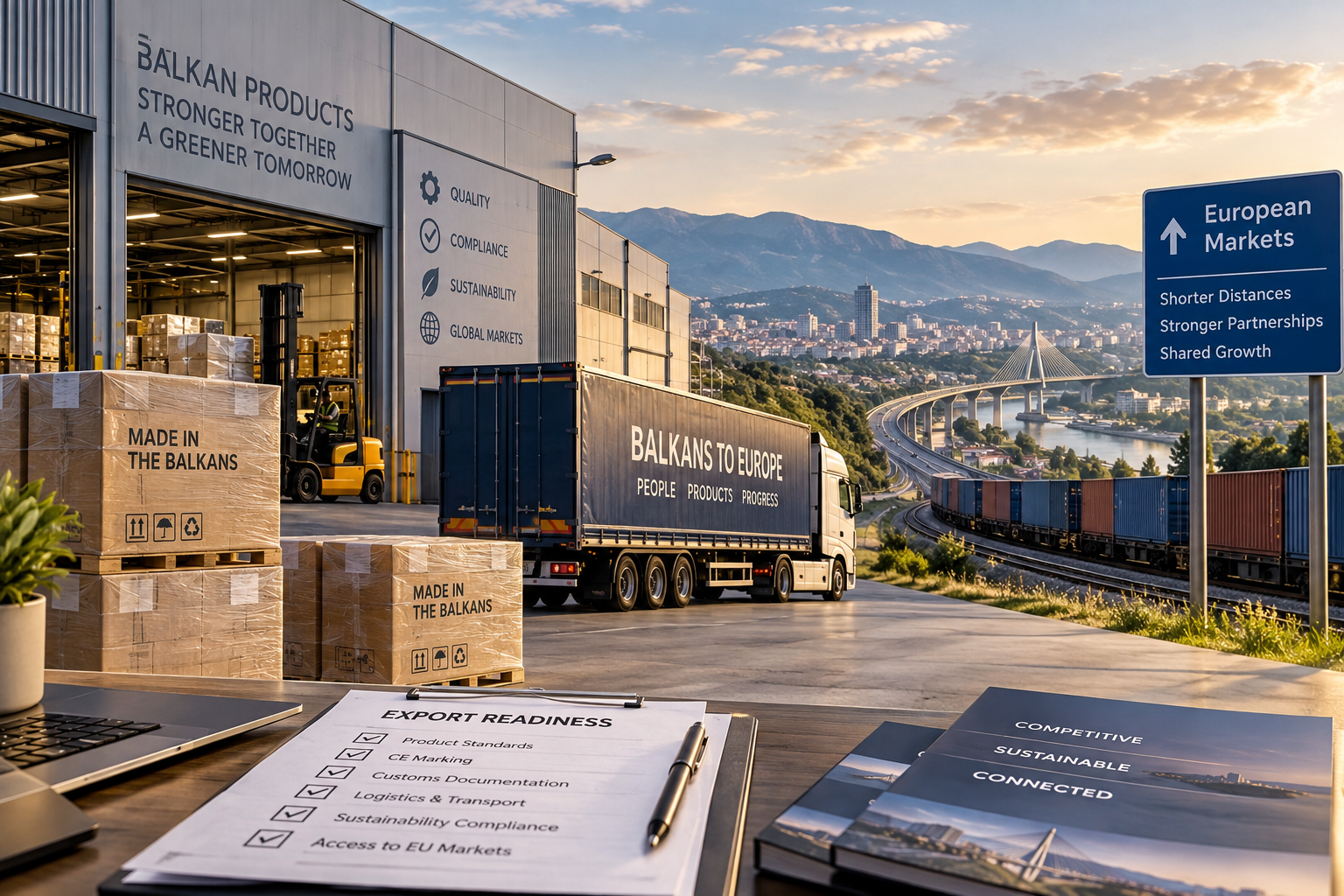
The 2026 Balkan-to-EU export readiness checklist
Before scaling outreach, manufacturers should be able to answer the following questions for every EU-bound SKU:
- Product classification: What is the correct CN/HS code, and has it been validated for the actual product specification?
- Market-access rules: Which EU product rules, harmonised standards, testing, labelling and technical-file obligations apply?
- Origin: Does the product qualify for preferential treatment under the relevant EU–Western Balkans arrangement, and can origin be documented?
- Customs: Who is the importer of record, who holds the EORI number, and who is responsible for customs declarations?
- Packaging: Are packaging conformity, labelling and destination-country producer-responsibility obligations mapped?
- CBAM: Is the product in scope, and can the supplier provide usable embedded-emissions data?
- Pricing: Does the export price include the full cost to serve, not only the ex-works factory cost?
- Logistics: Have transit time, border handling, packaging durability, claims and exception costs been tested?
- Contracts: Are Incoterms, warranties, liability, payment terms, returns and claims procedures clear?
- After-sales: Can the manufacturer handle technical questions, complaints, replacements, recalls and spare parts?
1. Start with the CN code, not the brochure
The customs classification of the product drives several downstream decisions: tariff treatment, rules of origin, import requirements, trade-defence measures and, for some products, CBAM exposure. A product marketed under one commercial name may fall under a classification that changes depending on material, composition, function or processing.
Export teams should therefore maintain a controlled SKU-to-CN-code register. The classification used on the quotation, commercial invoice, origin document, customs declaration and internal product file should be consistent.
The European Commission’s Access2Markets My Trade Assistant is the best starting point for checking tariffs, import requirements, taxes, rules of origin and trade-flow information for a specific product and destination.
2. Preferential origin can change the economics of the sale
Western Balkan exporters can benefit from preferential market access to the EU, but preferential treatment is not automatic simply because the product was manufactured in the region. The product must satisfy the applicable origin rule and the exporter must retain evidence that supports the claim.
This matters especially when imported raw materials or components are used. The relevant question is not only “where was the final product assembled?” but whether the required processing, value-added or tariff-shift rule has been met.
The EU and Western Balkan partners apply preferential rules under their respective agreements, and the region also participates in the Pan-Euro-Mediterranean system. Companies should therefore document:
- the origin rule applicable to each EU-bound SKU;
- supplier declarations and origin evidence for key inputs;
- the production steps performed locally;
- the proof of origin to be used for the shipment;
- the procedure for retaining and retrieving evidence during a customs verification.
A preferential duty rate that cannot be defended later is not a commercial advantage; it is a customs risk.
3. Customs documents must tell the same story
EU customs clearance normally relies on a combination of commercial and transport documents. The European Commission lists the commercial invoice as a core customs document and highlights the role of proof of origin and transport documents such as CMR, bill of lading, air waybill and rail consignment notes.
The invoice should align with the purchase order and customs declaration on product description, quantity, value, currency, payment terms and Incoterm. The packing list should reconcile with the physical shipment. The origin document should match the declared origin. Technical descriptions should not contradict the customs classification.
Small inconsistencies can produce disproportionate problems: customs questions, delayed clearance, buyer escalations or a loss of confidence in the supplier’s internal controls.
4. Product compliance must be mapped SKU by SKU
There is no single “EU certificate” that makes every product export-ready. Requirements vary by product category, end use and route to market. Depending on the product, the manufacturer may need to address CE marking, technical documentation, declarations of conformity, chemical restrictions, food-contact rules, machinery requirements, electrical safety, EMC, medical-device rules, construction-product rules, textile labelling, cosmetics requirements or other sector-specific legislation.
The manufacturer should create a product compliance matrix for each EU-bound SKU with at least:
- applicable EU legislation;
- applicable standards or test methods;
- required technical documentation;
- labelling and language requirements;
- manufacturer/importer obligations;
- test reports and certificates with validity dates;
- change-control rules when materials, suppliers or production processes are modified.
The key operational principle is version control. A test report for one formulation, model or production line should not automatically be assumed to cover every variant.
5. CBAM became a commercial data issue in 2026
The EU Carbon Border Adjustment Mechanism entered its definitive regime on 1 January 2026. It currently covers selected goods in cement, iron and steel, aluminium, fertilisers, electricity and hydrogen.
For many Balkan manufacturers, the formal CBAM obligation sits with the EU importer or its indirect customs representative, but the supplier controls much of the underlying production and emissions data. This creates a new buyer-qualification question: can the factory provide consistent, traceable and usable embedded-emissions information?
EU importers above the applicable threshold for CBAM goods need authorised-declarant status and must ultimately surrender certificates corresponding to embedded emissions. The commercial consequence for exporters is clear: poor emissions data can make a technically competitive supplier more difficult to buy from.
Manufacturers in affected sectors should maintain a CBAM data pack linked to installation, production route, product code and shipment. For a deeper operational guide, see EU CBAM in 2026: A Practical Guide for Western Balkan Exporters.
6. Packaging is now part of market-access readiness
The EU Packaging and Packaging Waste Regulation is another area exporters should not treat as a design issue only. As of 2026, packaging compliance increasingly requires a structured technical file, conformity evidence and a clear hand-off between the non-EU manufacturer and the EU importer.
For direct-to-consumer and marketplace sales, additional destination-country producer-registration and extended producer responsibility checks may also arise.
The first step is not to redesign every box. It is to map the packaging SKU, material composition, supplier evidence, labels, importer responsibilities and destination-country obligations. See our detailed EU PPWR 2026 compliance map for Western Balkan exporters.
7. Sustainability rules increasingly become buyer-data requirements
Many EU rules formally place duties on the EU operator or importer, yet the practical data burden travels upstream to the supplier. This is visible in CBAM and also in rules such as the EU Deforestation Regulation for relevant commodities and derived products.
A Western Balkan manufacturer may not be the statutory EU operator, but it can still lose the commercial opportunity if it cannot provide the product, source, traceability or production data the buyer needs.
For exporters of relevant wood, furniture and other covered products, our EUDR 2026 buyer-data test explains how supplier evidence should be linked to the actual shipment and SKU.
8. Calculate the true export price, not the factory price
A common export mistake is to apply a margin to the domestic ex-works price and assume the result is internationally competitive. The EU buyer sees the delivered economics, not the factory gate.
A realistic export cost model should include:
- export packaging and palletisation;
- testing, certification and technical-document maintenance;
- freight, fuel surcharges and terminal costs;
- customs brokerage and clearance;
- duties where applicable;
- insurance;
- financing and payment-term cost;
- sales commissions or distributor margin;
- warranty reserve and replacement shipments;
- returns and claims;
- local warehousing or fulfilment if required;
- currency risk;
- CBAM-related commercial exposure where relevant.
The result should be calculated by route and customer type: EXW to an importer, FCA/FOB shipment, DAP industrial customer, distributor model, or direct e-commerce sale all create different economics and responsibilities.
9. Incoterms are a risk-allocation tool, not a price suffix
“Price: €X DDP” is not a complete export strategy. Incoterms allocate certain transport costs and risks, but they do not by themselves settle product compliance, title, payment, warranty, customs representation or tax registration.
Before offering DAP or DDP, manufacturers should confirm exactly who can act as importer, who can make customs declarations, whether VAT registration is required, and whether the exporter is unintentionally taking on obligations it cannot practically fulfil.
For many first transactions, a simpler allocation of customs responsibilities can be safer than promising an all-inclusive delivered solution without the infrastructure behind it.
10. EU buyers qualify the supplier, not only the product
Industrial buyers often assess whether the manufacturer can maintain quality and delivery performance after the first order. Expect questions about:
- quality-management systems;
- capacity and lead time;
- critical subcontractors;
- batch or serial traceability;
- change management;
- business continuity;
- complaint handling;
- product-liability insurance;
- financial stability;
- cybersecurity or data handling where relevant;
- ESG and supply-chain information.
A professional supplier data room can materially shorten the qualification process. It should contain the current company profile, product specifications, certificates, test reports, quality documents, export references, production capabilities, compliance declarations and controlled templates for quotations and technical communication.
11. Test logistics before scaling sales activity
Geographic proximity is one of the Balkans’ advantages, but it should be converted into measurable service levels. A pilot shipment should test more than transit time.
Record border waiting time, documentation corrections, loading performance, damage rate, pallet stability, customs handling, consignee unloading constraints, tracking quality and exception costs. For routes through Romania and Bulgaria, full Schengen membership has improved some regional movement, but customs controls still exist at the EU’s external borders. See our analysis of Romania and Bulgaria in full Schengen and what it means for Balkan logistics.
12. Build after-sales responsibility before the first complaint
Export readiness does not end when customs releases the shipment. Before the first order, define:
- who receives technical complaints;
- response-time targets;
- warranty conditions;
- replacement and credit-note rules;
- spare-parts availability;
- root-cause analysis and corrective-action procedures;
- recall escalation where relevant.
For machinery, components and B2B industrial products, after-sales capability can be as important as unit price because the buyer is evaluating downtime risk.
A practical 30-day EU export-readiness sprint
Week 1: classify and scope
- Select 3–5 priority EU-bound SKUs.
- Confirm CN codes and target countries.
- Map applicable product rules and importer responsibilities.
- Identify whether CBAM, EUDR, packaging or other sector-specific rules apply.
Week 2: close the evidence gap
- Collect certificates, test reports, declarations and supplier evidence.
- Map preferential-origin requirements.
- Build the customs-document set.
- Create a controlled supplier data room.
Week 3: build the commercial model
- Calculate landed and delivered cost by route.
- Choose realistic Incoterms.
- Define distributor, importer or direct-sales margin structure.
- Set payment, warranty and claims assumptions.
Week 4: simulate the transaction
- Prepare a sample quotation and pro-forma invoice.
- Run a document check with a customs broker or importer.
- Test a pilot shipment or logistics quotation.
- Run a buyer-style supplier qualification review.
The documents an EU buyer should be able to request without creating chaos
A mature exporter should be able to provide a coherent package quickly. Depending on the product, this may include:
- commercial quotation and specification;
- company registration and bank details;
- quality certificates;
- declaration of conformity and technical documentation;
- test reports;
- material declarations;
- proof-of-origin documentation;
- commercial invoice and packing-list templates;
- transport and insurance information;
- CBAM or sustainability data where applicable;
- warranty and claims procedure;
- references and production-capacity information.
Five export-readiness mistakes that repeatedly destroy otherwise good opportunities
- Approaching buyers before compliance is mapped. The sales team creates demand that operations cannot support.
- Quoting from the domestic price list. Hidden export costs appear only after the buyer expects the original price.
- Assuming “Made in Serbia/Bosnia/North Macedonia” automatically proves preferential origin. Origin is a rule-based customs conclusion, not a marketing label.
- Sending inconsistent documents. Different descriptions, codes or specifications make the supplier look uncontrolled.
- Promising DDP or full compliance without understanding the legal and tax consequences. Commercial enthusiasm creates obligations the exporter cannot fulfil.
What an EU-ready Balkan manufacturer looks like
The strongest Balkan exporters are not necessarily the manufacturers with the lowest labour cost or the cheapest ex-works price. They are the companies that make procurement easy.
They know their product codes. They can explain origin. Their technical file is current. Their quotation matches their documentation. Their packaging survives the route. Their emissions and sustainability data can be used by the buyer. Their pricing includes the real cost of delivery. Their warranty process is defined. And when a buyer asks for evidence, the answer does not depend on searching through old emails.
That is the difference between having a product that could sell in the EU and having an export system that can scale in the EU.
FAQ: exporting from the Balkans to the EU
Do Balkan products automatically enter the EU duty-free?
No. Preferential access depends on the applicable agreement, the product’s tariff classification and whether the relevant rules of origin are satisfied and properly documented.
Does every exporter need an EORI number?
An EORI number is required for economic operators carrying out customs activities in the EU. In a conventional export from the Western Balkans, the EU importer or customs representative typically uses an EU EORI, but the exact structure depends on the route to market and who is responsible for customs formalities.
Does CBAM apply to every manufacturer exporting to the EU?
No. CBAM currently applies to selected goods in cement, iron and steel, aluminium, fertilisers, electricity and hydrogen. Classification should be checked at product-code level.
Is CE marking enough to prove export readiness?
No. CE marking is relevant only for product categories covered by legislation requiring it, and it does not replace customs, origin, packaging, contractual, logistics or after-sales readiness.
What should a manufacturer do before contacting EU distributors?
At minimum: confirm the target SKU and CN code, map compliance and origin, calculate the complete export cost, prepare consistent technical/commercial documents, define Incoterms and test logistics. This dramatically improves the quality of distributor conversations.
Planning to sell manufactured products from the Balkans into the EU? Inspira helps B2B companies validate target markets, structure route-to-market decisions, identify and qualify buyers or distributors, and build practical international business-development pipelines across the Balkans, Türkiye and Europe. Explore Inspira’s international business development services.
Sources and practical tools: European Commission DG Trade and Economic Security, Access2Markets, European Commission Taxation and Customs Union. Requirements vary by product and destination; exporters should verify current rules for the exact SKU and transaction before shipment.
Planning to expand your EU sales from the Balkans?
Inspira helps manufacturers and B2B companies validate target markets, identify and qualify buyers and distributors, define the right route to market and build a practical commercial pipeline across Europe, the Balkans and Türkiye.
Explore Inspira’s market entry and business development services →