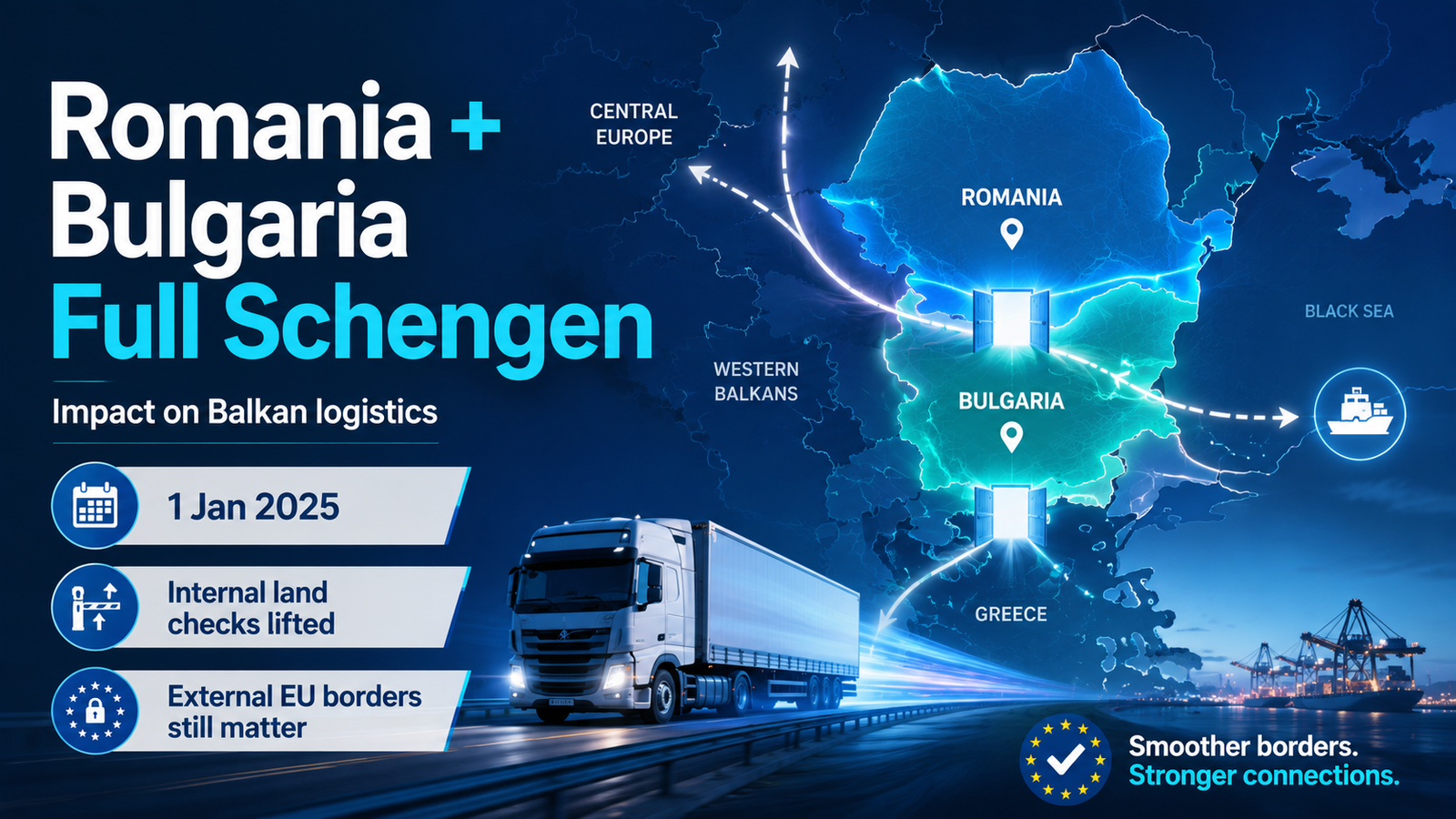
Romania and Bulgaria entered full Schengen on 1 January 2025, but the commercial effect is more precise than the slogan “borders disappeared.” Checks on people at internal land borders were removed. For manufacturers, hauliers and regional distributors, the real opportunity is better predictability—provided they understand where delays can still occur.
Full Schengen strengthens the Romania–Bulgaria route as a regional operating corridor. It does not eliminate customs at the EU’s external borders, temporary internal controls, road bottlenecks or weak shipment planning.
What full Schengen membership actually changed
Air and maritime internal-border checks were removed in March 2024. The final step came on 1 January 2025, when checks on persons at the internal land borders with and between Romania and Bulgaria were lifted. The two countries became full members of a Schengen area that now includes 29 states.
For road freight, the distinction matters. Romania and Bulgaria were already members of the EU customs union, so this was not the creation of a new duty-free trade area. The immediate operational benefit is the removal of routine passport-control procedures at internal Schengen borders. Drivers, service teams, commercial staff and business travellers can move with fewer formal stops.
That can reduce uncertainty in routes linking Greece, Bulgaria, Romania, Hungary and Central Europe. It also improves the logic of using Romania or Bulgaria as a distribution base for several neighbouring markets rather than treating each country as an isolated destination.
| Issue | What changed | What companies must still manage |
|---|---|---|
| Internal movement of people | Routine land-border checks were removed from 1 January 2025 | Identity documents, driver compliance and possible temporary controls. |
| EU goods movements | More predictable transit through the internal corridor | VAT evidence, excise rules, cabotage, CMR documentation and product-specific controls. |
| External EU borders | No removal of customs or external-border controls | Türkiye, Serbia, Moldova, Ukraine and North Macedonia remain external-border interfaces. |
| Business travel | Simpler multi-country itineraries inside Schengen | Visa-day calculations for non-EU nationals and national employment rules. |
The biggest gain is reliability, not speed on every journey
A border queue creates two costs. The first is visible: fuel, driver time and vehicle utilisation. The second is harder to price: missed delivery windows, uncertain production schedules and the buffer inventory required to protect a customer.
Full Schengen can reduce the second cost by making transit times more consistent. A route that is reliably ten hours can be commercially better than one that varies between eight and fourteen. Predictability supports tighter delivery appointments, more realistic driver planning and lower safety stock.
Companies should still measure actual performance. Congestion may move from a former checkpoint to a bridge, ring road, terminal or warehouse gate. The absence of passport booths does not add road capacity.
Why the Greece–Bulgaria–Romania corridor matters more
The route connects the Aegean and Black Sea economies with Central Europe. Thessaloniki can serve northern Greek and Balkan cargo. Bulgarian industrial locations provide access toward Türkiye, Serbia and Romania. Romanian logistics hubs connect the lower Danube, the Black Sea and Hungary.
For a distributor, this creates several operating models: one warehouse serving Romania and Bulgaria; a Romanian hub feeding Central Europe; a Bulgarian base linked to Türkiye and Greece; or a dual-hub model separating EU and non-EU flows.
The correct choice depends on customer density, customs exposure, labour, motorway access and return cargo. Full Schengen improves the corridor but does not make every location equally competitive.
External borders remain the decisive friction point
A shipment entering the EU from Türkiye through Bulgaria still faces the EU’s external customs and security framework. The same is true for flows from Serbia into Romania or Bulgaria. Documentation, risk selection, veterinary or phytosanitary controls and terminal capacity can still determine total transit time.
This is why businesses should separate two measurements: time spent at internal Schengen borders and time spent at external EU borders. Combining them into one average hides the real problem.
A common planning mistake
Do not reduce delivery promises automatically because Schengen removed internal checks. First collect lane data for at least eight to twelve weeks and identify whether the constraint is the border, road network, customs broker, terminal or customer unloading slot.
What changes for non-EU employees and business travellers
A multi-country trip across Romania, Bulgaria, Greece, Hungary and other Schengen states is now operationally simpler. There is no routine internal passport check at each land border.
However, full Schengen does not create a separate 90-day allowance for Romania or Bulgaria. For visa-exempt third-country nationals and holders of short-stay Schengen visas, time spent in these countries forms part of the common Schengen calculation. Companies should update travel policies and stop treating Romanian and Bulgarian stays as outside the Schengen day count.
Employment, posted-worker, social-security and payroll rules remain national. Free movement at the border is not permission to perform unrestricted work in every country.
A practical supply-chain review for 2026
- Recalculate route variability. Use actual telematics data before and after full Schengen, not anecdotal driver reports.
- Separate internal and external border time. This identifies where customs investment or a different crossing can create value.
- Review warehouse geography. Test whether a Romania–Bulgaria hub can replace duplicate stock without weakening service levels.
- Check driver and cabotage compliance. Faster movement does not relax EU road-transport rules.
- Update travel-day controls. Include Romania and Bulgaria in the common Schengen calculation for non-EU staff.
- Build an exception plan. Temporary border controls, road works and seasonal congestion can still disrupt the corridor.
Who benefits most
Time-sensitive manufacturers, automotive suppliers, retail distributors, express freight operators and service companies with mobile teams are likely to see the clearest benefit. The advantage is strongest where a route crosses several internal borders and where late delivery has a high operational cost.
Businesses moving primarily between an external EU country and one local destination may see a smaller improvement because the external border remains the dominant process.
The bottom line
Full Schengen membership makes Romania and Bulgaria more credible as connected regional operating bases. It reduces one layer of friction and makes north–south supply chains easier to design.
The strategic mistake would be to treat Schengen as a complete logistics solution. The companies that gain most will combine the new border regime with better lane data, customs design, warehouse positioning and realistic infrastructure analysis.