The nearest port is not automatically the cheapest port. A reliable Balkan gateway is the one that combines vessel connectivity, terminal capacity, rail and road access, customs performance, inland depots and enough operational resilience to protect the final delivery date.
Choose a port by total landed cost and delivery variability—not by ocean freight alone. The inland leg can erase a cheaper sea rate within a few hours of delay.
Four gateways, four different commercial roles
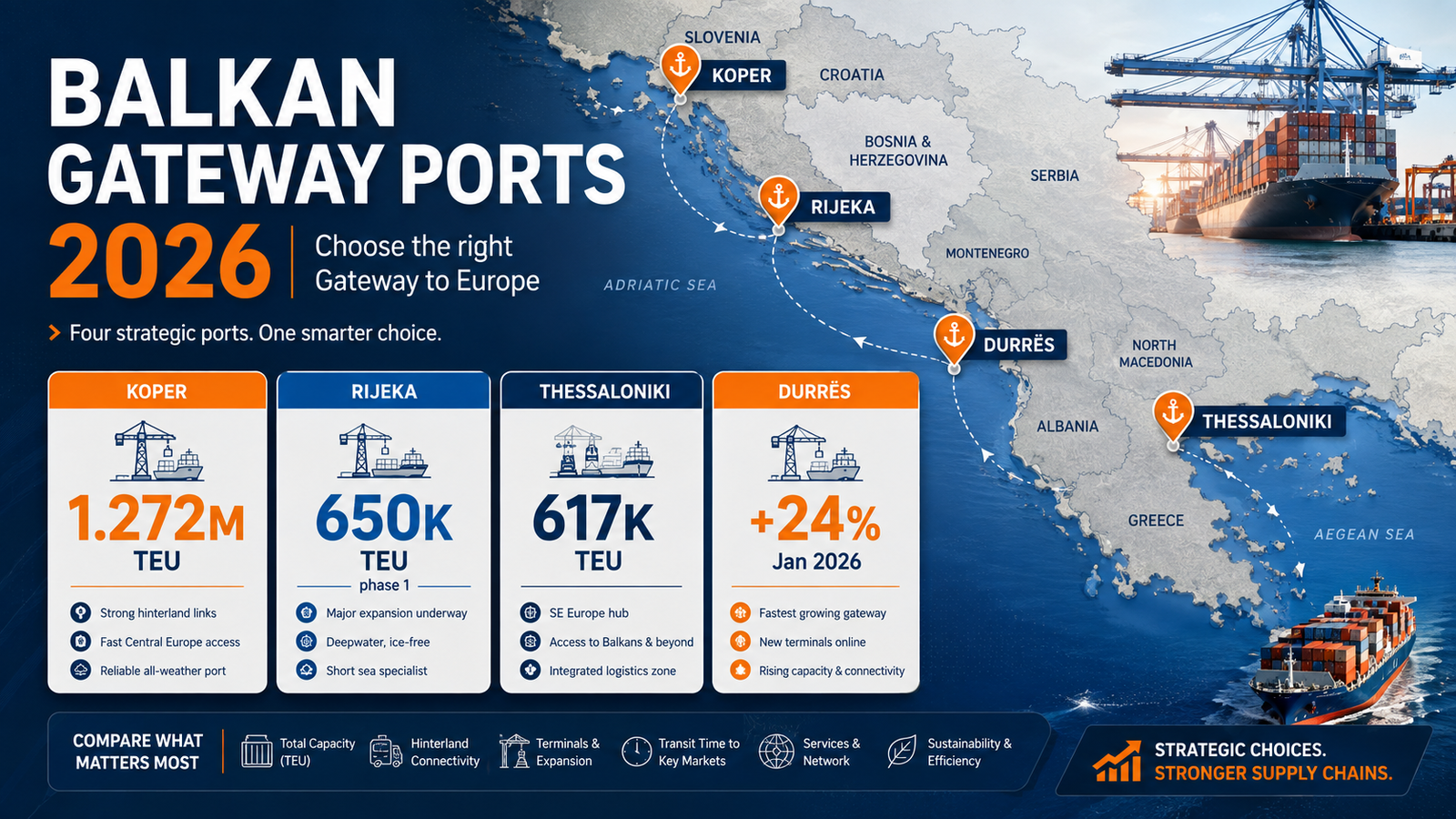
Koper is the most established high-volume container and automotive gateway among the four. Rijeka is being reshaped by a new deep-sea terminal and major rail ambition. Thessaloniki serves northern Greece and the central Balkans through a growing Aegean hub. Durrës combines Albanian cargo, Adriatic ferry traffic and proximity to Kosovo and North Macedonia.
The ports overlap, but they are not interchangeable. A container bound for Vienna, Belgrade, Skopje or Pristina faces different rail options, border interfaces and terminal economics depending on the chosen gateway.
| Gateway | 2025–2026 signal | Strongest fit | Main risk to test |
|---|---|---|---|
| Koper | 1.272 million TEU in 2025; 51% rail modal share | Austria, Hungary, Slovakia, Czechia, Slovenia and selected Balkan flows | Rail works, peak congestion and dependence on scheduled inland services. |
| Rijeka | New gateway designed for 650,000 TEU in phase one and 1.055 million after phase two | Croatia, Hungary, Serbia and Central European cargo seeking a modern North Adriatic option | Ramp-up performance and the pace of hinterland rail improvement. |
| Thessaloniki | 617,000 TEU in 2025, up 9.1%; expansion targets much larger vessels | Northern Greece, North Macedonia, Bulgaria, Serbia and regional reefer flows | Rail frequency, border performance and inland equipment availability. |
| Durrës | 17,944 TEU in January 2026, up 24% year on year; strong Italy ferry link | Albania, Kosovo and selected western North Macedonia cargo | Smaller scale, road dependence and transition linked to future port development. |
Koper: scale, rail and a mature hinterland network
Koper handled a record 1,272,161 TEU in 2025, 12% more than in 2024. Total maritime throughput reached 23 million tonnes, while rail carried 51% of cargo. That rail share is strategically important because a port becomes more competitive when it can move large volumes inland without relying only on trucks.
Koper also handled 914,817 vehicles and is investing heavily in new container quay capacity, storage areas and automotive infrastructure. The operator allocated €132.9 million to investment in 2025 and planned €201 million for 2026.
The strength is not only terminal productivity. Koper has established services toward Austria, Hungary, Slovakia, Czechia and other hinterland markets. The weakness is that a mature network can still face capacity pressure, rail maintenance and peak-period congestion. Importers should verify the exact train product, cutoff, free time and fallback truck capacity.
Rijeka: the strategic challenger
Rijeka’s new gateway terminal changes the North Adriatic competitive map. Phase one is designed for 650,000 TEU per year, a 400-metre berth, 20-metre depth and vessels up to 18,000 TEU. The full project targets 1.055 million TEU and vessels up to 24,000 TEU.
The terminal is highly electrified and remotely operated, with a private 5G network supporting equipment and cargo systems. This is not only an environmental story. New technology can improve data visibility and terminal consistency when processes are stable.
The commercial question is the hinterland. Rijeka’s potential depends on reliable rail toward Zagreb, Hungary, Serbia and Central Europe. A modern quay cannot compensate for weak inland frequency. During the ramp-up, shippers should compare actual train schedules, transit reliability and equipment availability rather than relying on design capacity.
Thessaloniki: the Aegean route into the central Balkans
Thessaloniki handled 617,000 TEU in 2025, a 9.1% increase, while conventional cargo reached 2.8 million tonnes. The port is expanding its container infrastructure and aims to serve ultra-large vessels up to 24,000 TEU.
Its geographic value is clear: northern Greece, North Macedonia, Bulgaria and Serbia sit within a logical inland corridor. The port has also developed reefer activity and signed cooperation arrangements intended to strengthen rail connectivity toward Bulgaria.
For cargo from Asia or the eastern Mediterranean, Thessaloniki can reduce sea distance compared with northern ports. The benefit survives only if rail or truck connections cross borders predictably. Border procedures, driver capacity and empty-container positioning should be included in the route model.
Durrës: a smaller gateway with a specific regional role
Durrës is not competing with Koper on volume. Its value is proximity to Albania’s main consumption and industrial areas, strong ferry links with Italy and access toward Kosovo and western North Macedonia.
In January 2026 the port handled 17,944 TEU, 24% more than a year earlier, while total monthly cargo exceeded 271,000 tonnes. The growth signal is useful, but one month should not be mistaken for annual capacity.
Durrës can be the most practical choice when final customers are nearby and the alternative requires a long inland move from Greece or the northern Adriatic. For larger regional distribution models, the importer should test road dependency, customs consistency, equipment supply and how future port-transition projects may affect operations.
The hidden cost in port comparisons
Demurrage, detention, storage and missed delivery appointments can exceed the ocean-freight difference between two ports. Ask for a full exception-cost history, not only the standard tariff.
How to run a serious port tender
- Use one identical shipment profile. Same origin, equipment, weight, season, customs regime and delivery point.
- Quote the complete chain. Ocean, terminal, customs, rail or truck, fuel, tolls, border cost, free time and empty return.
- Measure variability. Request median and worst-case transit, not one optimistic number.
- Check service frequency. A fast weekly train can be less useful than a slightly slower daily product.
- Model disruption. Define alternatives for port congestion, rail works, strikes, border delays and blank sailings.
- Run a controlled pilot. Move several containers before changing the whole supply chain.
Which port should a Serbian importer choose?
There is no universal answer. Koper offers scale and mature rail. Rijeka offers a new high-capacity option with strategic potential. Thessaloniki may be attractive for Aegean services and southern routes. Durrës can work for cargo tied to Albania, Kosovo or western North Macedonia.
The best choice may also be dual sourcing. Large importers can use one primary gateway and one tested alternative, reducing dependence on a single rail corridor or terminal.
The bottom line
Port selection is a network decision. The quay, train, customs broker, border, depot and final warehouse operate as one commercial system.
Koper leads on proven scale. Rijeka is the strongest new challenger. Thessaloniki is expanding its Aegean–Balkan role. Durrës remains a focused gateway whose value comes from proximity. The correct route is the one that performs under pressure, not the one that looks cheapest in a spreadsheet.