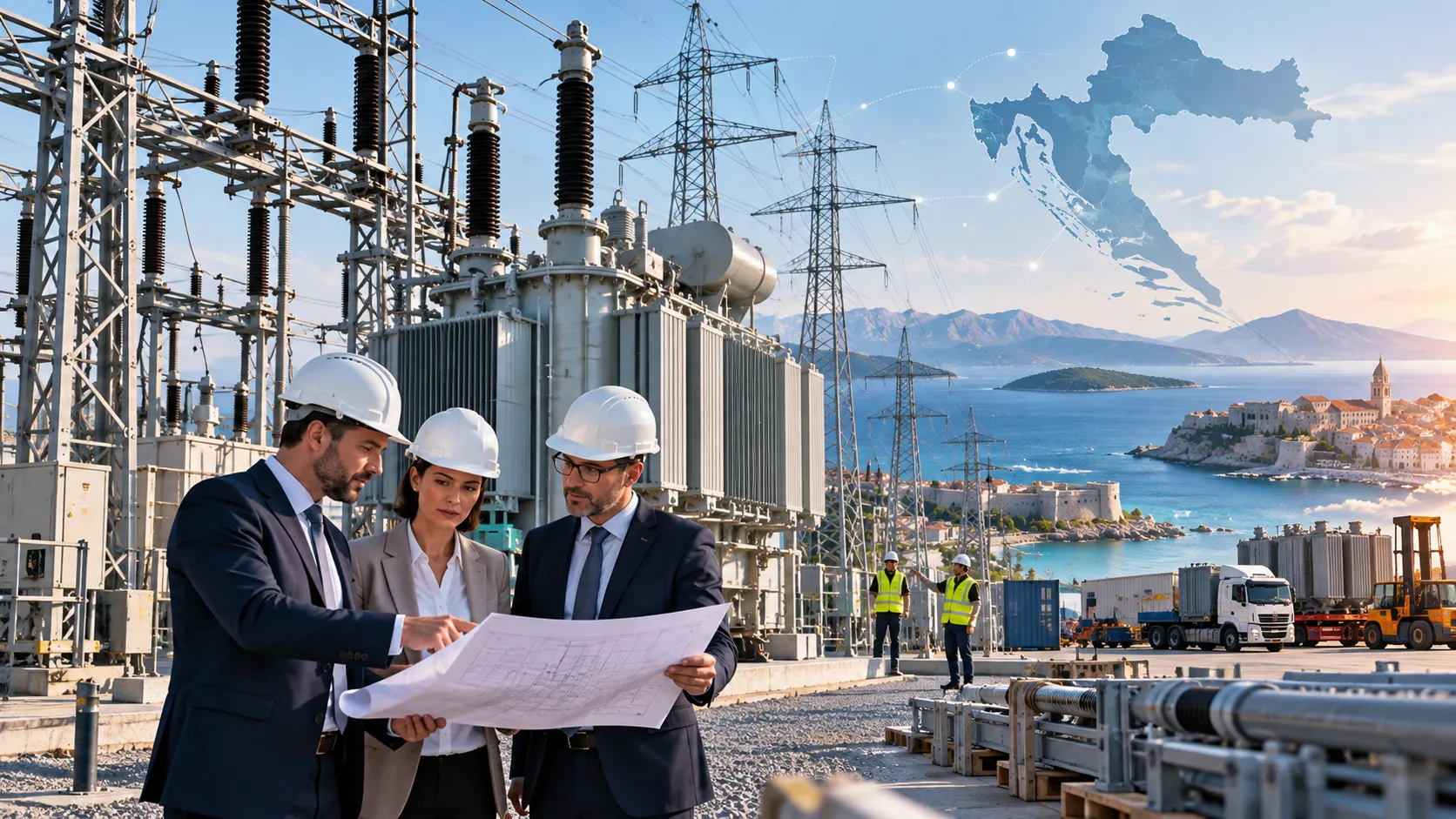
Croatia is becoming more relevant to international energy and infrastructure companies for a reason that is easy to miss: it is no longer only a small national market. It is simultaneously an EU member state upgrading its own grid, a manufacturing base for high-value electrical equipment, and a regional bridge between Central Europe, the Adriatic and Southeast Europe.
For foreign buyers, EPC contractors, component suppliers, engineering firms and technology providers, the opportunity is broader than purchasing a transformer from a Croatian manufacturer. Grid reinforcement, renewable integration, digitalisation and rising European demand are creating a business ecosystem in which equipment, software, services, logistics, testing, financing and long-term maintenance all matter. KONČAR is the most visible industrial case study, but the real story is the market around it.
International companies should not read Croatia only as an end-market. In 2026 it is also a sourcing base, an EPC and engineering partner market, a route into EU-funded grid modernisation, and a platform from which regional infrastructure opportunities can be followed.
Why Croatia’s grid market matters in 2026
Croatia’s transmission operator HOPS has been carrying out a multi-year programme to modernise, digitalise and expand the national transmission system. The programme is designed to strengthen north-south transfer capability, replace ageing equipment, improve system management and connect more renewable generation. HOPS’ published documentation also shows how grid development has become a bottleneck issue: thousands of megawatts of renewable projects have sought connection while network capacity, balancing and reinforcement must catch up.
This is not a Croatian anomaly. Across Europe, grids are moving from background infrastructure to a central investment constraint. The European Commission’s 2026 Clean Energy Investment Strategy explicitly links the energy transition to stronger network infrastructure and system integration, while the European Grids Package places more emphasis on interconnection, permitting and network expansion.
For an international company, that shift changes the commercial question. The opportunity is no longer simply “Can we sell equipment in Croatia?” It becomes “Which part of the grid-investment chain can we participate in — and with whom?”
KONČAR is useful as a market signal, not only as a supplier
The clearest evidence that Croatia has become part of the wider European grid-equipment cycle is KONČAR’s recent growth. In the first half of 2026 the group reported €724.9 million in consolidated revenue, with exports representing 71.2% of sales. It signed more than €1 billion of new contracts during the period and ended June with an order backlog above €2.9 billion. EU markets accounted for the largest increase in export revenue.
Those figures matter less as a corporate success story than as evidence of what is happening around European transmission and distribution. Demand for transformers, switchgear, control systems and grid integration is strong enough to fill production capacity years forward. For buyers, that can mean longer lead times. For suppliers and subcontractors, it can mean opportunities to enter value chains that need more capacity. For engineering and software firms, it can create demand around testing, digital control, cybersecurity, maintenance and integration.
KONČAR – Power Transformers, the joint venture between Siemens Energy and KONČAR, began a €260 million expansion of its Jankomir facility in May 2026. The company has stated targets to increase annual transformer capacity from 22,000 MVA to 30,000 MVA by 2027 and to 45,000 MVA by 2031. At the same time, KONČAR – Transformer Tanks opened a dedicated production facility in January 2026. These investments reinforce the case for viewing Croatia as part of Europe’s manufacturing response to grid bottlenecks.
Where foreign companies can actually participate
The most useful way to approach the market is by role rather than by country headline.
- Utilities and EPC contractors: Croatia can be a source of transformers, switchgear, digital systems and engineering capability, but delivery capacity must be verified at factory and project level.
- Component and material suppliers: capacity expansion creates potential demand for steel fabrications, electrical steel, insulation systems, cooling components, bushings, sensors, cabinets, protection equipment, cables and specialist services.
- Industrial technology firms: factory automation, condition monitoring, cybersecurity, grid software, remote diagnostics and digital-twin applications can enter through equipment makers, EPCs or utilities.
- Testing and engineering companies: type testing, certification support, design engineering, commissioning, field services and lifecycle maintenance become more valuable as equipment moves into more markets and project specifications become more demanding.
- Logistics and project-cargo providers: large transformers and high-voltage equipment require route studies, heavy transport, ports, cranes, permits and installation planning. Croatia’s Adriatic position can be commercially relevant well beyond the domestic market.
That last point is often underestimated. A grid-equipment investment cycle does not create opportunity only for electrical manufacturers. It also creates work for transport specialists, industrial property, technical recruitment, professional services, finance and local project partners.
Croatia’s advantage is its position inside the EU industrial system
Croatia combines several characteristics that matter to foreign firms: EU membership, the euro, Schengen, an Adriatic logistics base and proximity to Slovenia, Hungary, Austria, Italy, Bosnia and Herzegovina, Serbia and Montenegro. That does not make it the cheapest location in Southeast Europe, but it can reduce friction for companies that need EU contracting, euro payments, regulatory alignment and access to nearby non-EU markets.
This is why the opportunity should be read regionally. A supplier may contract with a Croatian manufacturer, source components elsewhere in Central Europe, use Rijeka or another Adriatic gateway for project cargo, and support installation in a Western Balkan market. A technology provider may sell first into an EU reference project and then use that reference elsewhere in Southeast Europe.
For wider context, see BalkansNetwork’s analysis of Western Balkans renewable-energy investment in 2026, its comparison of Koper, Rijeka, Thessaloniki and Durrës as regional gateway ports, and the guide to choosing a Balkan operating base.
The opportunity is real — but capacity is not the same as availability
Rapid expansion creates a paradox. Strong demand validates the market, but it can also make the best suppliers harder to access. A €2.9 billion backlog is evidence of commercial strength; it is not evidence that a production slot exists for a new buyer next quarter. The same applies to newly announced capacity. A factory under construction cannot be treated as available output until equipment is installed, commissioned and allocated.
International buyers should therefore qualify the exact operating entity and factory rather than rely on the group name. KONČAR’s platform includes different businesses for large power transformers, distribution and special transformers, switchgear, transformer tanks and digital systems. Ownership, technical scope, guarantees and delivery responsibility vary between them.
What buyers and partners should verify before committing
The original version of this article focused mainly on due diligence. That remains important, but it should sit inside the wider market picture. Before a prequalification, supply agreement, investment or partnership, management should request evidence on six points:
- Counterparty: exact legal entity, ownership, authorised signatory, financial strength, guarantees and parent support.
- Capacity: named factory and production line, reserved slot, long-lead materials, design-freeze date and FAT window.
- Technical compliance: applicable standards, type-test reports, reference installations and treatment of specification deviations.
- Commercial protection: delivery guarantees, liquidated damages, warranty, performance security and change-control rules.
- Lifecycle support: commissioning, spares, field service, repair capability and response times.
- Digital and cyber scope: software support, remote access, patching, logging, vulnerability management and responsibility between equipment and system integrators.
Who should pay attention now
The Croatian grid-equipment story is most relevant to companies that can connect to an existing industrial chain rather than arrive with a generic market-entry pitch. A German or Italian component maker looking for new OEM customers, a Turkish electrical-equipment manufacturer seeking EU partnerships, an engineering company with substation expertise, a software firm working on grid digitalisation, or a logistics operator experienced in oversized cargo all have a more concrete reason to study the market than a company simply looking for “opportunities in Croatia.”
The best entry point may also be indirect. Supplying a Croatian manufacturer that already exports across Europe can be commercially more attractive than winning a Croatian public tender directly. Conversely, an EPC contractor may use Croatia as a supplier and engineering base for projects elsewhere in the Balkans.
The decision rule
Do not enter because “energy is growing.” Enter when you can identify the exact procurement chain, factory, customer, technology gap or project where your company adds value. Croatia’s grid market is becoming more interesting precisely because it is connected to a larger European investment cycle. That creates more opportunity — and also more competition.
For foreign decision-makers, KONČAR is therefore best understood as a gateway into a broader question: how can your company participate in the European grid build-out from Southeast Europe?
Sources
- HOPS Annual Report 2024 — transmission-grid modernisation and digitalisation
- Croatia — revitalisation, construction and digitalisation of the transmission network
- European Commission — Clean Energy Investment Strategy 2026
- KONČAR — first-half 2026 results
- KONČAR — €260 million power-transformer factory expansion
- IFC — KONČAR Croatia investment programme
- European Commission — grain-oriented electrical steel safeguard investigation