Western Balkans Rail Freight in 2026 is a selective, contract-led logistics tool rather than a region-wide substitute for road transport. Corridor X provides operating cross-border links through Serbia towards Croatia and North Macedonia, but works, train paths, traction, crews, border handling and terminal capability can still determine whether a particular shipment is viable. Corridor VIII presents a different decision: the North Macedonia–Bulgaria connection remains incomplete and is currently more relevant as an infrastructure and equipment market than as an end-to-end freight route. Shippers should tender rail for repeatable volumes only against a documented operating plan and should retain road fallback where execution risks remain unresolved.
Western Balkans Rail Freight route-readiness map
The central Western Balkans does not offer a single level of rail readiness. The Serbia–Croatia and Serbia–North Macedonia legs of Corridor X are physically connected and support rail operations, although infrastructure condition, construction works and border procedures can affect execution. The eastern connection from North Macedonia towards Bulgaria includes an opened section and active investment, but Corridor VIII does not yet provide a complete North Macedonia–Bulgaria through-freight railway.
That distinction is more useful to a freight buyer than a general statement that a corridor is “open” or “under development.” A route can exist physically while remaining commercially unsuitable for a particular consignment because the required train path, locomotive, crew, wagons, terminal slot or border arrangement has not been confirmed. Conversely, a constrained corridor can still support repeat traffic when a railway undertaking builds a specific operating model around known interfaces and the shipper can provide a predictable loading programme.
| Route or interface | Evidence-based 2026 status | Decision implication |
|---|---|---|
| Serbia–Croatia via Šid–Tovarnik | Operating cross-border interface; the Serbian approach is electrified, but degraded-speed sections exist and the larger upgrade remains in preparation | Seek a live rail quotation where an undertaking can confirm the complete operating plan; do not infer general frequency or dependable transit times |
| Serbia–North Macedonia via Tabanovce | Physical rail connection exists; joint border-station works were under procurement in May 2026 | Rail can be tendered, but current border procedures must be included because one-stop controls are not yet evidenced as operational |
| North Macedonia towards Bulgaria on Corridor VIII | Kumanovo–Beljakovce is open, Beljakovce–Kriva Palanka is under construction, and the final Kriva Palanka–border section remains in preparation | Not an evidenced end-to-end freight alternative; currently more relevant to contractors, suppliers, financiers and future terminal planning |
| Niš–Dimitrovgrad towards Bulgaria | Electrification, signalling, modernisation and bypass works have an identified financing package | Obtain current operating conditions from the undertaking; projected improvements are not present service levels |
No verified evidence supplied for this dossier establishes benchmark rail tariffs, dependable transit times, routine service frequency, wagon availability, terminal slots or disruption-adjusted reliability on these routes. Procurement teams should therefore treat corridor descriptions as a starting point for market testing, not as a substitute for a consignment-specific quotation and operating plan.
The first decision is whether the cargo profile justifies that market test. Repeatable volume, predictable loading, suitable wagons and rail-connected endpoints strengthen the case for requesting rail or intermodal offers. Irregular consignments, tight delivery windows, unconfirmed terminal access or dependence on several unpriced handovers strengthen the case for road or for a rail proposal backed by reserved road contingency.
Market scale indicates a selective proposition, not automatic growth
The clearest recent volume indicator in the supplied evidence is North Macedonia’s freight contraction. According to an EBRD board report on freight rolling-stock renewal, the country’s rail freight fell from 1.7 million tonnes in 2020 to 0.8 million tonnes in 2024. The EBRD cited Serbian Corridor X works, underinvestment and ageing rolling stock among the factors affecting the sector.
The decline has two decision implications. First, infrastructure availability is only one input into railway competitiveness. A functioning line does not guarantee sufficient locomotives, wagons, crews or commercial service design. Second, the historical contraction should not be turned into a claim of permanent decline. Infrastructure and rolling-stock investment may alter supply conditions, but financing alone does not guarantee train paths, demand, operating capacity or service quality.
On the Serbian side, project documents present an expected investment outcome rather than verified current throughput. The Western Balkans Investment Framework record for the Stara Pazova–Šid and Inđija–Golubinci upgrade forecasts freight on the relevant leg increasing from 1.75 million to 3 million tonnes annually. This is a project forecast supporting an investment case. It is not observed cargo volume, a published capacity allocation or a promise that capacity will be available to an individual shipper.
Freight buyers should keep three types of numbers separate:
- Observed volume records what a railway carried in a defined past period but does not prove future service availability.
- Project forecasts describe anticipated investment outcomes and should not be presented as current performance.
- Financing values show the scale and institutional structure of works, not the cost of transporting cargo or the amount of capacity an undertaking will sell.
The defensible market conclusion is deliberately narrow. Rail is worth testing for concentrated and repeatable flows, particularly where origins and destinations are rail-connected or terminal handling can be arranged without excessive first- and last-mile movements. The evidence does not support a claim that rail is uniformly competitive for smaller, irregular or time-critical consignments, nor does it provide a universal break-even distance, tonnage or price.
Industrial freight analysis can be considered alongside regional production networks. BalkansNetwork’s separate Western Balkans automotive supply-chain dossier offers related sourcing context, but it is not evidence of traffic on any railway assessed here. Each buyer must establish the actual origin-destination pair, cargo profile, production tolerance and handling requirements before comparing modes.
Corridor X west: operating continuity with unfinished upgrades
The Serbian railway from Batajnica and Stara Pazova through Šid to the Croatian border is approximately 100 kilometres long and electrified at 25 kV/50 Hz. The WBIF project description nevertheless identifies sections affected by degraded speeds. It lists the Stara Pazova–Šid and Inđija–Golubinci upgrade in preparation, targeting a double-track, mixed-traffic railway designed for speeds of up to 160 km/h.
Physical continuity and electrification remove fundamental infrastructure barriers, but they do not settle the commercial decision. The planned design speed is not a published freight transit time, and a future double-track configuration does not establish current path availability. During a modernisation cycle, execution can also depend on works windows, possessions, temporary operating regimes and path changes. The supplied project record does not provide a date-specific disruption calendar, so the bidder must confirm conditions for the proposed movement.
A useful operating example emerged at Tovarnik in September 2025. ENNA Transport HR and ENNA Transport BGD reported a handover in which Serbian drivers worked the train to Tovarnik and Croatian drivers took over thereafter, avoiding a locomotive exchange. The case demonstrates one operator-specific method for managing the border interface.
The example should not be extended beyond what it proves. It does not establish universal interoperability, access to the same arrangement for competing undertakings, a routine daily schedule, a benchmark border dwell time, dependable transit performance or guaranteed capacity. Another undertaking may require a different crew, locomotive or handover model. Wagon type, train composition, cargo requirements and terminal arrangements can also change the proposed operation.
Serbia’s 2024–25 trade-facilitation implementation plan identified Šid–Tovarnik for infrastructure improvement and additional staffing. That confirms the crossing as a policy and implementation focus, but it does not prove that the measures have been completed or have reduced freight dwell times. A quotation request should ask the undertaking to state its assumed border sequence, planned handover and allocation of commercial risk if the stop exceeds the operating plan.
The near-term case is strongest for repeat-volume or block-train users that can offer a predictable loading programme. Those users can request proposals from authorised railway undertakings or qualified rail logistics intermediaries and require each bidder to identify the undertaking responsible on both sides of the border. Infrastructure managers remain essential for network access and works information, but a freight buyer still needs an undertaking or intermediary to assemble and contract the transport chain.
The buyer should also distinguish elimination of a locomotive swap from elimination of border risk. A driver handover may simplify one part of the process, while customs, police, inspections, documentation, path coordination and terminal reception remain separate dependencies. A commercially useful offer must show how all of those interfaces fit the promised loading and delivery windows.
Corridor X south: Tabanovce is connected, but one-stop control is not live
The Serbia–North Macedonia railway is physically connected at Tabanovce, making it a present transport corridor rather than a proposed future alignment. Its operational constraint is that the planned joint border solution is still being implemented. This distinction matters because a joint station can target duplicated controls on an existing connection and may provide freight value without waiting for an entirely new line, but that value should not be booked before the facility and its procedures are operational.
The EBRD describes the Tabanovce joint rail-border station as a €7.4 million project supported by an EBRD loan of up to €5 million and a €2.4 million Western Balkans Investment Framework grant. The project is intended to establish a common border railway station for Serbia and North Macedonia.
Implementation status is decisive. An EBRD procurement notice published in May 2026 covered a joint building together with renovation, utilities and associated works. Procurement for the building and supporting infrastructure means the one-stop facility cannot yet be treated as an operational control arrangement. No claim that it has reduced border dwell time is supported.
Until commissioning and operating procedures are verified, shippers should require the railway undertaking or forwarder to document the current process. The operating plan should identify customs, border-police and inspection sequencing where applicable; responsibility for presenting documents; crew and traction arrangements; technical or wagon checks; and the contractual treatment of a delay that extends beyond the planned border window.
North Macedonia’s freight decline adds a supply-side reason for caution. The EBRD report associates reduced traffic partly with ageing rolling stock and underinvestment, alongside disruption from Serbian Corridor X works. This makes rolling-stock renewal a logistics variable rather than an issue separate from infrastructure. A usable path does not assure that suitable traction and wagons will be available for the requested date.
Financing for rolling stock may improve future operating capability, but a financing decision is not evidence that locomotives have been delivered, accepted into service, assigned to freight or allocated to a particular route. Before contracting, the buyer should ask whether the quoted traction is existing, leased, newly delivered or dependent on another undertaking, and what replacement plan applies if the planned locomotive is unavailable.
Responsibilities across the interface also need to remain clear. Infrastructure managers govern network access and works conditions; railway undertakings assemble and operate the train; border and inspection bodies determine their controls; and terminals govern loading, unloading and yard access. No single participant can independently guarantee the complete chain unless the relevant obligations and dependencies are contractually assembled.
Belgrade–Niš and Niš–Dimitrovgrad: investment alongside works risk
The main Serbian north–south section is subject to a large modernisation programme. The EBRD’s Belgrade–Niš project record covers roughly 230 to 243 kilometres and includes a €550 million EBRD loan within a wider financing package of approximately €2.2 billion. The programme is intended to improve passenger and freight services.
For freight procurement, this creates two different time horizons. The strategic direction is positive because the corridor has major financing for renewal. The near-term operating effect can be more complicated because construction may require possessions, revised paths or temporary restrictions. The supplied evidence does not provide a universal works calendar or disruption-adjusted freight times, so a shipper should request a date-specific path and works-risk statement from the bidder.
East of Niš, a €134 million package was announced for the Niš–Dimitrovgrad railway in 2025. It covers electrification, signalling, modernisation and the Niš bypass. Any stated speed or freight-volume gains associated with the investment are project outcomes rather than current commercial service levels.
This distinction is important when buyers compare routes towards Bulgaria. The Niš–Dimitrovgrad programme and North Macedonia’s Corridor VIII works are separate operating and investment propositions. General references to east–west connectivity do not prove that either can currently deliver a specified end-to-end movement. The bidder must identify the actual route, border interface, traction plan, path, terminal and onward operating responsibility.
For suppliers, the programmes indicate a project market in rail civil works, electrification, signalling and associated equipment. Each opportunity must still be assessed through the relevant procurement documents. Financing approval does not establish the value of an individual tender, eligibility for that tender, its award timing or access to a subcontracting package.
Corridor VIII is a project market before a through-freight route
North Macedonia opened the 30.8-kilometre Kumanovo–Beljakovce section towards Bulgaria in January 2025, according to the Western Balkans Investment Framework. The following Beljakovce–Kriva Palanka section remained under construction. Opening the first phase is a measurable infrastructure milestone, but it does not complete the railway to Bulgaria.
The remaining 23.4-kilometre Kriva Palanka–Bulgarian-border section was still in preparation. The WBIF project record describes a €573.2 million financing structure that includes €350 million in EIB and EBRD loans. The final section and cross-border connection remain essential to end-to-end functionality, and financing should not be represented as completed construction or guaranteed capacity.
The correct 2026 classification is therefore clear: Corridor VIII is not an evidenced end-to-end North Macedonia–Bulgaria freight option. Freight owners should not contract cargo on the assumption that the complete corridor is available. An open domestic section may have a role where an undertaking can quote a valid movement, but that is materially different from cross-border through operation.
The immediate opportunity lies in the project supply chain. Subject to the scope of individual procurements, the supported opportunity areas include civil works, signalling, electrification, equipment and terminal development. Firms must verify each tender’s eligibility, technical requirements, securities, consortium rules and deadlines rather than treating the aggregate financing structure as an addressable contract value.
Terminal and industrial-zone managers can use the construction period to examine potential future cargo aggregation without presenting that demand as secured. Relevant checks include whether a site has a usable siding, who controls and maintains it, which train lengths and loads it can handle, whether loading equipment is available and whether projected cargo is sufficiently concentrated for a train product. The supplied evidence does not establish those conditions for any particular site.
This creates a firm separation between shipper readiness and investment readiness. Corridor VIII can be investable for works, systems, equipment and terminal preparation before it is available as a complete commercial freight route. Suppliers should monitor project procurement; shippers should wait for evidence of completed infrastructure, systems integration, operating authorisation and an actual service plan before treating it as a through option.
The operating chain determines whether a quotation is credible
Rail readiness is produced by a chain of organisations rather than a single corridor authority. Infrastructure managers control network access and communicate works conditions. Railway undertakings provide traction and operational responsibility. Customs, border police and inspection bodies affect border processing. Terminal operators control loading, unloading and yard capability. Industrial-zone managers may govern siding access, while project-finance institutions fund assets without operating the resulting freight service.
A credible quotation must therefore cover the complete movement rather than only the rail line-haul component. Before accepting a cargo commitment, the buyer should obtain written confirmation of the following points:
- Route and path: the exact routing, planned departure date, path status and known works windows or diversions.
- Operating responsibility: the railway undertaking responsible on each national network and the point at which responsibility changes.
- Traction: the locomotive plan, including exchanges where required and confirmation that the proposed traction can operate on each section.
- Crews: the crew-change or driver arrangement and the response if the planned crew is unavailable.
- Wagons: confirmed wagon type, quantity, payload, technical acceptance and suitability for the commodity.
- Border process: the expected sequence for customs, police, inspections, train documentation and technical checks at each relevant border.
- Terminal capability: opening windows, track availability, train-length limits, loading equipment, storage conditions and responsibility for first- and last-mile transport.
- Delay allocation: waiting-time assumptions, detention exposure, cancellation terms and responsibility for exceptional border or infrastructure delay.
- Road fallback: the activation trigger, provider, pricing mechanism and cargo-transfer procedure if rail cannot operate as planned.
The road-fallback clause is essential when production continuity or contractual delivery dates matter more than the expected advantage of rail. “Road fallback available” is not a complete contingency. The buyer needs to know whether capacity has been reserved, merely quoted or left to the spot market; who can authorise the switch; whether the cargo can be transferred safely; and which party bears additional transport and handling costs.
The Tovarnik case illustrates why operating detail matters. Avoiding a locomotive exchange can remove one source of border complexity, but only for an arrangement confirmed by the undertaking offering the train. It cannot be assumed from common gauge, electrification or another operator’s completed movement. The same discipline applies at Tabanovce: a planned common station cannot be priced as an operating benefit before commissioning and implementation of the relevant controls.
Terminal validation should be independent of the line-haul quotation where necessary. A route may be technically available while the receiving facility lacks a suitable siding window, unloading equipment, storage space or capacity for the proposed train length. The buyer should identify who has verified each terminal assumption and whether a missed slot leads to storage, detention, remarshalling or road-transfer exposure.
A tender framework for rail, intermodal and road fallback
A shipper should tender rail alongside road when the cargo can support the additional planning discipline. Strong candidates include repeat shipments, high aggregate tonnage, predictable production schedules, rail-connected plants or terminals, and flows that can support a block train or consolidated product. No verified evidence in this dossier establishes a universal break-even distance, tonnage or price, so those thresholds must come from comparable live offers.
The request for quotation should use consistent cargo and service assumptions for every bidder. It should specify the commodity, applicable cargo restrictions, annual and per-dispatch volume, loading pattern, origin and destination, collection and delivery windows, wagon or loading-unit requirements, maximum lot size, documentation responsibility and contingency expectations.
| Decision condition | Procurement response | Reason |
|---|---|---|
| Repeatable volume, flexible delivery window and confirmed terminal capability | Tender rail or intermodal against road | A defined operating plan can be built around predictable loading and border arrangements |
| High volume but unresolved path, traction or wagon availability | Request a conditional rail offer and retain road capacity | Infrastructure presence alone does not secure operating inputs |
| Time-critical cargo during major works or uncertain border treatment | Require contractually defined road fallback | Project records do not establish disruption-adjusted reliability |
| Irregular small lots without rail-connected endpoints | Compare intermodal consolidation with direct road | Terminal and first- or last-mile handling may outweigh the rail proposition |
| North Macedonia–Bulgaria movement proposed over complete Corridor VIII | Reject that route assumption unless the bidder proves a different operating itinerary | The final Corridor VIII cross-border rail section is incomplete |
| Supplier seeking Corridor VIII business | Track project tenders rather than freight schedules | The supported current opportunity is in infrastructure, systems, equipment and terminals |
Price comparisons should include the full movement rather than a headline line-haul rate. Commercial components may include pre-carriage, terminal handling, wagon provision, rail haulage, border waiting exposure, documentation, storage, transhipment where relevant, final delivery and conversion to road. This dossier cannot provide benchmark prices because no verified comparable tariff dataset was supplied.
Transit-time comparisons require the same discipline. A bidder should separate terminal cut-off, train formation, departure wait, line haul, border processing, handover, destination unloading and final delivery. It should also state whether a quoted duration is a schedule, operational target, contractual commitment or historical average. None of the cited project-finance records establishes dependable commercial transit times.
The commercial evaluation should test both the base case and the failure case. A lower rail quotation may not be the lower-risk choice if an unpriced border delay or works disruption would stop production. Equally, retaining road fallback does not mean road must be used routinely. It means the buyer has defined the point at which the planned rail movement ceases to meet the cargo requirement and has allocated the consequences before dispatch.
Commercial scenarios and the signals that could change them
For the western Corridor X interface, the base case is continued selective use of the operating Serbia–Croatia connection while the larger Serbian upgrade remains preparatory. The ENNA handover shows that an undertaking can engineer a locomotive-and-crew solution at Tovarnik, but it does not establish a market-wide service standard. A material next signal would be verified completion of border infrastructure or staffing measures followed by operating evidence of their effect.
For the southern Corridor X interface, the base case is an operating Serbia–North Macedonia connection using current border procedures while the planned joint facility is implemented. The decisive future signals are completion and commissioning of the Tabanovce works and verified operation of the joint controls. Completion of a building alone would not necessarily prove that customs, police, inspection and railway procedures have been fully integrated.
For North Macedonia’s freight market, rolling-stock delivery matters because equipment condition has been identified as part of the constraint. The useful commercial signal is not only financing or procurement but acceptance into service and demonstrable availability to freight operations. Shippers should still ask whether traction and wagons are confirmed for their lane and dispatch date.
For Corridor VIII, the base case remains construction and preparation rather than through-freight operation. Signals that would justify changing that classification include material progress on the final Kriva Palanka–Bulgarian-border section, completion of the cross-border connection, systems integration, operating authorisations and an evidenced commercial service plan. Financing is an important enabler, but it does not itself close the physical and operational gap.
Project-market participants should monitor procurement portals and contracting authorities rather than rely on general corridor announcements. EBRD, EIB, EU and WBIF involvement provides financing structures for the featured investments, while each contract remains governed by its own scope and procurement terms. Prospective contractors should distinguish total project financing from an individual tender value and from the share realistically available to a consortium member or subcontractor.
The overall decision is not whether rail is categorically better than road. It is whether a named undertaking can convert a physically available corridor into a documented service for a defined cargo, date and terminal pair. On Corridor X, that question is worth testing for repeat or consolidated volumes, with road fallback where works, borders or operating inputs remain unresolved. On Corridor VIII, the near-term business case belongs mainly to infrastructure and equipment suppliers rather than shippers seeking an end-to-end North Macedonia–Bulgaria rail movement.
This dossier should be refreshed after material status changes, including commissioning of the Tabanovce joint station and controls, major changes in Belgrade–Niš or Niš–Dimitrovgrad works conditions, procurement or construction progress on Corridor VIII’s final section, or rolling-stock delivery that changes freight traction availability. Even after those milestones, live confirmation from the undertaking, border participants and terminals will remain necessary before a cargo commitment.
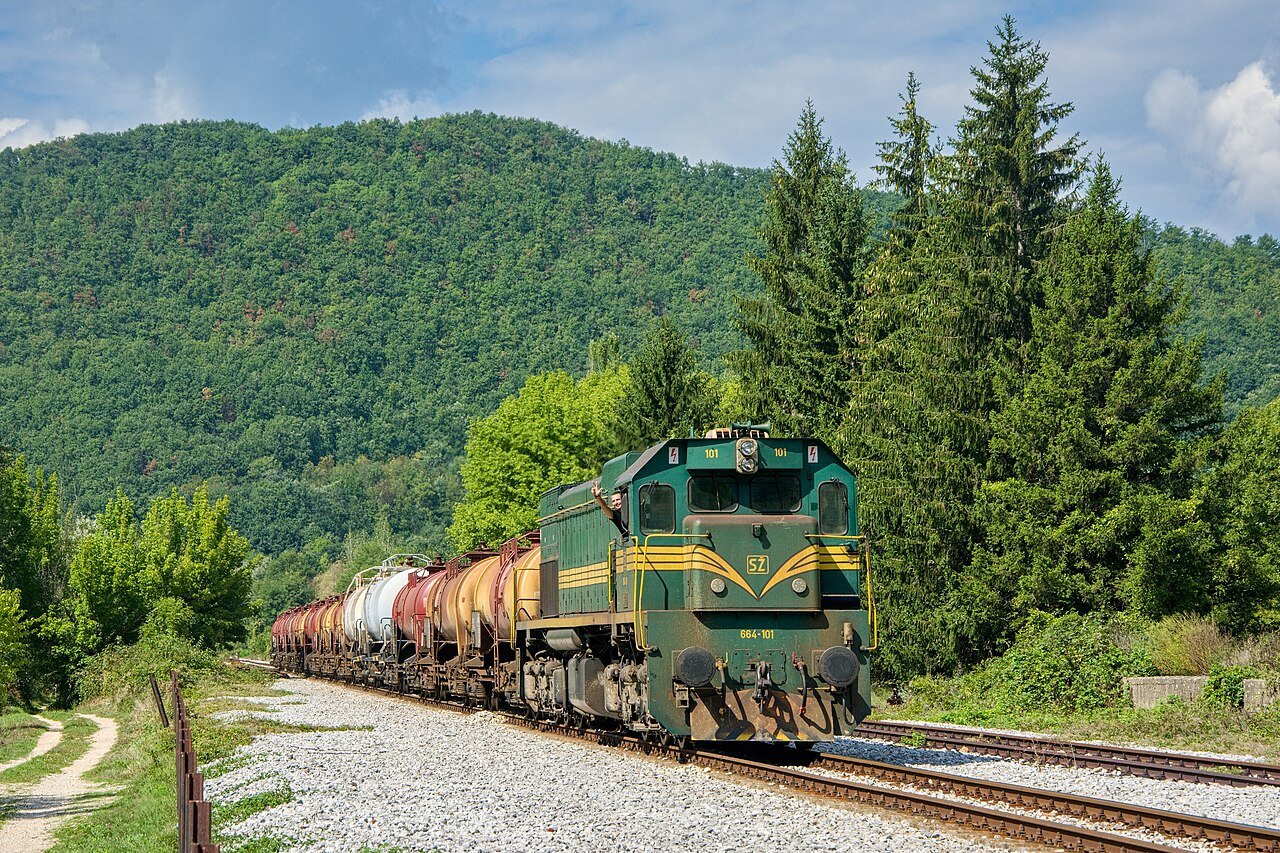
Featured image: freight train in Serbia. Photo: Petr Štefek / Wikimedia Commons, CC BY-SA 3.0 CZ.
Sources
- wbif.eu
- arhiva.infrazs.rs
- New section of railway in North Macedonia towards the Bulgarian border is now operational
- High Speed Rail Belgrade to Nis | We invest in changing lives
- ENNA Transport HR i BGD prvi put u Tovarniku obavili razmjenu vlakova uz interoperabilnost osoblja
- nktot.gov.rs
- Rail Joint Border Crossing – Tabanovce | We invest in changing lives
- View Notice | ECEPP
- COUNTRY
- Project details
- Bulgaria and North Macedonia Sign Agreement to Advance Corridor VIII Rail Connectivity – Transport Community
- Serbia: European Union commits €134 million to modernise Niš-Dimitrovgrad railway link
- Serbia, Hungary and North Macedonia sign trilateral freight agreement | News | Railway Gazette International
- Corridor 8, the long and winding road