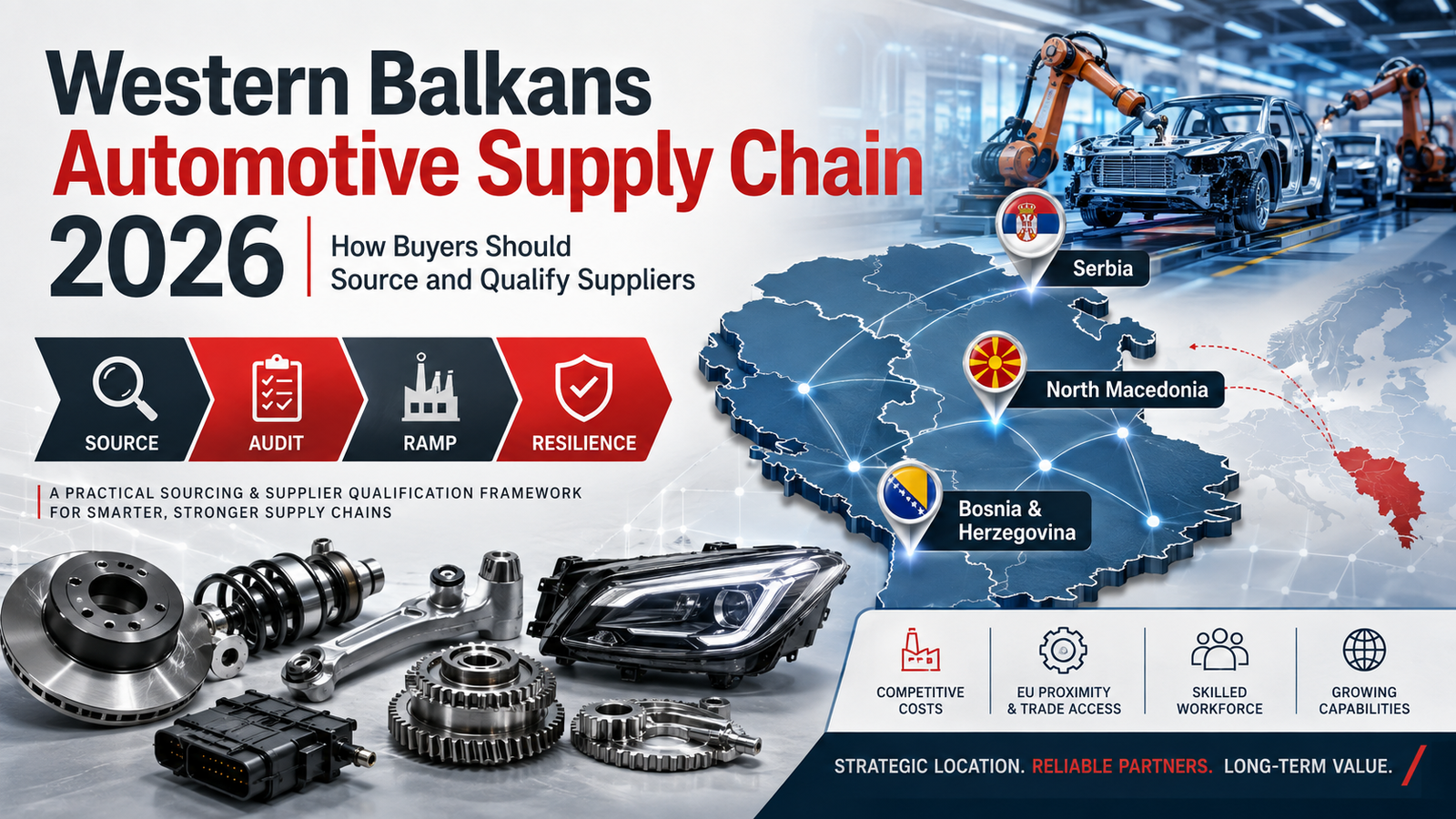
The Western Balkans are not one automotive cluster. They are a connected set of specialised production locations: Serbia offers the broadest industrial base, North Macedonia has a concentrated export platform for components, and Bosnia and Herzegovina combines automotive know-how with deep metal-processing capability.
The region can offer engineering, labour-intensive production and proximity to European plants. The value appears only after a buyer verifies quality systems, process capability, financial resilience and the true sub-supplier chain.
Why the region matters to automotive buyers
European automotive supply chains are under pressure from electrification, shorter model cycles, cost competition and the need for more resilient sourcing. The Western Balkans sit close to plants in Central Europe, Italy, Türkiye and the wider EU market, making them relevant for components where transport time, engineering response and labour content matter.
Serbia’s development agency describes automotive as one of the country’s most important industrial sectors. Its published sector profile counts around 60 international investors, more than €1.7 billion invested and over 27,000 jobs, although some figures reflect a historical sector snapshot rather than a full 2026 census.
North Macedonia’s investment agency states that automotive-component exports reached €3.82 billion in 2022 and represented 46% of national exports. Bosnia and Herzegovina’s investment agency reports that automotive companies export roughly 90% of production to around 30 countries.
The figures use different years and methodologies, so they should not be added together. Their value is directional: automotive and related metal/electrical production are central export industries across the region.
| Market | Typical capabilities | Best sourcing fit | Risk to test |
|---|---|---|---|
| Serbia | Tyres, suspension, wiring, batteries, cast and machined engine/chassis parts, electronics and system suppliers | Larger programmes, mixed Tier 1–Tier 3 sourcing and engineering-intensive localisation | Labour competition, customer concentration and uneven SME maturity. |
| North Macedonia | Wire harnesses, safety systems, seats, electronics, catalysts, plastics, aluminium and zinc die-casting | Export-oriented, labour-sensitive and weight-efficient components | High dependence on a limited number of large exporters and imported inputs. |
| Bosnia and Herzegovina | Precision metal parts, gears, shafts, brakes, clutches, pumps, filters, plastics, rubber, textiles and batteries | Machining, metal processing, smaller specialised series and supplier development | Fragmented administration, financing depth and variable management systems. |
Serbia offers the deepest supplier landscape
Serbia combines multinational plants with a wider base of local Tier 2 and Tier 3 companies. The Development Agency of Serbia highlights stamping, pressing, injection moulding, forging, casting and machining as areas where domestic SMEs contribute to the chain.
This depth matters when a buyer wants to localise not only the finished component but tooling, maintenance, packaging and secondary operations. It also creates variation. One supplier may operate to international automotive standards, while another may have strong machines but weak planning, traceability or commercial control.
Serbia’s Supplier Development Programme reflects this gap by combining consultancy with support for machinery and equipment. Buyers can use supplier development strategically, but they should not assume that a grant or new machine has created process discipline.
North Macedonia is concentrated and highly export-oriented
North Macedonia has attracted global component manufacturers in wiring, electronics, seating, safety, catalysts and precision production. More than 50 automotive and machine-component companies operate in the country, according to the investment agency.
The model works well for high-value-to-weight and labour-intensive components that can reach European customers quickly. Industrial zones and trade agreements support the export platform.
The concentration creates a useful workforce and quality culture, but also vulnerability. A buyer should test whether the supplier depends on one large customer, one imported material or one border route. The local operation may be excellent while critical tooling, engineering approval or raw material remains controlled by a parent company abroad.
Bosnia and Herzegovina is strongest where automotive meets metalworking
Bosnia and Herzegovina’s automotive base developed from a longer tradition of vehicle assembly, mechanical engineering and metal processing. Companies produce precision metal parts, driveline components, brakes, steering, pumps, filters, electrical parts, plastics, rubber and textiles.
The country can be attractive for machined, forged, cast and fabricated components, including smaller series that do not fit a high-volume Asian sourcing model. The strongest suppliers often combine automotive work with industrial, energy or machinery customers.
Administrative complexity differs between the Federation, Republika Srpska and Brčko District. Buyers must know which entity hosts the factory, which tax and labour system applies and how permits, utilities and logistics are managed locally.
Certification is an entry ticket, not proof of capability
An IATF 16949 or ISO certificate shows that a management system has been audited. It does not prove that the supplier can hold a critical tolerance at target volume, recover from a machine failure or finance raw materials during a ramp-up.
A qualification programme should review process capability, control plans, measurement systems, preventive maintenance, traceability, change control, layered audits and corrective-action performance. The buyer should observe production of a similar part, not only a prepared presentation.
Ask for customer-specific audit results where disclosure is permitted. Repeated premium freight, sorting and line complaints may reveal more than the current certificate.
The lowest quotation can be the highest-cost supplier
A small unit-price advantage disappears quickly when the buyer pays for premium freight, sorting, production stops, engineering rework or emergency tooling transfer.
Financial resilience belongs in technical sourcing
Automotive programmes consume working capital before they generate stable cash. Suppliers buy material, tooling and equipment, hire people and carry receivables. A technically capable SME can fail during a successful ramp because it cannot finance growth.
Buyers should review audited accounts, debt, overdue taxes, customer concentration, inventory financing and the cash impact of the proposed programme. Payment terms that look standard to a multinational may be impossible for a smaller Balkan supplier.
Support can include tooling advances, shorter terms during ramp-up, direct material arrangements or structured capacity investment. The objective is not to subsidise weakness but to avoid creating a financing failure through the sourcing contract.
Map the real sub-supplier chain
A supplier may perform final machining or assembly while depending on imported castings, resin, electronic components or heat treatment. The buyer needs visibility beyond the first-tier plant.
Map single-source materials, tooling ownership, special processes and geopolitical exposure. Confirm whether an alternative source is qualified or merely named. For critical parts, verify how quickly production could move if one sub-supplier stops.
Regional sourcing can shorten transport, but it does not remove global dependencies embedded in raw materials and electronics.
Electrification changes the opportunity map
Traditional engine and exhaust components face long-term pressure as electric-vehicle penetration grows. At the same time, demand expands for wiring, power electronics, thermal management, lightweight structures, battery housings, sensors, software and charging equipment.
Suppliers should be evaluated on their ability to migrate capabilities. A precision machining company may move into electric-drive or structural parts. A wire-harness producer may expand into higher-voltage systems. A plastics supplier may enter thermal or battery components.
The transition also creates stranded-asset risk. Buyers and investors should understand how much revenue depends on internal-combustion platforms and when those programmes are expected to end.
A 10-step supplier qualification process
- Define the process, not only the part. Identify special characteristics and required technologies.
- Build a regional longlist. Use clusters, chambers, investment agencies and customer references.
- Screen ownership and finance. Confirm beneficial owners, debt and customer concentration.
- Verify certification directly. Check scope, site address and issuing body.
- Audit a live process. Review capability, scrap, downtime and traceability.
- Map sub-suppliers. Include material, tooling and special processes.
- Run sample and capacity trials. Test repeatability at production speed.
- Model logistics variability. Include borders, winter, premium freight and return packaging.
- Agree change control. No material, tool or process change without approval.
- Start with a controlled ramp. Increase volume only after performance is stable.
Where buyers create unnecessary risk
Problems arise when purchasing selects a supplier on quoted price before engineering and quality complete the process review. They also arise when a buyer awards too much volume to one new supplier, imposes long payment terms or changes forecasts without recognising working-capital impact.
A regional supplier should not be treated as a disposable low-cost source. The best results come from clear technical communication, realistic forecasts and disciplined escalation.
The bottom line
The Western Balkans offer a credible automotive and mobility sourcing base with different strengths across Serbia, North Macedonia and Bosnia and Herzegovina. Proximity, engineering and industrial tradition can create real advantage.
The region rewards buyers who look beyond the factory tour. Quality systems, finance, sub-suppliers, logistics and transition to electric mobility determine whether a promising supplier becomes a resilient long-term partner.