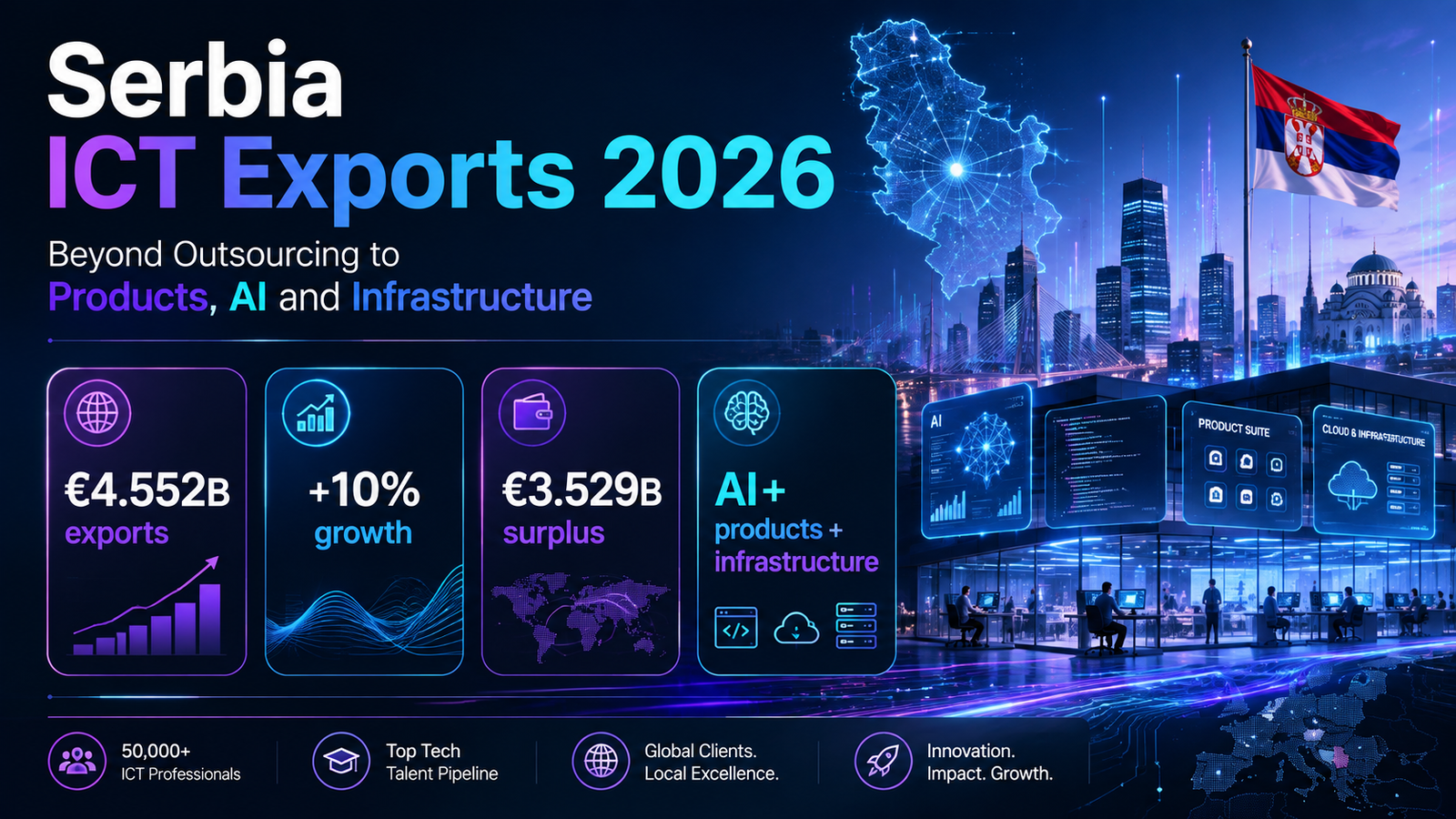
Serbia’s technology sector has crossed the point where it can be described simply as a low-cost outsourcing market. ICT services exports reached €4.552 billion in 2025, with a €3.529 billion surplus. The next question is whether that scale can produce more proprietary products, research-intensive companies and durable regional infrastructure.
Outsourcing created talent, export revenue and international discipline. The higher-value phase requires product ownership, specialised intellectual property, stronger sales capacity and infrastructure that supports AI, cloud and regulated industries.
The export numbers show a mature economic sector
According to Serbia’s Office for IT and eGovernment, ICT services exports reached a record €4.552 billion in 2025, 10% more than in 2024. December alone generated €471 million, while the annual sector surplus reached €3.529 billion.
The previous year had already been strong: exports of ICT products and services reached €4.133 billion in 2024, more than 20% above 2023. The slowing percentage in 2025 should not be read as weakness. Growth from a larger base is harder, and the sector is now large enough to affect wages, office markets, education and the country’s external balance.
Belgrade remains the main centre, but Novi Sad, Niš, Kragujevac, Čačak and other university cities contribute engineering, research and startup capacity.
| Growth model | Commercial advantage | Main constraint |
|---|---|---|
| Outsourcing and engineering services | Fast access to skilled teams and international clients | Margin pressure, wage inflation and client concentration. |
| SaaS and proprietary products | Recurring revenue and stronger valuation potential | Global sales, product management and customer acquisition. |
| AI and data services | High-value engineering and sector-specific automation | Compute cost, data access, regulation and shortage of senior specialists. |
| Fintech and regulated software | Regional banking, payments and compliance demand | Licensing, security, procurement cycles and trust. |
| Data centres and cloud infrastructure | Domestic hosting, public-sector systems and regional resilience | Power availability, connectivity, scale and customer density. |
Why outsourcing remains important
Outsourcing is sometimes described as a stage that Serbia should leave behind. That is too simplistic. Engineering services train teams in international delivery, security, documentation and complex customer management. They also generate cash without requiring the same sales investment as a global product company.
The problem is not outsourcing itself. The risk is a business model based on one foreign client, easily replaceable labour and margins that disappear when salaries rise. Strong service companies specialise by technology or industry, own delivery methods and develop reusable intellectual property.
A credible investor should examine revenue concentration, utilisation, staff seniority, employee turnover, billing rates, bench cost and how much work depends on a founder’s personal relationships.
The product gap is a sales gap as much as a technology gap
Serbian engineers can build sophisticated software. Product companies often struggle later, when they need positioning, enterprise sales, pricing, channel partnerships and customer success in foreign markets.
This creates an investment opportunity beyond coding. International commercial teams, industry advisers and distribution partners can help Serbian companies convert technical capability into recurring export revenue.
Due diligence should distinguish software that has paying customers from a technically impressive platform still searching for a market. Monthly recurring revenue, retention, implementation time and support cost reveal more than the number of features.
AI can raise value—but also raises the cost of competition
Artificial intelligence allows small teams to build new products, automate services and work with large data sets. Serbia’s mathematics, engineering and computer-science base supports this direction.
However, general AI tools are becoming globally available. The defensible opportunity lies in industry data, workflow integration and domain expertise: banking compliance, energy forecasting, industrial maintenance, agriculture, healthcare, logistics, cybersecurity and public administration.
Companies should clarify where models run, who owns training data, how confidential information is protected and whether the service can comply with EU customer requirements. A prototype using a public model is not the same as a secure enterprise product.
Digital infrastructure is becoming part of the investment case
Serbia has invested in e-government, data infrastructure, science and technology parks and the State Data Centre in Kragujevac. These assets support public systems and create a base for cloud, disaster recovery and advanced services.
For private data-centre investment, the decisive variables are power, fibre, land, cooling, redundancy and customer demand. A location with inexpensive land but no firm power reservation is not ready. AI workloads intensify the power and cooling requirement.
The country’s position between EU and non-EU markets can support regional hosting, but data-location claims must be matched with legal, security and connectivity requirements from actual clients.
The export figure does not equal local value
High service exports are positive, but investors should ask how much value remains in Serbia through salaries, profit, intellectual property, local suppliers and reinvestment—not only where the invoice is issued.
Talent is the strongest asset and the largest constraint
Rapid sector growth increases competition for experienced developers, architects, product managers and sales leaders. Entry-level talent may be available while senior specialists remain difficult to recruit.
A realistic workforce model should include gross employment cost, benefits, remote-work expectations, retention, training and management capacity. Comparing only net salary with Western Europe gives a misleading cost advantage.
Companies can widen the talent pool through university cooperation, regional hiring and hybrid teams. They should also assess whether key knowledge sits with a small number of people who may leave after an acquisition.
Tax incentives need substance and documentation
Serbia offers tax mechanisms that can support qualifying research and development and intellectual-property income. The commercial value depends on where development occurs, who owns the IP, how costs are documented and whether the company meets the legal conditions.
A foreign group should avoid locating only contracts or IP in Serbia while the real decision-making and development happen elsewhere. Transfer pricing, permanent establishment, payroll and beneficial ownership must reflect the actual operating model.
A practical investor checklist
- Separate service and product revenue. They have different margins, risks and valuation logic.
- Measure customer concentration. Stress-test the loss of the largest client.
- Audit the talent pyramid. Confirm seniority, turnover and dependency on key employees.
- Verify IP ownership. Review employee, contractor and group-company agreements.
- Test data and AI compliance. Map hosting, data rights, security and customer obligations.
- Rebuild adjusted EBITDA. Include market salaries for founders and required sales investment.
- Check international sales capacity. Product quality without distribution does not create scale.
Where the next growth may come from
The strongest opportunities are likely to combine Serbian engineering with a specialised international market: industrial software, cybersecurity, fintech infrastructure, gaming technology, health systems, energy analytics, logistics platforms and AI-enabled professional tools.
Regional expansion can be a useful first step. Banks, manufacturers, retailers and public institutions across Southeast Europe face similar digitalisation needs, while Serbian companies understand the operating environment better than distant competitors.
The bottom line
Serbia’s €4.55 billion ICT-services export result confirms that technology is a core national industry. The country has proven it can deliver engineering at international scale.
The higher-value challenge is different: own more products, protect intellectual property, develop global sales and build infrastructure for data-intensive services. Investors who bring commercial capability as well as capital can participate in that transition.