Opening a company in Serbia is usually faster than making it operational. Foreign founders are often surprised by this distinction: registration may take days, while banking, beneficial-owner compliance, residence, accounting and commercial readiness determine whether the business can actually function.
Serbia can be an effective regional base, but incorporation should be treated as the beginning of the process—not the finish line.
Why Serbia remains attractive to foreign founders
Serbia combines a relatively large Western Balkan labour market, competitive operating costs, strong technical talent and practical links with the European Union, CEFTA markets and Türkiye. Belgrade is the region’s deepest management and services centre, while Novi Sad and Niš add engineering and technology capacity.
The country is outside the EU, which creates both flexibility and friction. A Serbian company can be useful for regional trade and service delivery, but EU-facing businesses still need to design VAT, customs, data, certification and payment flows carefully.
The registration process is now electronic
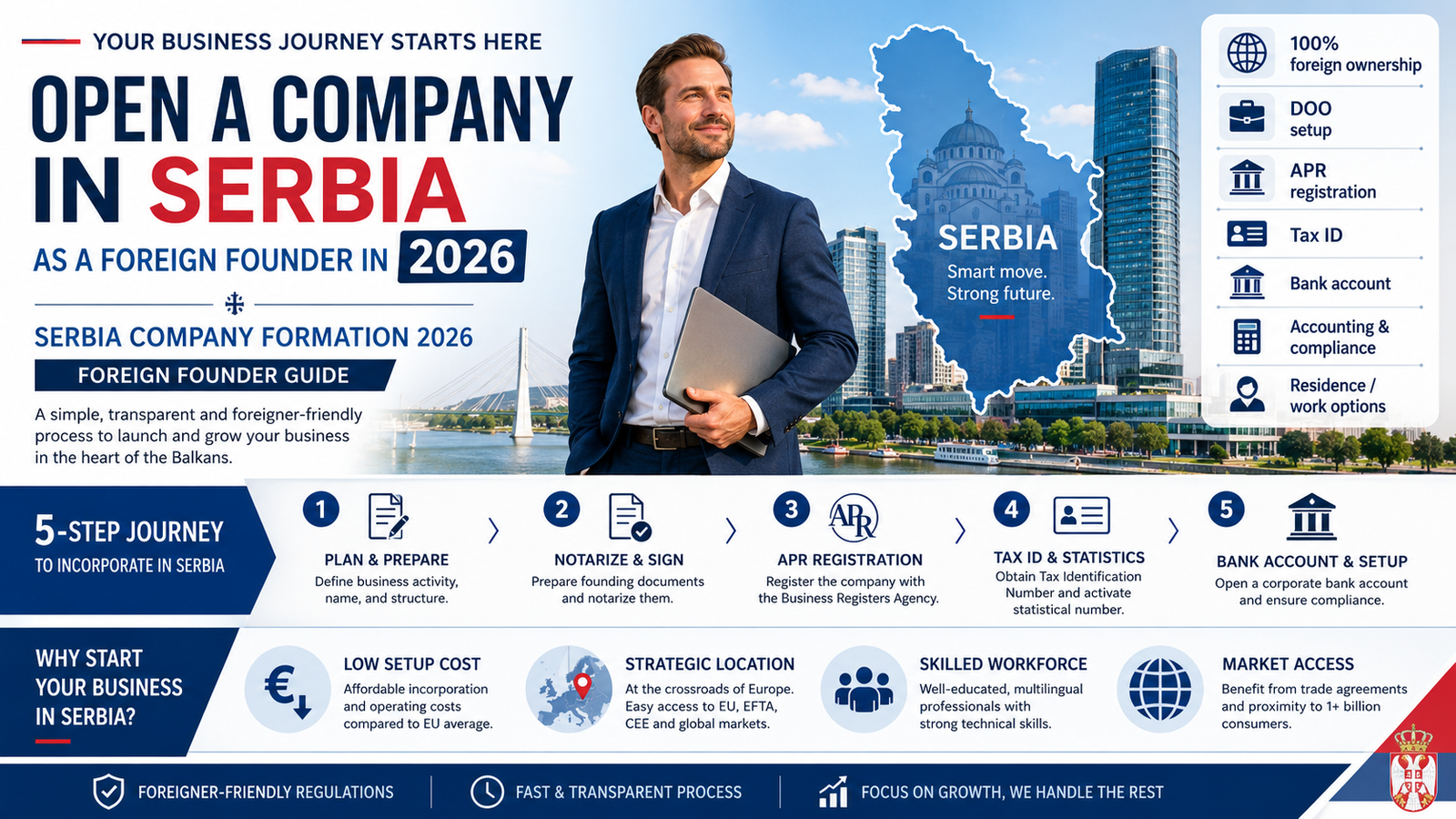
Since 17 May 2023, the incorporation of Serbian companies—including limited liability companies—must be submitted electronically to the Serbian Business Registers Agency. The applicant needs a qualified Serbian electronic certificate, the signing software and an accepted payment card.
For a foreign natural person establishing a single-member limited liability company, the e-application can be filed personally or through an authorised representative. In practice, many foreign founders use a Serbian lawyer or registration agent because the applicant must work inside the Serbian electronic-signature system and prepare documents in the required form.
The one-stop registration system issues the company registration number and tax identification number. VAT registration can also be handled through the integrated process when applicable.
| Step | What happens | Where founders lose time |
|---|---|---|
| 1. Structure | Choose founder, director, activity, capital and registered address | Using a generic structure before checking banking, tax and residence consequences. |
| 2. Documents | Prepare founding act, identity evidence and powers of attorney | Foreign documents may need certification, apostille and Serbian court translation. |
| 3. Electronic filing | Submit through the SBRA system | The applicant needs a Serbian qualified electronic signature or a local proxy. |
| 4. Post-registration | Beneficial owner, bank, accounting and employment setup | The company exists legally but may still be unable to invoice or receive funds. |
| 5. Residence and work | Apply on the correct basis if the founder will live or work in Serbia | Company ownership alone does not automatically guarantee a permit. |
The official fee is the smallest part of the budget
The SBRA fee for electronic incorporation is RSD 5,900. That number is useful, but it is not the cost of becoming operational. A realistic budget may also include legal drafting, certified translations, notarial work, address services, accounting setup, bank compliance, electronic signatures and residence support.
The cheapest provider is not necessarily the cheapest route. Errors in the founding act, activity code, director arrangement or ownership documentation can create more cost later than a careful setup at the beginning.
Banking is the real commercial gate
A registration certificate does not oblige a bank to accept the company. Serbian banks apply their own compliance procedures and may ask for the founder’s tax residence, source of funds, ownership chain, business plan, expected counterparties, countries of payment and supporting contracts.
Founders from higher-risk jurisdictions, companies with complex ownership or businesses expecting payments connected with sanctioned markets should pre-screen banking before incorporation. The right question is not “Can a Serbian company open an account?” but “Which bank is comfortable with this exact ownership, activity and transaction profile?”
Serbia’s entry into SEPA schemes in 2026 is commercially important because participating banks can offer more efficient euro payments. It does not eliminate bank onboarding or sanctions compliance.
Tax should be modelled around the business, not the headline rate
Serbia’s standard corporate income tax rate is 15%, and the standard VAT rate is 20%. Those headline figures are competitive, but the effective burden depends on payroll, dividends, related-party transactions, permanent-establishment risk, withholding taxes, deductible costs and available incentives.
Technology and R&D companies may benefit from an IP Box regime, enhanced deductions for qualifying research and development expenditure and selected employment or investment incentives. Eligibility depends on substance, documentation and the exact legal conditions. It is dangerous to put an incentive into the business plan before a Serbian tax adviser has confirmed that the company and expenditure qualify.
Do not confuse ownership with the right to work
A foreigner may own a Serbian company without living in Serbia. If the founder will work or manage the business in the country, the correct visa, temporary residence or single residence-and-work permit must be assessed separately.
Residence and work for founders
Running a Serbian business can be a valid basis for residence under self-employment rules, but establishing a company does not guarantee approval. The authorities assess the legal basis, documentation and individual circumstances.
Depending on nationality and intended length of stay, a founder may need a D visa or may be able to apply directly for a single temporary residence and work permit. Serbia’s official portal states that single permits can be issued for up to 36 months. Founders who only attend meetings or perform limited ownership and representative activities for short periods may fall under narrower exemptions, but those rules should not be stretched into day-to-day employment.
What a credible first 60 days look like
A well-prepared founder uses the first two months to move from legal registration to commercial readiness. That means confirming the bank account, appointing an accountant, registering the beneficial owner, implementing invoice and document flows, signing the registered-office arrangement, preparing employment or management contracts and documenting the first customer pipeline.
It also means deciding what the Serbian company will actually do. A regional sales office, a software development centre, an import company and a consulting vehicle need different contracts, staffing, VAT treatment and compliance procedures.
A safer sequence for foreign founders
- Define the operating model. Identify customers, currencies, countries, employees and expected transactions.
- Pre-screen banking and tax. Test the ownership and payment profile before registering.
- Prepare foreign documents correctly. Confirm apostille, certification and translation requirements.
- Register the company electronically. Use a qualified local representative when necessary.
- Complete post-registration compliance. Bank, beneficial owner, accounting, tax and contracts.
- Apply for residence or work rights separately. Do not assume the company certificate is enough.
- Review after the first quarter. Confirm that the structure matches actual commercial activity.
The bottom line
Serbia is one of the most practical jurisdictions in the Western Balkans for a foreign founder who needs people, regional access and a serious operating base. It is less suitable for someone looking only for a cheap company certificate.
The difference between a successful structure and a dormant company is preparation. Registration is administrative. Banking, tax, residence, customers and local execution are the business.
Planning to establish a company in Serbia?
Before committing to incorporation, staffing and fixed costs, Inspira’s Market Validation Sprint helps foreign founders test demand, buyers, competition, route to market and the operating model needed to decide whether a Serbian entity is the right commercial structure.
Continue reading on BalkansNetwork
Official sources
- Serbian Business Registers Agency — e-Incorporation
- Serbian Business Registers Agency — Formation instructions
- Serbian Business Registers Agency — Fees
- Welcome to Serbia — Residence and work permit
- Welcome to Serbia — Visa for foreign business owners
- European Commission — Serbian banks join SEPA schemes