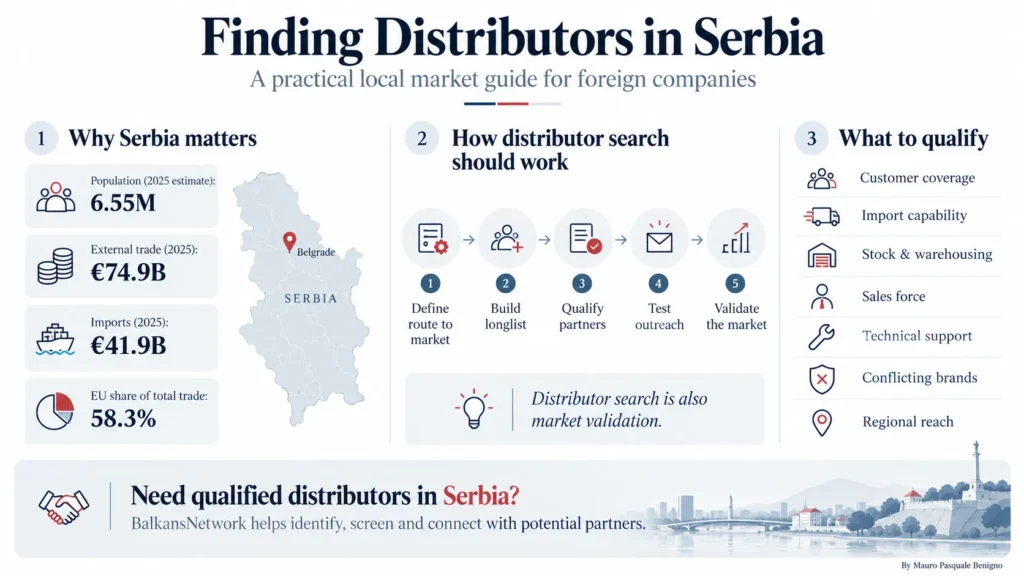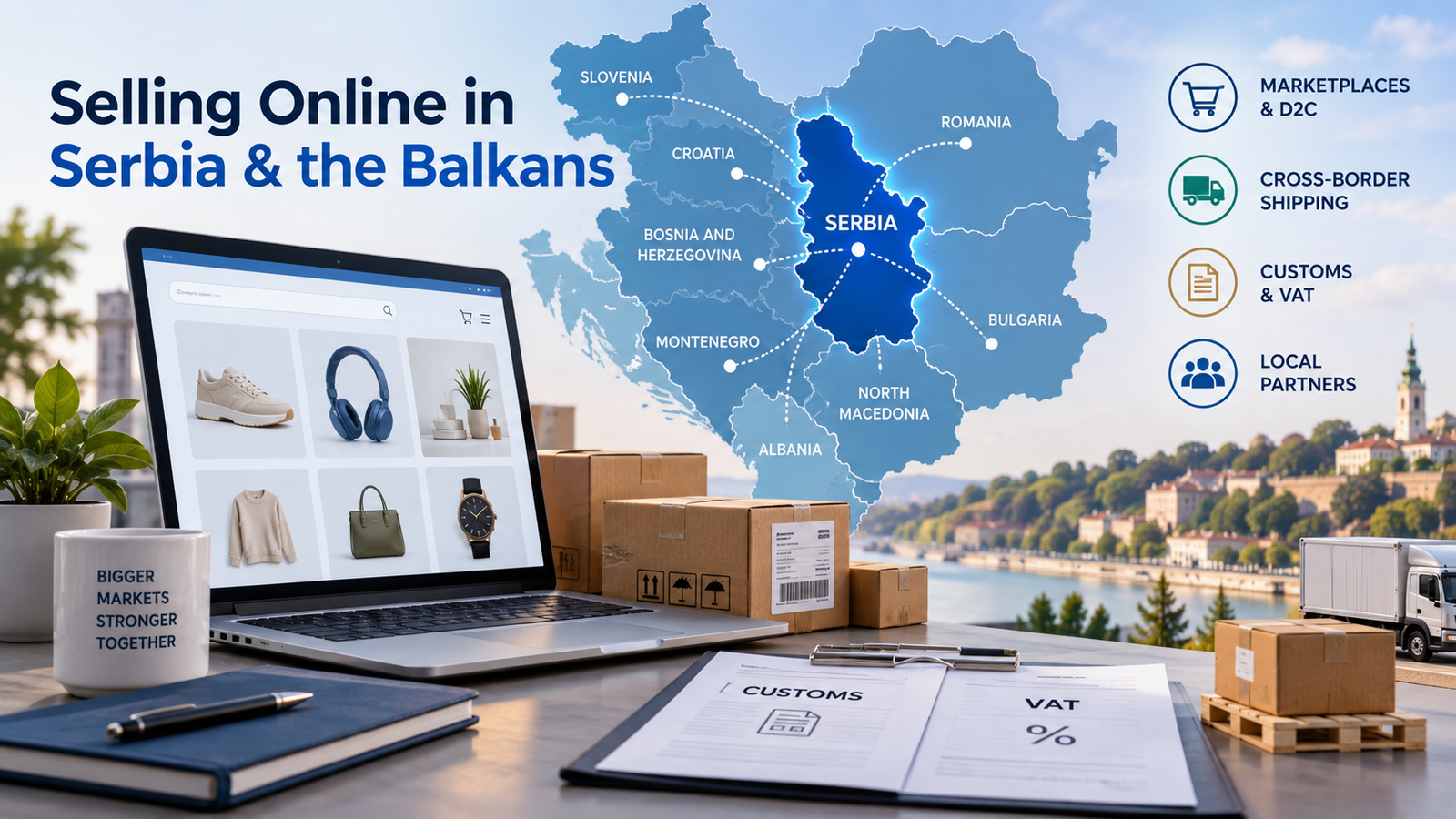
Selling online in Serbia is not the same as adding another EU country to your checkout. Serbia is a fast-growing e-commerce market, but it remains outside the European Union and its customs territory. For a European DTC brand, the route to market can therefore determine whether an attractive product becomes a scalable local business — or a checkout burdened by import VAT, customs procedures, delivery friction and difficult returns.
This 2026 guide explains the practical choices: selling directly from an EU website, using Serbian marketplaces, working with a local importer or distributor, or building a local fulfilment model. It also explains Serbia’s current customs rules, representative duty rates by product category and HS code, preferential EU-origin treatment, VAT, payments, logistics and how the Serbian model compares with other Balkan markets.
Serbia’s e-commerce market in 2026: demand is growing quickly
The latest National Bank of Serbia data show strong momentum. In the second quarter of 2026, Serbian consumers made 34.2 million online purchases paid by card or electronic money, up 28.5% year on year. Of these, 24.45 million were dinar transactions and 9.75 million were purchases on foreign websites. The number of domestic online stores reached 6,278 at the end of June 2026, 21.4% more than a year earlier. Importantly, the NBS states that these statistics do not include cash-on-delivery transactions, so the actual e-commerce market is larger than the card/e-money data alone suggest.
For a foreign brand, this creates a real opportunity: Serbian customers already buy internationally. But the 9.75 million foreign-site transactions should not be read as proof that cross-border DTC is frictionless. The commercial question is not only whether a Serbian consumer can buy from your website. It is whether your total landed price, delivery promise, payment options and return process remain competitive once the parcel crosses a non-EU customs border.
Can a European DTC brand sell directly from its own website to Serbia?
Yes. A Serbian customer can order from a foreign website and receive an international parcel. For demand testing, this can be the fastest entry route because the brand keeps control of pricing, merchandising, customer data and creative. The difficulty begins after checkout: Serbia is outside the EU customs union, so the parcel is an import into Serbia.
A seemingly simple €80–€150 order can acquire import VAT, customs duty where applicable, carrier or postal handling charges and a longer delivery cycle. If the customer discovers these costs only at delivery, conversion, repeat purchase and customer satisfaction can suffer. Returns are also more difficult because the product must move back across a customs border. This is why brands should compare cross-border DTC with local stock, a marketplace seller, an importer/distributor or a Serbian fulfilment partner before scaling paid acquisition.
Serbia customs in 2026: the three rules a DTC brand must understand
Serbian Customs distinguishes simplified treatment for certain low-value postal shipments from the regular commercial customs procedure. According to the current Customs Administration guidance, VAT is payable on low-value postal items regardless of value, while import duty becomes relevant above the applicable exemption threshold. The standard Serbian VAT rate is 20%; a reduced 10% rate applies to specified categories under the VAT Law.
| Postal shipment value | Customs treatment described by Serbian Customs | VAT |
|---|---|---|
| Up to €50 | Low-value non-commercial postal items are exempt from import duty. | VAT still applies; general rate 20% unless a reduced rate applies. |
| Over €50 and up to €3,000 | For the simplified postal regime described by Customs, a uniform 10% import duty can apply. | Normally calculated after adding customs duty to the taxable customs base; general rate 20%. |
| Over €3,000 / regular procedure | Regular customs clearance using the applicable HS tariff rate, origin and trade agreement. | VAT applies according to the Serbian VAT rules. |
Important: a DTC brand should not treat the €50/10% parcel rules as a universal commercial tariff. Customs procedure can vary with the nature of the shipment, carrier, importer, product restrictions and whether the goods enter under a regular commercial declaration. For a scalable market-entry model, calculate the product under its actual HS code and origin before committing to pricing.
What the landed cost can look like: official Serbian Customs examples
The Customs Administration gives a useful illustration. For a €100 mobile phone with free shipping under the simplified low-value treatment, a 10% uniform duty produces €10 customs duty. VAT at 20% is then calculated on €110, adding €22. Total import charges are therefore €32, making the cost €132 before any separate postal or carrier service fees. If €10 shipping is separately charged, the customs value in the example becomes €110, the duty €11 and VAT €24.20, taking total import charges to €35.20.
That difference matters for conversion. A customer comparing a local offer at 12,990 RSD with a foreign website price cannot compare sticker prices alone. The merchant should model the landed consumer price — product, freight, duty, VAT, handling and return risk — and decide whether those costs are paid upfront by the seller or collected from the buyer.
How much duty does Serbia charge by product category?
There is no single Serbian customs rate for “fashion”, “electronics” or “consumer goods”. Serbia’s 2026 Customs Tariff is aligned with the EU Combined Nomenclature and assigns rates at tariff-code level. The latest WTO tariff profile also shows how wide the category spread can be: the simple average MFN applied tariff is around 7.3% overall, but agricultural and consumer categories can be much higher.
| WTO product group | MFN applied average | Commercial implication |
|---|---|---|
| Dairy products | 21.7% | High sensitivity; agricultural preferences/quotas must be checked product by product. |
| Beverages & tobacco | 24.1% | Tariff and excise/compliance can materially alter economics. |
| Clothing | 20.4% | Origin is especially important for EU fashion brands sourcing outside Europe. |
| Fruit & vegetables | 15.4% | Seasonal/specific agricultural measures may apply. |
| Textiles | 9.1% | Finished-product classification can differ substantially from material averages. |
| Rubber, leather & footwear | 8.6% | Use exact footwear/material HS code before pricing. |
| Electrical/electronic equipment | 6.9% | Individual lines still range from zero to much higher rates. |
| Mechanical/office/computing machinery | 4.4% | Generally lower, but classification and origin remain decisive. |
| Chemicals | 3.1% | Regulatory/product-safety requirements can matter more than the headline tariff. |
These are category averages from the latest WTO tariff profile, not quotations for a specific product. An actual import must use the relevant Serbian 2026 tariff code.
Representative 2026 Serbian HS-code examples
The following examples illustrate why product-level classification matters. They reproduce 2026 Serbian tariff data and show the standard rate alongside the preferential rate shown for qualifying EU-origin goods.
| Example product | HS code | Standard duty | EU preferential rate* | VAT |
|---|---|---|---|---|
| Smartphones | 8517 13 00 00 | 5% | 0% | 20% |
| Other headphones/headsets | 8518 30 00 90 | 15% | 0% | 20% |
| Certain plastic toys | 9503 00 95 00 | 10% | 0% | 20% |
| Plastic clothing/accessories incl. certain gloves | 3926 20 00 00 | 20% | 0% | 20% |
*The preferential rate is not obtained merely because a parcel is dispatched from an EU warehouse. The product must satisfy the applicable preferential rules of origin and the importer must use the required proof/documentation. Classification, origin and any product-specific measures must be verified before a customs declaration.
The crucial EU-origin distinction: “shipped from the EU” is not the same as “EU origin”
Serbia has a Stabilisation and Association Agreement with the European Union, in force since 2013, and the EU–Western Balkans origin framework uses the Pan-Euro-Mediterranean (PEM) rules. Revised PEM rules have applied with Serbia since 2025/26. These rules determine whether a product qualifies for preferential access.
This matters enormously for DTC brands. A shoe designed in Milan, stored in Italy and manufactured in Asia does not automatically acquire EU preferential origin because it leaves an Italian warehouse. Likewise, a consumer-electronics brand may have EU inventory but products of Chinese, Vietnamese or other origin. If the origin test is not met, the standard or other applicable origin-specific rate can apply. Conversely, qualifying EU-origin industrial goods can often enter at a zero preferential customs rate when the origin conditions and proof are satisfied. Agricultural and food products require particular care because trade liberalisation is not uniform across every line and quotas or reduced rates can apply.
Where do Serbian consumers buy online?
There is no Serbian Amazon marketplace. Amazon currently lists ten European stores — the UK, France, Germany, Italy, Spain, Poland, the Netherlands, Sweden, Belgium and Ireland — but not Serbia. Customers in countries without a dedicated Amazon store may sometimes order from neighbouring Amazon stores when export delivery is enabled, but this does not remove Serbian customs, tax or last-mile friction.
The local ecosystem therefore matters more. Ananas has developed as a structured Serbian marketplace with local merchants and broad consumer categories. KupujemProdajem is a major local online-trading platform but has a different marketplace/classifieds dynamic and should not be treated as a direct equivalent of Amazon. Shoppster is another relevant local/regional e-commerce route. Which platform is suitable depends on product category, required seller structure, brand positioning, fulfilment, advertising tools and who acts as seller/importer of record.
OECD’s 2026 Western Balkans Enterprise Survey helps explain the wider pattern: among surveyed SMEs selling online, own websites and social media are used far more often than international third-party marketplaces. The OECD explicitly notes that Amazon and eBay have limited presence in the region and that domestic alternatives such as KupujemProdajem and Ananas shape actual marketplace behaviour. Cash on delivery also remains predominant for a large share of regional e-commerce transactions.
Why Amazon and the standard EU playbook are less dominant in the Western Balkans
The issue is not that Balkan consumers do not shop online. It is that the region is commercially fragmented. Serbia, Bosnia and Herzegovina, Montenegro, North Macedonia, Albania and Kosovo are separate customs and tax environments. They also differ in payment habits, delivery networks, language, returns, consumer trust and platform ecosystems. A single EU fulfilment strategy does not automatically reproduce the economics of selling from Germany to France or Italy.
That fragmentation creates room for local marketplace operators, couriers, distributors and hybrid retail/e-commerce groups. It also explains why a good regional distributor or local fulfilment partner can create more value than simply opening international shipping from an EU site.
Four practical routes to market in Serbia
| Route | Best use | Advantages | Main weaknesses |
|---|---|---|---|
| Cross-border from EU website | Demand test, niche/high-margin products | Fast launch, full brand/data control, low fixed investment | Customs/VAT friction, delivery time, returns, surprise fees if poorly designed |
| Local marketplace | Products already suited to marketplace discovery | Existing traffic, local checkout, integrated logistics/marketing options | Fees, price competition, onboarding/seller requirements, less customer ownership |
| Importer/distributor | Brands seeking local retail + online scale | Local stock, customs expertise, marketplace/retail relationships, easier returns | Lower gross margin, less pricing/channel control, partner dependence |
| Local entity + 3PL / hybrid | Brands with proven demand and strategic commitment | Maximum channel control, local DTC, faster delivery, data ownership | Higher setup, accounting, tax, compliance and operational burden |
How Serbia compares with the rest of the Balkans
“The Balkans” is not one customs market. For practical commercial planning, it helps to separate the six Western Balkan economies from the EU member states in Southeast Europe.
| Market | EU customs status | Practical e-commerce entry point |
|---|---|---|
| Serbia | Non-EU | Strongest scale among Western Balkan markets; combine local marketplaces/distribution with controlled DTC testing. |
| Bosnia & Herzegovina | Non-EU | Local importer/retailer and social/marketplace channels often reduce fragmented delivery and administrative friction. |
| Montenegro | Non-EU | Small market; regional distributor and tourism-linked retail can be more efficient than a standalone setup. |
| North Macedonia | Non-EU | Localised payments/COD and regional distribution relationships remain important. |
| Albania | Non-EU | Mobile/social commerce is important; test demand but solve last-mile, payment and returns locally. |
| Kosovo | Non-EU | Young digital consumer base; separate customs/payment setup and local partner validation required. |
| Croatia | EU | EU DTC economics are easier for Union goods; local marketplaces, language and fulfilment still affect conversion. |
| Slovenia | EU | Small, digitally mature EU market; cross-border DTC can be efficient with localisation. |
| Bulgaria | EU | EU customs advantages plus powerful regional marketplace routes such as eMAG. |
| Romania | EU | Large regional e-commerce market; eMAG offers cross-border marketplace reach into Romania, Bulgaria and Hungary. |
| Greece | EU | EU DTC plus strong local marketplace/search-shopping behaviour; Skroutz is a major route. |
| Türkiye | Non-EU; customs union with the EU for many industrial goods but separate tax/e-commerce regime | Large, distinct market that generally deserves its own marketplace, compliance and fulfilment strategy rather than being treated as an extension of the Western Balkans. |
How to meet the right distributor, marketplace and platform partners
The best partner is not necessarily the company with the largest warehouse or the broadest “Balkans” presentation. A DTC brand should validate category fit and execution capability. Ask which channels generate actual sell-out in your category; which marketplaces the partner actively operates; whether it can act as importer and seller of record; how VAT/customs documentation is managed; what stock level and delivery SLA it requires; how COD is reconciled; who pays for returns; whether the brand receives sell-through and customer data; and whether territory exclusivity blocks future expansion.
For many brands, the most robust first step is a market validation sprint: classify the product and landed cost, benchmark local retail and marketplace prices, identify 10–20 relevant distributors/platform operators/3PLs, test partner interest and then choose the operating model. That prevents the company from signing an exclusive distributor simply because it was the first one available.
Online acquisition still needs local commercial execution
The strategic lesson is similar to the one in our Nelt regional distribution platform case study: regional reach does not eliminate local execution. A consumer may discover a product through Instagram, TikTok, Google or an international website, but inventory, customs, local delivery, payments, marketplace operations and returns still determine whether demand converts into a durable business.
Planning to enter the Serbian or Balkan market?
Inspira supports companies with market validation, distributor and partner identification, route-to-market strategy and hands-on business development across Serbia, Southeast Europe and Türkiye.
Sources and methodology
Data and rules checked on 11 September 2026. Tariff figures are informational; product classification, origin, quotas, excise/product-safety measures and documentation should be verified for the actual transaction before import.
- National Bank of Serbia — Q2 2026 internet-purchase statistics
- Customs Administration of Serbia — 2026 Customs Tariff
- Customs Administration of Serbia — postal items and low-value shipment guidance
- Serbian Tax Administration — VAT rates
- European Commission — Western Balkans trade and PEM rules of origin
- OECD — Western Balkans Enterprise Survey 2026: e-commerce and digital transactions
- Amazon — current European marketplace stores
- Carinska tarifa portal — searchable 2026 Serbian tariff lines based on Official Gazette 107/2025 and 45/2026
- eMAG Marketplace — regional cross-border selling information
- Skroutz Merchants — Greece marketplace and fulfilment information