There is no single “best” Balkan country for an international company. There is only a location that fits a specific operating model better than the alternatives.
A regional sales team, a shared-services centre, a manufacturing plant and an EU-facing headquarters do not need the same things. One may need multilingual commercial talent and direct flights. Another may care more about industrial land, labour depth, customs procedures or whether the company sits inside the EU legal framework.
That distinction matters more in 2026 because Southeast Europe is becoming more commercially integrated while remaining institutionally fragmented. EU–Western Balkans trade in goods exceeded €88 billion in 2025, more than double the level of a decade earlier, while trade in services exceeded €20 billion in 2024. At the same time, the region still spans EU and non-EU jurisdictions, euro and non-euro economies, Schengen and external-border regimes, and very different labour and banking environments.
The right question is therefore not “Which Balkan country is cheapest?” It is: where will this company face the least friction between customers, people, regulation, logistics and capital?
The short answer: match the base to the job
| Operating model | Strong first choice | Why | Alternative |
|---|---|---|---|
| Regional HQ / business development | Serbia | Belgrade combines regional reach, management talent, engineering depth and a large Western Balkan commercial network. | Croatia if EU establishment matters more than cost. |
| EU legal base with lower operating cost | Bulgaria | EU, Schengen and euro area from 2026, 10% corporate tax and the EU’s lowest average hourly labour cost in 2025. | Romania for greater labour-market scale. |
| Large EU market + shared services | Romania | Large domestic market, deep talent pool, strong industrial and services base, full Schengen participation. | Bulgaria for lower headline tax and smaller structure. |
| Adriatic / EU commercial platform | Croatia | EU, euro and Schengen, strong links to Central Europe and the Adriatic, easier positioning for EU customers. | Slovenia for higher-value Central European integration. |
| Advanced EU logistics / high-value operations | Slovenia | Euro, Schengen, excellent access to Austria, Italy and Central Europe; strong fit for higher-value operations. | Croatia for lower cost and wider Adriatic footprint. |
| Export manufacturing | Serbia / North Macedonia | Competitive industrial cost, established foreign-investment base and access to regional supply chains. | Romania or Bulgaria when EU establishment is essential. |
| Cost-sensitive engineering / delivery centre | Serbia / Bosnia and Herzegovina | Technical skills and lower operating cost than most EU locations. | North Macedonia for a smaller but tax-efficient structure. |
| Small international or tourism-linked business | Montenegro | Euro, low headline corporate tax and simple fit for boutique international services. | Croatia for scale and EU framework. |
This is not a ranking. A German industrial group, a Turkish manufacturer and a US software company can rationally choose three different Balkan bases even if they serve the same region.
Why the regional opportunity is getting more serious
The Balkans used to be treated by many international companies as a collection of small peripheral markets. That view is increasingly outdated.
The European Union remains the dominant commercial reference point for the Western Balkans. In 2025, goods trade between the EU and the six Western Balkan partners was worth more than €88 billion, with machinery, base metals, mineral products and chemicals among the largest categories. EU–Western Balkans trade in services exceeded €20 billion in 2024. This matters because regional operations are no longer only about selling locally: they increasingly support European supply chains, nearshoring, engineering, IT, manufacturing and specialised services.
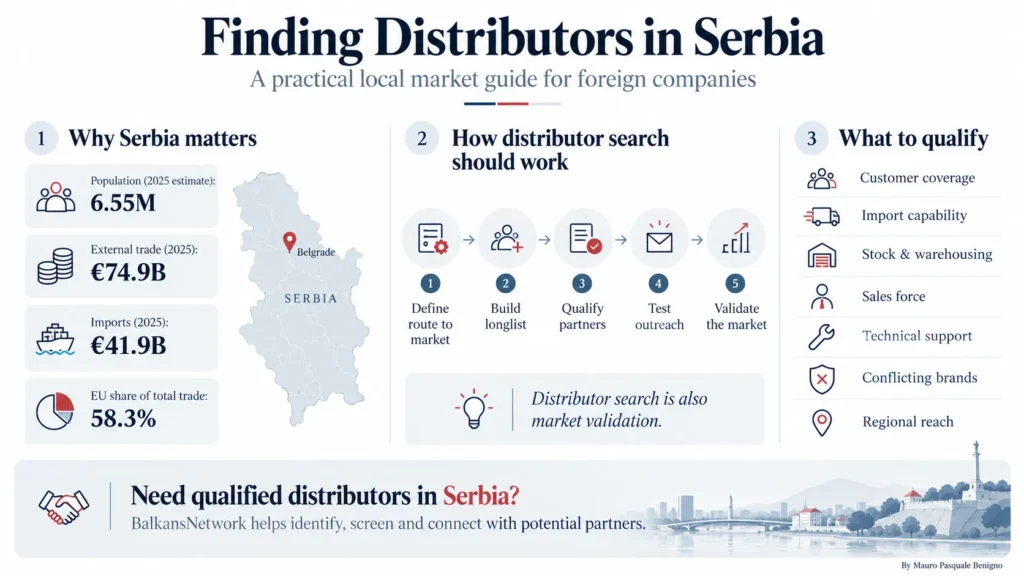
Serbia illustrates the shift. Its goods exports reached €33.07 billion in 2025, up 8.4%, while EU member states accounted for 58.3% of Serbia’s total external trade. Serbia’s ICT services exports separately reached a record €4.552 billion in 2025, with a €3.529 billion surplus. Those numbers do not make Serbia the right base for every company, but they show that the region can support more than low-cost assembly.
The first dividing line: EU base or non-EU base?
This is usually the most important structural decision.
If the company must contract as an EU entity, participate in certain EU procurement or funding frameworks, simplify VAT and intra-EU trade, or reassure regulated customers, then Croatia, Slovenia, Bulgaria or Romania deserve priority. Bulgaria became even more interesting in 2026: it adopted the euro on 1 January 2026 after becoming a full Schengen member together with Romania from 1 January 2025.
If the priority is regional commercial reach, lower cost, engineering talent or access to Western Balkan and neighbouring markets, Serbia may offer a stronger operating compromise despite being outside the EU. North Macedonia, Bosnia and Herzegovina and Montenegro can also work well for more specialised models.
The practical mistake is to treat EU membership as either irrelevant or automatically decisive. It is neither. It is a constraint to model against the company’s real commercial process.
Serbia: the strongest general-purpose regional base
For many international companies, Belgrade remains the most balanced location for a Western Balkan headquarters or business-development hub.
Serbia’s attraction is not a single tax rate. The corporate income tax rate is 15%, but the stronger argument is the combination of market size, management depth, technical talent, central geography and established links with EU companies, Türkiye, CEFTA markets and other international partners.
For commercial teams, Belgrade offers a larger professional network than most capitals in the Western Balkans. For technology and engineering, Serbia has enough depth to support not only small teams but substantial delivery centres. The record €4.552 billion in ICT services exports in 2025 is a useful indicator of that capacity.
Serbia is particularly convincing for:
- regional sales and business development;
- engineering and software teams;
- industrial technology and supplier development;
- Western Balkan headquarters;
- companies combining Balkan activity with Türkiye and Central Europe.
The trade-off is clear: Serbia is not inside the EU customs, VAT or regulatory perimeter. Banking and cross-border structuring also deserve more attention than many investors expect. A company that needs a purely EU operating platform may therefore prefer Croatia, Bulgaria or Romania even at a higher cost.
Bulgaria: materially stronger after euro adoption
Bulgaria’s proposition changed in 2026. It is now simultaneously an EU member, a full Schengen member and part of the euro area.
That matters for regional treasury, customer contracts and management simplicity. The corporate income tax rate remains 10%. Eurostat estimated Bulgaria’s average hourly labour cost at €12.0 in 2025, the lowest in the EU, compared with an EU average of €34.9.
For an international company that wants an EU legal base without Western European operating costs, Sofia deserves serious attention. Plovdiv is highly relevant for manufacturing and industrial supply chains, while Varna and Burgas can matter for Black Sea logistics and service operations.
Bulgaria is especially attractive for:
- shared services and back-office operations;
- software and technical teams;
- EU-based regional management;
- industrial projects around Sofia and Plovdiv;
- companies that value euro settlement and low corporate tax.
The caveat is that low labour cost is not static. Eurostat recorded a 13.1% increase in Bulgarian hourly labour costs in 2025. A location decision should therefore be built on productivity and hiring depth, not on today’s salary spreadsheet alone.
Romania: scale changes the equation
Romania should not be viewed simply as “a more expensive Bulgaria.” Its advantage is scale.
It offers one of the largest labour markets in Southeast Europe, a substantial domestic economy, established automotive and industrial clusters, large IT and shared-services sectors, and strong cities beyond Bucharest, including Cluj-Napoca, Timișoara, Iași and Brașov.
Eurostat estimated average hourly labour cost at €13.6 in 2025, still among the lowest levels in the EU. Romania has been a full Schengen member since 1 January 2025. The standard corporate income tax rate is 16%, although the actual tax profile depends on the company’s size, activity and eligibility for other regimes.
Romania is often the stronger choice when a company needs to recruit at scale, build a service centre, combine manufacturing with engineering, or access a larger domestic customer base while remaining fully inside the EU.
Croatia: not the cheapest, but often easier to explain to EU customers
Croatia’s value is institutional and commercial rather than purely cost-driven.
It is inside the EU, euro area and Schengen. The tax system currently applies a 10% corporate income tax rate to companies with annual revenue up to €1 million and 18% at or above that threshold. Labour costs are higher than in Bulgaria or Romania and rose sharply in 2025, so Croatia is not a location to choose simply because it is “Balkan and cheaper.”
Where Croatia becomes compelling is for companies that need an EU-facing commercial identity, Adriatic logistics, access to Central European customers or a regional base that is easy for foreign management to understand.
Zagreb is the obvious headquarters location. Rijeka matters for port and logistics activity. Osijek can be interesting for lower-cost technology and operations. Split is relevant to tourism, hospitality and maritime businesses but has more seasonal labour and property constraints.
Slovenia: a premium Balkan base with Central European logic
Slovenia is often omitted from “Balkan cost” comparisons because it is structurally closer to Central Europe in income, institutions and business culture. That is exactly why it can be the right answer for some companies.
Ljubljana offers euro, Schengen, EU law, strong infrastructure and direct commercial proximity to Italy, Austria, Croatia and the wider Central European market. Koper provides a strategically important Adriatic port connection.
Slovenia’s corporate income tax is temporarily 22% for 2024–2028, higher than most nearby jurisdictions. It is therefore rarely the best option for a cost-minimisation strategy. It can be excellent for high-value headquarters, logistics coordination, advanced industrial activities and companies that care more about institutional quality and access than headline tax.
North Macedonia: manufacturing economics can be very competitive
North Macedonia deserves more attention than its domestic market size suggests.
The corporate profit tax rate is 10%, and the country has built a strong proposition around export manufacturing and technological-industrial development zones. Skopje remains the main management and services location, while industrial projects may be better served by zones and secondary cities depending on labour availability and suppliers.
North Macedonia works best when the operating model is export-driven and the company can benefit from industrial infrastructure, incentives and lower operating cost. It is less suitable when the business needs a large local customer base or a deep senior-management pool.
Bosnia and Herzegovina: talent and cost, but only if you choose the exact jurisdiction
Bosnia and Herzegovina can be highly competitive for engineering, outsourced services and specialised manufacturing. Corporate income tax is 10% across the Federation of Bosnia and Herzegovina, Republika Srpska and Brčko District, and VAT is 17%.
The difficulty is not the headline tax rate. It is administrative fragmentation.
An investor should never stop at the question “Should we open in Bosnia?” The real question is whether the business should be in Sarajevo, Banja Luka, Mostar, Tuzla or another location, and under which entity, canton and municipal framework.
For a management team willing to handle that complexity, the country can offer real value. For a company that wants a single, highly standardised regional platform, Serbia or an EU”
urisdiction may be easier.
Montenegro: efficient for small international structures, weak for scale
Montenegro uses the euro and applies progressive corporate income tax from 9% to 15%. That can make it attractive for boutique consulting, tourism-linked businesses, remote-first companies and small international service structures.
Its limitation is scale. The domestic market and labour pool are small. Podgorica is the practical administrative and professional centre; Tivat, Kotor and Budva are more relevant to tourism, premium services, yachting and real estate.
Montenegro can be a very good operating base for the right small company. It is usually a poor choice for an employer that needs to hire dozens of specialised people locally.
Labour cost is useful — but productivity is more useful
Eurostat’s 2025 data make the cost spread inside the EU very visible. Average hourly labour cost was €34.9 across the EU, but only €12.0 in Bulgaria and €13.6 in Romania. At the same time, labour costs rose 13.1% in Bulgaria, 11.6% in Croatia and 9.3% in Slovenia during 2025.
This is why the cheapest location on a spreadsheet can become expensive in practice. Management should compare:
- gross employment cost, not net salary;
- time required to fill specialist roles;
- employee turnover;
- language and management capability;
- productivity per employee;
- availability of second-line managers;
- relocation and expatriate costs.
A €1,500-per-month employee who requires heavy supervision can be more expensive than a €2,500-per-month employee who can manage customers independently.
Logistics: the map is less important than the border
Geography creates the impression that every Balkan location is close to every other one. Operationally, that is not true.
EU external borders, customs clearance, driver waiting times, port congestion, rail capacity and the exact Incoterm can matter more than straight-line distance. Bulgaria and Romania’s full Schengen membership removed internal-person border checks from 2025, improving regional mobility, while Serbia, North Macedonia, Bosnia and Herzegovina and Montenegro remain outside the EU customs territory.
For an industrial company, a two-hour difference in border reliability can matter more than a €100 monthly difference in warehouse rent.
Before choosing a logistics base, run real lanes: factory to customer, not capital city to capital city.
Banking and payments should be tested before incorporation
International companies often leave banking until after the legal entity has been formed. That is backwards.
The practical questions are straightforward:
- Will a local bank accept the ownership structure?
- Can the company receive and send the currencies it needs?
- What documentation is required for cross-border payments?
- How are dividends, intercompany loans and service fees treated?
- Does the business need local residence, signatories or substance?
- How easily can the headquarters treasury team integrate the account?
A company that exists legally but cannot move money efficiently is not an operating base.
The city can matter more than the country
Country comparisons are useful only up to a point. In practice, the decision is often between cities.
| City | Best fit | Watch for |
|---|---|---|
| Belgrade | Regional HQ, sales, technology, international management | Higher cost than secondary Serbian cities |
| Novi Sad | Engineering, software, industrial technology | Smaller senior commercial pool |
| Sofia | EU HQ, services, tech, shared services | Fast wage growth |
| Plovdiv | Manufacturing, logistics | Specialist management depth |
| Bucharest | Large-scale services, corporate HQ, sales | Congestion and higher metropolitan cost |
| Cluj-Napoca / Timișoara | Technology, engineering, shared services | Competitive hiring market |
| Zagreb | EU-facing HQ, sales, regulated sectors | Higher employment cost |
| Ljubljana | Premium regional management, logistics, high-value services | Small labour pool and higher cost |
| Skopje | Management, services, export operations | Small domestic market |
| Sarajevo / Banja Luka | Engineering, services, specialist teams | Different administrative frameworks |
| Podgorica | Small international structures | Limited scale |
A 30-day Balkan location validation process
Before signing a lease or appointing a local director, an international company can eliminate most avoidable mistakes in four weeks.
Week 1: define the operating model
- Which countries generate revenue?
- Which functions will actually sit in the base?
- How many people must be hired in year one and year three?
- Does the legal entity need to be inside the EU?
- Which currencies, banks and payment routes are essential?
Week 2: build a comparable cost and risk model
- employment cost for the same roles;
- office, warehouse or industrial property;
- corporate tax and payroll treatment;
- customs, VAT and import/export process;
- banking and treasury requirements;
- incentives only where eligibility is confirmed.
Week 3: test the market, not the brochure
- interview recruiters and candidates;
- meet two or three banks;
- test logistics lanes with real freight forwarders;
- speak with existing international investors;
- verify licensing and compliance with local specialists.
Week 4: choose the structure
- score locations against weighted business criteria;
- select a primary base and, if useful, a secondary operational location;
- define the legal entity, management substance and banking plan;
- prepare a 90-day implementation roadmap.
The objective is not to produce another report. It is to make a decision that can survive contact with reality.
When a distributed Balkan model is better than one headquarters
Some of the strongest regional structures are intentionally distributed.
A company might place regional management in Belgrade, keep its EU contracting entity in Sofia or Zagreb, manufacture in North Macedonia, and use a Croatian or Slovenian logistics route for selected EU customers. That may sound more complex on paper, but it can be operationally cleaner if each location has a clear purpose.
The wrong distributed model creates tax, transfer-pricing and management confusion. The right one separates functions deliberately: commercial, legal, production and logistics.
Five mistakes international companies repeatedly make
- Choosing on corporate tax alone. A 10% rate has little value if hiring, banking or customs create more friction than the tax saving.
- Comparing countries instead of cities. Belgrade versus Niš or Zagreb versus Osijek can produce a bigger operating difference than two neighbouring countries.
- Assuming incentives are automatic. Most investment incentives have thresholds, eligible-cost rules, job commitments and application timing requirements.
- Ignoring the EU/non-EU boundary. Customs, VAT, product compliance and procurement can change the optimal structure.
- Trying to put every function in one place. Regional management, production and logistics often have different ideal locations.
The bottom line
If a company needs one practical Western Balkan headquarters, Serbia is usually the strongest all-round candidate. If it needs an EU base with low cost and euro simplicity, Bulgaria has become materially stronger in 2026. For scale, Romania is difficult to ignore. For an EU-facing Adriatic platform, Croatia is often easier commercially. For high-value Central European integration, Slovenia can justify its higher cost. North Macedonia, Bosnia and Herzegovina and Montenegro can be excellent specialist choices when the operating model fits them.
The key is to stop asking which country looks best in a ranking and start testing which location creates the fewest operational compromises for the actual business.
Planning a Balkan market entry or regional operating base?
Inspira helps international companies compare locations, validate demand, identify partners and suppliers, test banking and route-to-market assumptions, and turn a market-entry decision into an executable commercial plan across the Balkans and Türkiye.
Explore Inspira’s market-entry and business development services →
Related reading on BalkansNetwork
- Where to launch an innovative company in the Western Balkans
- Opening a company in Serbia as a foreign founder in 2026
- Exporting from the Balkans to the EU: 2026 readiness guide
- Romania and Bulgaria in full Schengen: what it means for Balkan logistics
Sources and verification
Data checked in September 2026. Tax and incentive rules can change and should be confirmed for the exact company structure before implementation.
- Council of the EU — EU–Western Balkans investment and trade
- Eurostat — hourly labour costs in 2025
- Statistical Office of the Republic of Serbia — external trade, final data 2025
- Government of Serbia — ICT services exports 2025
- European Central Bank — Bulgaria introduces the euro
- Bulgarian Ministry of Finance — corporation tax
- Invest in Croatia — tax system
- North Macedonia Ministry of Finance — profit tax
- FIPA Bosnia and Herzegovina — taxes
- Slovenian Financial Administration — corporate income tax