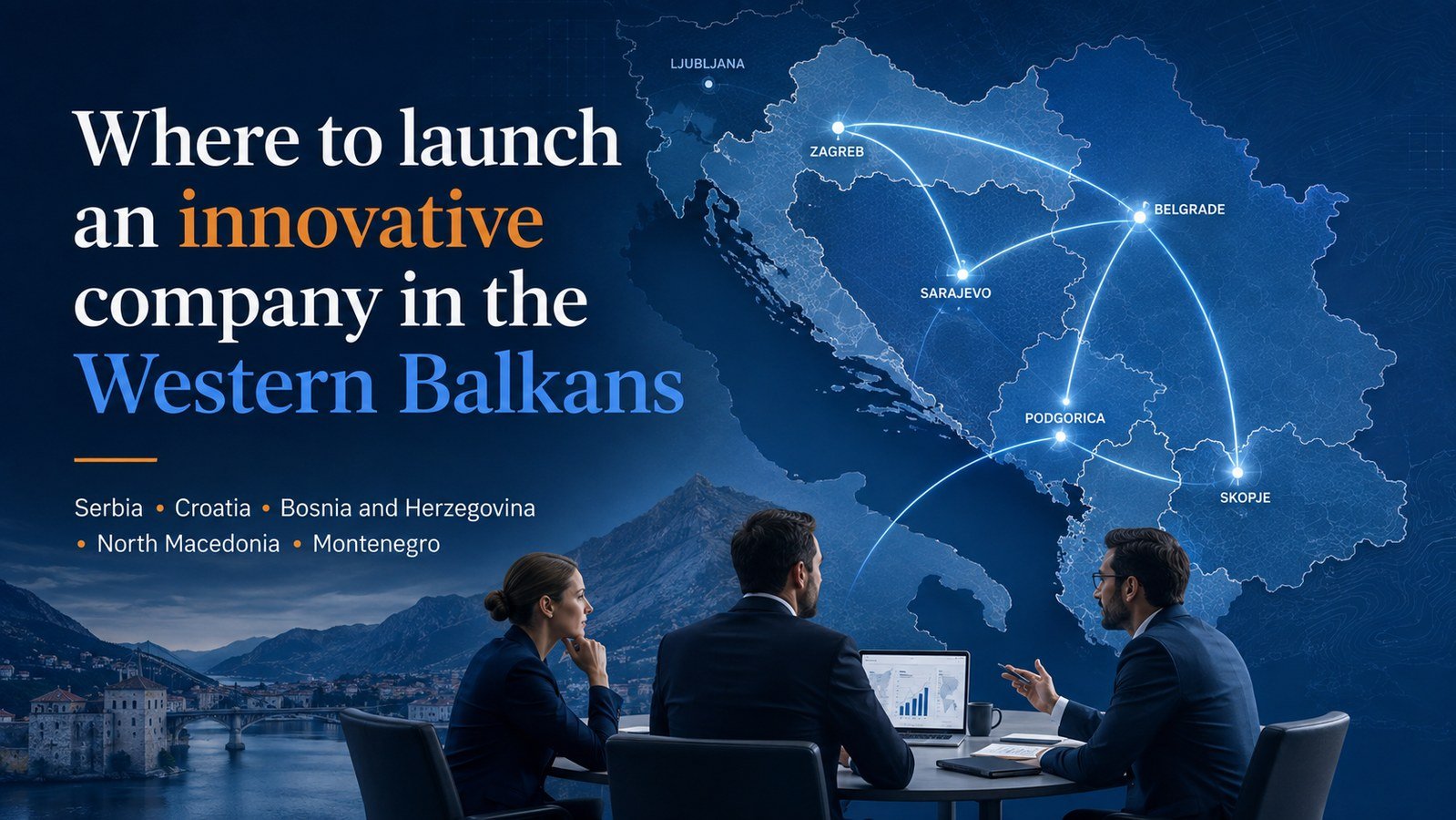
Choosing the best location for an innovative company in the Balkans is not a branding exercise. It is a decision about tax, access to customers, regulation, hiring, banking, incentives and the amount of friction management is prepared to absorb.
Serbia, Croatia, Bosnia and Herzegovina, North Macedonia and Montenegro are often presented as if they belonged to one business environment. They do not. The headline tax rate may look similar, but the practical difference between operating from Belgrade, Zagreb, Sarajevo, Skopje or Podgorica can be substantial.
This guide is designed for founders and international companies that are not merely asking where incorporation is cheapest, but where the business itself has the best chance of working.
Serbia is usually the most balanced choice for regional operations, software, engineering and companies that need depth of talent. Croatia is stronger when EU positioning, euro payments, legal familiarity and access to European programmes matter more than cost. North Macedonia is highly competitive for manufacturing, technical services and companies that can use its industrial zones. Montenegro works best for small, international, tourism-linked or remote-first businesses, not for companies that need a large labour market. Bosnia and Herzegovina can be cost-effective and technically capable, but only for management teams willing to handle a fragmented legal and administrative system.
Innovative company in the Balkans: comparison at a glance
| Country | Corporate tax | Standard VAT | Best suited to | Main weakness |
|---|---|---|---|---|
| Serbia | 15% | 20% | Software, engineering, regional headquarters, tradable services, industrial technology | Outside the EU; banking and cross-border structuring require care |
| Croatia | 10% below €1m revenue; 18% from €1m | 25% | EU-facing SaaS, deep-tech, regulated products, tourism technology, high-value services | Higher labour and operating costs |
| Bosnia and Herzegovina | 10% | 17% | Engineering, outsourced development, manufacturing support, cost-sensitive operations | Fragmented laws, registrations and incentives |
| North Macedonia | 10% | 18% | Manufacturing, export services, technical centres, companies using TIDZ zones | Small domestic market and limited local capital |
| Montenegro | Progressive 9%–15% | 21% | Tourism, hospitality technology, remote-first firms, boutique international services | Very small talent and customer base |
These are headline rates. The effective burden depends on payroll, dividend treatment, deductions, incentives, tax treaties and the way revenue is generated. Any final structure should be reviewed locally before incorporation.
Serbia: the strongest all-round operating base
For an innovative company in the Balkans, Serbia is often the first country international founders examine, and not only because Belgrade has become the region’s most visible business hub. It combines a relatively large labour market, a strong engineering tradition, lower costs than most EU capitals and a growing network of innovation institutions.
The standard corporate income tax rate is 15%. That is not the lowest rate in this comparison, but Serbia offers incentives that can matter more than the headline number for an innovative company. The official startup support portal highlights an IP Box regime that can reduce the effective tax on qualifying income from intellectual property developed in Serbia, an increased deduction for eligible R&D costs, reliefs connected with founders and new employment, and a 30% tax credit for corporate investors that invest in qualifying innovative startups.
Those incentives are not automatic. The IP must be developed and protected correctly, R&D expenses must be documented, and the definition of an innovative startup is subject to conditions. The investor tax credit, for example, is tied to Article 50j of the Corporate Income Tax Law and includes limits on ownership, company age, revenue and the use of profits.
What opening a company looks like
Since May 2023, Serbian companies such as limited liability companies must be incorporated electronically through the Serbian Business Registers Agency. In practice, a foreign founder usually works through a Serbian lawyer or registration agent because the filing system requires a qualified electronic certificate accepted in Serbia. The one-stop registration process also assigns the registration number and tax identification number.
The formal registration can be quick. The parts that deserve more attention are the bank account, beneficial-owner registration, employment documentation and any residence or work status for foreign directors.
Where Serbia is strongest
Belgrade is the logical choice for sales, management, professional services, fintech relationships and companies that need to recruit experienced people. Novi Sad is often more attractive for engineering, software development and university links. Niš can offer lower costs and technical talent, but the senior hiring pool is narrower.
Serbia is particularly credible for SaaS, AI, enterprise software, industrial technology, engineering services and regional headquarters. It is also useful for companies trading across the Western Balkans or combining Balkan operations with Türkiye and Central Europe.
Where founders miscalculate
The domestic market is too small for most venture-scale companies to rely on Serbian customers alone. A startup should usually be international from the beginning. Another common mistake is to assume that every investment incentive is available to an early-stage software company. Serbia’s large cash-grant programmes and ten-year corporate tax holiday are mainly designed for substantial projects, especially manufacturing and internationally tradable services. The ten-year holiday requires an investment exceeding roughly €8.5 million and more than 100 new employees.
Serbia is a strong choice when
The company needs engineers, a regional commercial base, access to a larger Western Balkan labour market and the possibility of using R&D or IP incentives. It is less convincing when the business must be incorporated inside the EU for regulatory, investor or procurement reasons.
Croatia: more expensive, but structurally easier for EU business
For an innovative company in the Balkans that needs EU positioning, Croatia is not the cheapest jurisdiction in the region, and it should not be sold as one. Its advantage is different: the company operates inside the European Union, the euro area and Schengen. For a business selling to EU customers, raising money from EU investors or working in a regulated field, that can remove more friction than a lower corporate tax rate elsewhere.
The corporate income tax rate is 10% for companies with annual revenue below €1 million and 18% from that threshold upward. The standard VAT rate is 25%. A simple limited liability company can be formed with nominal capital of €1, although founders should not confuse low statutory capital with the real funds required to operate.
Foreign founders can establish a Croatian company under substantially the same conditions as domestic investors, but the fully integrated START system is not available in the same way to every foreign applicant. Non-resident founders may still need physical steps, a Croatian personal identification number and local professional support.
Why Croatia can justify the higher cost
For an EU-facing SaaS company, Zagreb offers a clearer legal and commercial position than a non-EU base. Contracts, VAT treatment, employment and access to European programmes are easier to explain to international investors and customers. Croatia also has credible technical talent and a growing number of companies with international product experience.
The Investment Promotion Act can reduce corporate tax and provide grants for qualifying investment projects, but the thresholds matter. A micro-enterprise normally needs at least €50,000 in eligible fixed-asset investment and three new jobs. For an ICT or software development centre, the minimum investment may also start at €50,000, but the employment threshold is higher. Applications must be submitted before the investment begins.
Croatia’s R&D support is more relevant to innovative companies. Amendments effective from 2025 increased the additional reductions of the tax base to 400% of eligible basic-research costs, 300% for industrial research, 250% for experimental development and 300% for feasibility studies. The economic value depends on taxable profit and project eligibility; it is not a cash grant automatically paid to a loss-making startup.
Best locations
Zagreb offers the deepest management, technology and investor network. Rijeka can be attractive for logistics, maritime activities and industrial projects. Split is relevant for tourism technology, hospitality and remote-first businesses, but its housing market and seasonality can complicate hiring. Osijek has lower costs and a smaller but active technology community.
Bosnia and Herzegovina: low taxes, real talent and a difficult operating map
An innovative company in the Balkans can benefit from Bosnia and Herzegovina’s costs and talent, but the country cannot be analysed as one uniform jurisdiction. The country has a state-level framework, but company law, corporate tax, labour rules and many incentives are managed separately in the Federation of Bosnia and Herzegovina, the Republic of Srpska and the Brčko District. Within the Federation, cantons can add another layer.
The headline numbers are attractive: corporate income tax is 10% and VAT is 17% across the country. Foreign investors receive national treatment under the Law on the Policy of Foreign Direct Investments and may repatriate profits and investment proceeds. Yet the administrative experience depends heavily on where the company is established.
Federation or Republic of Srpska?
In the Federation, company formation normally involves a notarised founding act, payment of capital, registration with the competent court, opening a bank account and registration with the tax authorities. The official target for the court stage is five days, but the complete process can take longer once banking, permits and municipal requirements are included.
In the Republic of Srpska, registration is channelled through APIF, which combines court registration with tax and statistical registration. The official registration step is described as taking three days. For investors, the difference is not merely procedural: the two entities also have different employment rules, personal income taxes and incentive programmes.
The Republic of Srpska introduced updated investment incentives in 2025. Eligible companies making investments of at least BAM 50,000 excluding VAT may apply for support for technological advancement and the green or circular transition, subject to de minimis limits. Manufacturing companies investing in equipment and facilities may also reduce their corporate tax base by the value of qualifying investment. The Federation relies more heavily on annual federal and cantonal programmes, including support for newly established companies, employment, training and entrepreneurial infrastructure.
Where Bosnia makes sense
Sarajevo has the strongest concentration of professional services, international institutions and a growing software sector. Banja Luka offers a simpler administrative environment for some businesses and lower costs. Mostar is relevant for tourism, engineering and companies linked to Croatia or the Adriatic region. Tuzla and Zenica retain industrial competence that can matter for manufacturing and technical services.
Bosnia is credible for outsourced software development, engineering teams, industrial design, specialised production and businesses where cost matters more than immediate access to venture capital. It is less suitable for founders who want a single digital procedure, uniform rules and predictable administration across the country.
The Bosnia rule
Do not select “Bosnia and Herzegovina” in the abstract. Select the exact entity, canton and municipality. A tax or incentive advantage in Banja Luka may not exist in Sarajevo, and a procedure described for the Federation may not apply in the Republic of Srpska.
North Macedonia: the most aggressive industrial proposition
For an innovative company in the Balkans focused on industrial production, North Macedonia has one of the clearest low-tax propositions in the region. Corporate income tax is 10%, personal income tax is generally 10% and the standard VAT rate is 18%. Small and micro companies with annual income up to MKD 3 million can qualify for exemption from profit tax, while companies between MKD 3 million and MKD 6 million may choose a simplified 1% tax on total income instead of the standard profit-tax regime.
A standard limited liability company requires minimum share capital of €5,000. The Central Registry operates a one-stop system and official investor guidance states that formation can be completed in two to three business days in practice. Foreign investors receive the same basic right to establish companies as domestic investors.
The real differentiator: TIDZ zones
North Macedonia’s Technological Industrial Development Zones are aimed at serious productive investment, not ordinary coworking startups. Qualifying users can receive a ten-year exemption from corporate and personal income tax, VAT and customs relief on specified imports, low-cost long-term land leases, infrastructure connections and potential support for capital expenditure.
For a manufacturer, electronics company, automotive supplier, engineering centre or export-oriented technical service, these benefits can change the economics of a project. For a five-person SaaS company, they are usually less relevant than the general tax regime and labour market.
The Law on Financial Support for Investments also provides support for productive initial investments, revenue growth, competitiveness and employment, based on statutory conditions and an agreement with the government. A company should not assume approval until its project has been reviewed against the law and the current programme.
Where to locate
Skopje is the default choice for technology, professional services, banking and management. Štip, Prilep, Bitola and locations near industrial zones can be more interesting for production and labour-intensive operations. The country’s central position is useful for serving Serbia, Bulgaria, Greece, Albania and Kosovo, although border procedures remain relevant because North Macedonia is not an EU member.
The main constraint is scale. The domestic customer base is small, senior talent is limited and local venture funding is not deep. A company should enter North Macedonia with an export model, not discover later that the local market cannot support its growth.
Montenegro: efficient for a small company, difficult for a large one
A small innovative company in the Balkans may find Montenegro attractive because it uses the euro, has a simple corporate structure and offers one of the lowest tax burdens in the region for modest profits. Corporate income tax is progressive: 9% on profit up to €100,000, then a 12% band, rising to 15% for higher profit levels. The standard VAT rate is 21%.
Registration fees are low and the official investment portal presents the limited liability company as a relatively straightforward structure. In practice, founders still need to complete bank, tax, beneficial-owner and, where relevant, residence and work procedures.
The country also maintains an inventory of investment incentives. The 2025 register listed 55 measures aimed at SMEs, innovators, entrepreneurs and investors. Newly established production businesses in underdeveloped municipalities may qualify for an eight-year corporate tax exemption, capped at €200,000 over the period.
Montenegro has also developed a legal framework for innovation and research incentives. The existence of a framework does not mean every startup receives a tax holiday. Status, registration and programme-specific conditions must be checked before the business plan includes any benefit.
Where Montenegro works
Podgorica is the practical base for administration, banking and year-round hiring. Budva, Kotor and Tivat are relevant for hospitality, premium tourism, property technology, mobility and international lifestyle services, but costs and seasonality are high. Bar is more relevant for logistics and port-related activity.
Montenegro is well suited to boutique consulting, remote-first companies, travel technology, hospitality services, yacht and marina services, small international agencies and founders who value the euro and a simple operating environment.
It is a weak choice for companies that need to recruit dozens of specialised employees locally. The total labour market is small, and experienced technical or managerial staff can be difficult to find. Foreign founders who intend to work in the company also need to consider temporary residence and work-permit rules, not merely company ownership.
Which country fits which business?
| Business model | First choice | Alternative | Reason |
|---|---|---|---|
| SaaS / enterprise software | Serbia | Croatia | Serbia offers talent and R&D incentives; Croatia offers EU legal and commercial positioning |
| Deep-tech / regulated innovation | Croatia | Serbia | EU programmes and regulation favour Croatia; Serbia can be stronger for engineering cost and development |
| Manufacturing / industrial technology | North Macedonia | Serbia | TIDZ zones and low tax are powerful; Serbia offers a larger supplier and labour base |
| Outsourced engineering / development centre | Bosnia and Herzegovina | Serbia | Bosnia can reduce cost; Serbia offers greater scale and simpler regional management |
| Tourism / hospitality technology | Croatia | Montenegro | Croatia has scale and EU access; Montenegro offers a concentrated premium tourism market |
| Small international consulting or remote-first firm | Montenegro | Serbia | Montenegro offers euro simplicity and low tax; Serbia provides more talent and infrastructure |
A practical selection process
A responsible comparison should begin before lawyers prepare incorporation documents.
- Define the first customers. Identify where contracts will be signed, which currency will be used and whether EU establishment is commercially necessary.
- Build the real employment budget. Compare gross salary, employer contributions, recruitment fees, office costs and retention—not only net wages.
- Pre-screen the bank account. A legal company without a functioning bank account is not an operating company. Foreign ownership, shareholder nationality and expected transactions should be discussed before incorporation.
- Verify incentive eligibility in writing. Check the legal basis, application deadline, excluded activities, minimum investment, job obligations and maintenance period.
- Separate startup incentives from investment incentives. A grant for a young software company is not the same as state aid for a factory employing 100 people.
- Model the exit and future financing. Consider whether investors will accept the jurisdiction, how shares can be transferred and where intellectual property should be owned.
- Choose the city, not only the country. Belgrade and Niš, Zagreb and Osijek, Sarajevo and Banja Luka, Skopje and Štip, Podgorica and Tivat offer very different labour and cost structures.
Final assessment
There is no universally best country for an innovative company in the Balkans.
Serbia is the strongest general-purpose base. Croatia is the clearest EU platform. North Macedonia has the most aggressive industrial proposition. Montenegro is efficient for a small international business. Bosnia and Herzegovina can offer genuine cost and talent advantages, but only to companies prepared to manage institutional complexity.
The wrong decision usually comes from focusing on the easiest number to compare: the corporate tax rate. The right decision comes from comparing the complete operating system—customers, talent, regulation, banking, incentives, funding and the ability to scale.
A 9% or 10% tax rate is not an advantage if the company cannot hire, open the right bank account, qualify for the promised incentive or sell to its target market. The best location is the one that removes the largest strategic constraint from the business model.
Choosing where to launch or expand in the Balkans?
Inspira’s Market Validation Sprint helps founders and international companies compare real market demand, buyers, competition, route to market and operating constraints before choosing a country, city or legal structure in Southeast Europe.
Continue exploring Balkan business markets
Use BalkansNetwork’s regional coverage to compare the wider operating environment before choosing a jurisdiction.
Official sources
- Serbian Business Registers Agency — company registration
- Serbia Startup Portal — tax benefits and incentives
- Development Agency of Serbia — investment incentives
- Invest Croatia — tax system
- Invest Croatia — Investment Promotion Act incentives
- Invest Croatia — R&D state aid
- FIPA Bosnia and Herzegovina — taxes
- FIPA Bosnia and Herzegovina — business establishment
- FIPA Bosnia and Herzegovina — investor incentives
- North Macedonia Ministry of Finance — profit tax
- Invest North Macedonia — company registration
- Invest North Macedonia — TIDZ zones
- Government of Montenegro — taxation and incentives
- Montenegrin Investment Agency — incentive inventory
- Government of Montenegro — foreign employment and work permits