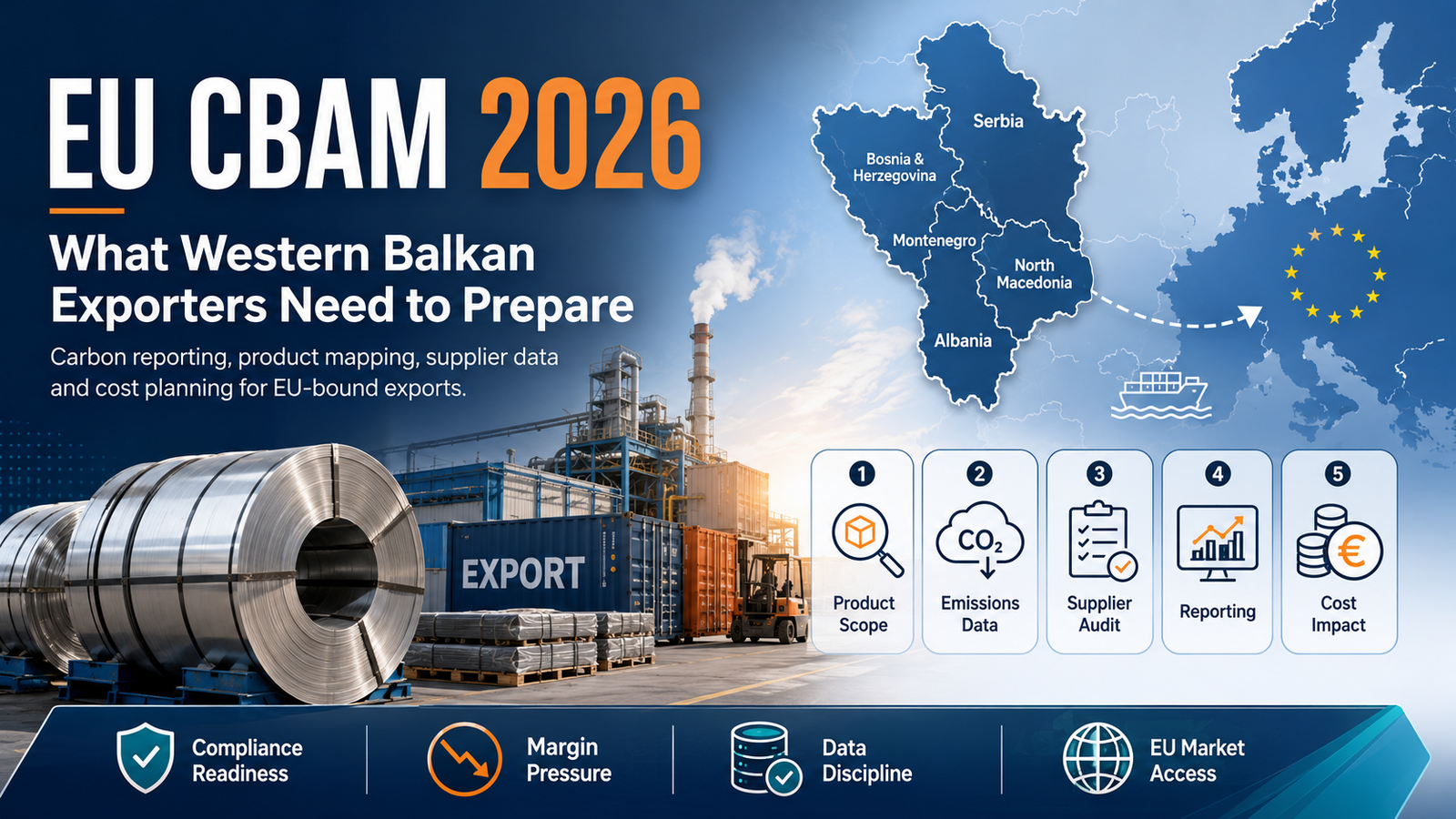
CBAM became a commercial issue on 1 January 2026, not an environmental footnote. For Western Balkan producers selling carbon-intensive goods into the European Union, the quality of emissions data can now influence whether an EU customer can import, price and defend the transaction.
The legal obligation sits mainly with the EU importer, but a supplier that cannot provide usable installation and emissions data may become commercially difficult to buy from.
What changed in 2026
The EU Carbon Border Adjustment Mechanism entered its definitive regime on 1 January 2026. During the transitional period, importers reported embedded emissions without buying certificates. Under the definitive system, authorised CBAM declarants must report emissions and surrender certificates linked to the carbon content of imported goods.
The covered sectors include cement, iron and steel, aluminium, fertilisers, electricity and hydrogen, together with selected downstream products listed in the regulation. Classification depends on the customs code, not the marketing description.
The 50-tonne threshold changes who must apply
The simplified regime introduced a single mass-based threshold of 50 tonnes per importer per calendar year for most CBAM goods. EU importers—or their indirect customs representatives—above that threshold must obtain authorised CBAM declarant status.
The threshold does not make emissions data irrelevant for smaller suppliers. Buyers may consolidate volumes from several producers, exceed the limit during the year or require data as part of procurement and sustainability systems even before a legal filing is due.
| Actor | Formal responsibility | Practical requirement |
|---|---|---|
| EU importer / indirect representative | Authorisation, declaration and certificate surrender | Needs reliable product quantities, origin, installation and verified embedded-emissions data. |
| Western Balkan producer | No direct certificate surrender in the EU | Must calculate and document emissions in a form the importer and verifier can use. |
| Non-EU installation operator | Can register in the O3CI module | Uploads installation and emissions information once and shares it with declarants. |
| Verifier | Checks declared embedded emissions | Requires traceable methodology, source data, production boundaries and supporting records. |
Why exporters should use the O3CI registry
The Commission’s module for Operators of Third-Country Installations allows non-EU producers to upload installation and emissions data and share it with authorised declarants. This is more efficient than rebuilding the same information for every importer.
Registration is not a substitute for correct data. The exporter still needs a documented calculation boundary, production volumes, fuel and electricity data, precursor information where relevant and evidence that can survive verification.
Actual values are commercially better than blind default values
An importer may be able to use default values in certain circumstances, but defaults are not automatically favourable. A producer with efficient equipment, lower-carbon electricity or a credible carbon price may lose its advantage if it cannot prove actual performance.
The emissions file should therefore be treated as part of the product documentation, alongside specifications, certificates, origin documents and quality records. Sales teams should know what data exists and how quickly it can be supplied.
How the certificate cost works
CBAM certificate prices are linked to EU Emissions Trading System allowance prices. For 2026 emissions, the Commission calculates a quarterly average for the quarter in which the goods were imported. From 2027, prices move to a weekly calculation.
The first declaration covering 2026 imports is due in 2027, and the current consolidated rules provide for surrender by 30 September 2027. A carbon price effectively paid in the country of origin may reduce the number of certificates, provided it can be demonstrated under the rules.
Exporters should not promise a precise CBAM cost using only today’s carbon price. The cost depends on the customs code, embedded emissions, import quarter, free-allocation phase-out, verified carbon price paid at origin and the importer’s compliance position.
The hidden commercial risk
A producer may remain technically capable of exporting while becoming unattractive to buyers because its data arrives late, changes between shipments or cannot be verified. CBAM readiness is now part of supplier reliability.
A 90-day exporter action plan
Weeks 1–2: map every EU-bound product to its CN code and confirm whether it is covered. Identify the EU importer of record and expected annual volume.
Weeks 3–5: define the installation boundary, production routes, direct emissions, electricity consumption and relevant precursors. Assign one internal owner for CBAM data.
Weeks 6–8: test the calculation with the importer or its adviser. Register the installation in O3CI when appropriate and prepare supporting documents.
Weeks 9–12: integrate CBAM fields into quotations, contracts and shipment documentation. Agree who pays for verification, how corrections are handled and what happens if data is unavailable.
What contracts should address
Export contracts should define the information the supplier must provide, the deadline, the calculation method, confidentiality, audit access and liability for inaccurate data. They should also state whether the price can be adjusted if the importer’s certificate cost changes.
A vague clause requiring “all CBAM documents” is not enough. The parties need an operating procedure that works shipment after shipment.
The bottom line for Balkan manufacturers
CBAM does not automatically make Western Balkan products uncompetitive. It makes carbon intensity and data quality more visible. Efficient producers can use that transparency as an advantage—if they can prove it.
The companies most exposed are not necessarily those with the highest emissions. They are the ones that wait for an EU customer to request data and then discover that production, energy and accounting systems were never designed to produce it.