North Macedonia can offer a foreign manufacturer more than low cost. Its real value is the combination of export-oriented industrial zones, established automotive and electronics supply chains, proximity to EU and Turkish markets and a relatively compact operating environment.
The incentive package can improve a good project. It cannot rescue a factory with the wrong labour location, weak supplier depth, uncertain utilities or an export model that depends on one customer.
Why North Macedonia belongs on a regional shortlist
The country sits on the main north–south route between Serbia and Greece and has road access toward Bulgaria, Albania and Kosovo. Skopje is the principal management, services and logistics centre. Industrial zones around Skopje, Štip, Prilep, Struga, Kičevo and other locations support different manufacturing models.
North Macedonia is not a large domestic consumer market. Its investment proposition is production for export. Automotive components, electrical systems, textiles, food processing, metalworking, pharmaceuticals and technology services form the strongest operating base.
That export orientation is visible in the automotive sector. Invest North Macedonia states that automotive-component companies accounted for 46% of national exports in 2022 and generated €3.82 billion in exports. The figure is historical rather than a 2026 forecast, but it demonstrates how strongly several large industrial investors shape the country’s trade structure.
| Decision area | Potential advantage | What must be verified |
|---|---|---|
| TIDZ location | Long-term land lease, infrastructure support and tax/customs incentives | Exact zone readiness, utilities, incentive approval and construction timetable. |
| Labour | Manufacturing experience and technical skills | Commuting area, turnover, shift availability, training time and wage inflation. |
| Trade access | Agreements with the EU, CEFTA, EFTA, Türkiye and Ukraine | Rules of origin, product certification and customer-specific requirements. |
| Logistics | Access toward Thessaloniki, Serbia and regional markets | Border variability, rail options, driver capacity and winter resilience. |
| Banking and tax | Competitive headline tax environment | Account opening, transfer pricing, VAT cash flow and incentive conditions. |
What the TIDZ incentives can include
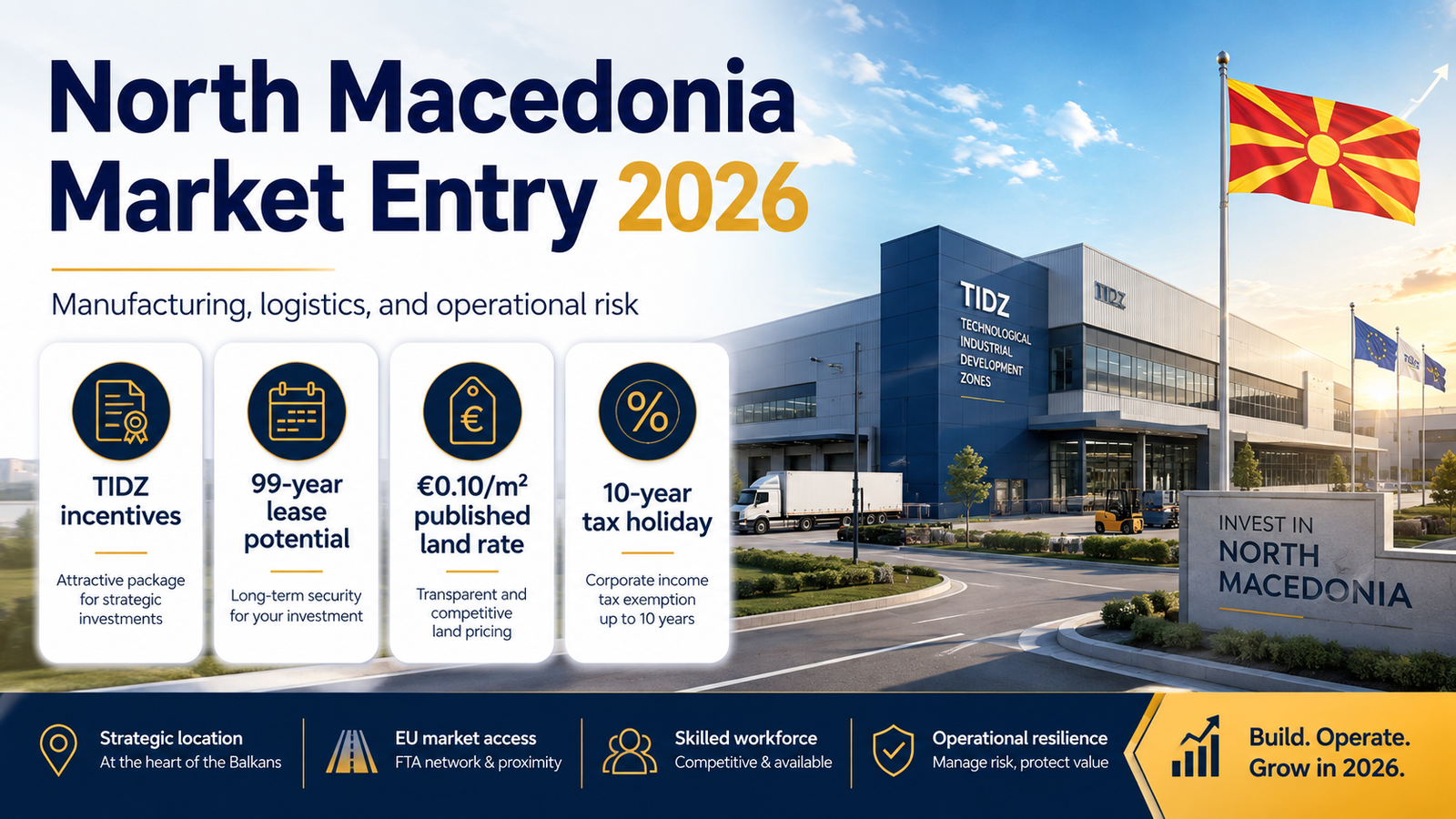
The official investment agency describes land in Technological Industrial Development Zones as available through long-term lease for up to 99 years at €0.10 per square metre per year. It also lists free connections to certain utility networks, exemption from municipal utility taxes and building-permit fees, and a ten-year corporate and personal income-tax holiday for qualifying zone users.
Additional benefits may include VAT treatment for imports and trade inside the zones, customs-duty exemptions for equipment and support linked to capital investment. These are promotional descriptions of the available framework, not an automatic entitlement for every project.
An investor should obtain a written, project-specific incentive decision. The document should define eligible expenditure, investment and employment commitments, payment timing, reporting, audit rights, clawback and what happens if the business plan changes.
Choosing a TIDZ is an operating decision, not a tax decision
A zone close to Skopje may offer deeper labour, management and supplier access but stronger competition for employees. A secondary-city location may provide lower labour pressure and municipal support, while requiring more training, transport and management travel.
The factory’s labour catchment should be mapped by real commuting time. A radius on a map is not enough. Shift work depends on buses, road quality, seasonal weather and whether employees can reach the site before public transport begins.
Utilities require similar verification. Ask for current available electrical capacity, redundancy, planned upgrades, gas pressure, water quality, wastewater conditions and the contractually responsible provider. “Infrastructure available” does not always mean “capacity reserved for this project.”
Automotive experience creates both capability and concentration risk
North Macedonia hosts more than 50 companies across automotive and machine components, according to the investment agency. Products include wiring systems, electronics, safety systems, seats, catalysts, precision plastics, aluminium and zinc castings and printed circuit boards.
This creates a trained workforce and supplier culture familiar with quality systems, traceability and export production. It also creates exposure to the European automotive cycle. A new plant should test whether local wages and recruitment assumptions remain realistic when several manufacturers expand at the same time.
Non-automotive investors can benefit from transferable skills in cable assembly, plastics, machining, quality control and industrial maintenance. They should not assume that every automotive worker is immediately available or that skills transfer without training.
Rules of origin are more important than the list of trade agreements
North Macedonia promotes access to a duty-free market of hundreds of millions of consumers through its trade agreements. The commercial benefit depends on origin.
Importing components from Asia, performing limited assembly and exporting to the EU does not automatically create preferential Macedonian origin. Bill of materials, tariff classification, processing rules and supplier declarations must be modelled before the factory is located.
A project can be competitive on labour and lose the advantage through customs duty because the production step does not satisfy the required transformation rule.
The incentive trap
Do not record the full value of an incentive as guaranteed project income. Model the timing, eligibility conditions, audit risk and possibility that employment or capital commitments are not met exactly as planned.
Logistics: Thessaloniki is an advantage only when the inland route works
Access to the Port of Thessaloniki can support Asian and Mediterranean supply chains. The corridor also connects north through Serbia toward Central Europe.
Importers should obtain actual transit data for the border, terminal and final delivery. Rail can improve scale, while truck transport offers flexibility. The correct mix depends on volume, equipment, production schedule and the cost of a missed line stop.
Dual-route planning is sensible for critical components. A manufacturer may use Thessaloniki as the primary gateway and maintain tested alternatives through the Adriatic or Bulgarian routes.
Banking, currency and working capital
Company registration is not the same as a functioning bank relationship. Foreign founders should present the ownership structure, source of funds, expected customers, suppliers, countries and currencies before incorporating.
The Macedonian denar is managed against the euro, which supports planning, but local wages, taxes and costs still create currency exposure. Exporters should model receivables, import payments, VAT recovery and inventory financing rather than focusing only on the nominal exchange-rate regime.
A safer market-entry sequence
- Define the product and origin model. Confirm tariff codes, trade-agreement eligibility and customer certification.
- Shortlist locations by labour and logistics. Add incentives only after the operating shortlist is credible.
- Request written utility capacity. Include commissioning dates and expansion requirements.
- Negotiate the incentive agreement. Model cash timing and clawback, not only the headline value.
- Pre-screen banking. Test the real transaction profile with more than one bank.
- Run a supplier-development plan. Separate components that can be localised from those that must remain imported.
- Build a recruitment pilot. Hire and train a first team before the main production ramp.
Who should consider North Macedonia
The strongest fit is for export-oriented manufacturing with medium labour intensity, manageable energy requirements and products that benefit from proximity to European customers. Automotive, electrical, electronics, precision plastics, metal processing, food and selected technology operations are natural candidates.
The country is less suitable for a project that depends on a large domestic consumer market, very deep local capital markets or immediate access to a broad pool of highly specialised senior managers outside Skopje.
The bottom line
North Macedonia is a serious manufacturing location when the project is designed around exports, labour geography and corridor logistics. Its industrial zones and incentives can improve capital efficiency and accelerate setup.
The best investors will treat the country as an operating system, not a tax package. The factory succeeds when workforce, suppliers, origin, utilities, logistics and financing work together after the incentive presentation is over.