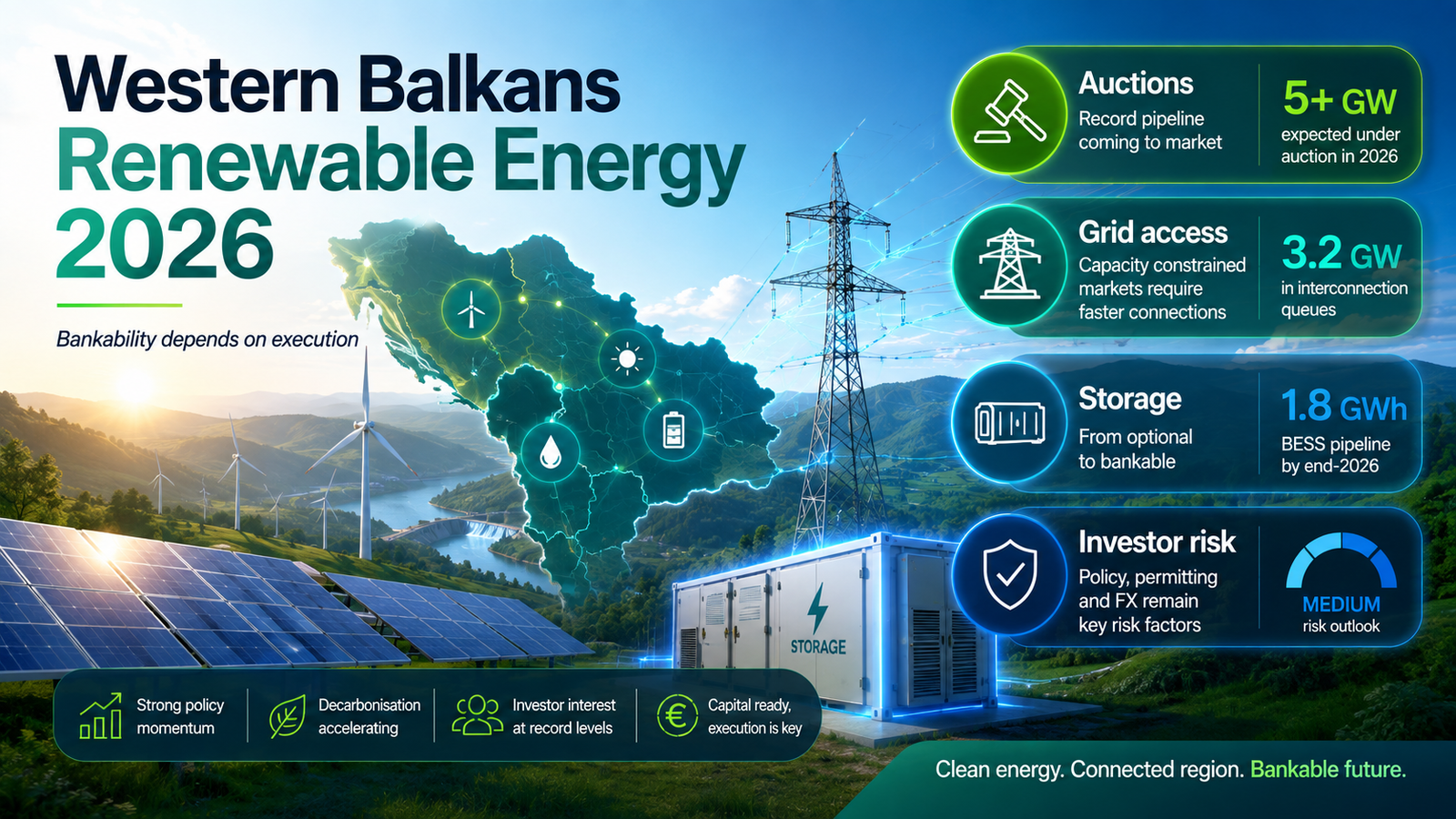
The Western Balkans no longer lack renewable-energy ambition. The constraint in 2026 is execution: projects must secure land, permits, grid capacity, bankable revenue and a credible route through increasingly integrated European electricity markets.
A good solar or wind resource does not create a bankable project by itself. Grid access, curtailment rules, balancing cost, permitting and offtake structure decide whether the asset produces value.
The market is moving from targets to competitive allocation
Across the region, renewable capacity is increasingly being developed through auctions, market-based premiums and private power-purchase agreements rather than simple administrative feed-in tariffs. This is a healthier direction, but it transfers more risk to developers.
The Energy Community’s 2025 implementation assessment described a real transition: renewable deployment is expanding, national energy and climate plans are advancing and power-market integration is becoming central. Progress remains uneven. Serbia and Moldova had completed full transposition of the Electricity Integration Package, while other contracting parties still faced gaps affecting market coupling and investment confidence.
For investors, the region should therefore be analysed project by project and country by country. A headline target does not reveal whether a grid connection is available or whether a permit can survive judicial review.
| Risk layer | What investors should verify | Why it changes value |
|---|---|---|
| Grid connection | Reserved capacity, connection timetable, reinforcement cost and queue rules | A permitted project without a firm connection can remain stranded for years. |
| Revenue | Auction premium, PPA credit quality, merchant exposure and indexation | Small pricing assumptions create large changes in debt capacity and equity returns. |
| Permitting | Land title, spatial plan, environmental assessment and community consultation | Weak early documentation creates litigation and refinancing risk. |
| Balancing and curtailment | Responsibility, pricing, forecast tolerance and compensation rules | Variable generation can lose revenue even when the plant is technically available. |
| Storage | Connection treatment, market access, degradation and revenue stacking | A battery is valuable only if the rules allow it to earn from several services. |
Grid capacity is becoming the scarce asset
Solar modules and wind turbines can be procured. Transmission capacity cannot be delivered as quickly. Many national systems were designed around centralised thermal or hydropower generation, not hundreds of variable projects seeking connection at the same time.
Developers should demand more than a preliminary connection opinion. The due-diligence file should show the exact substation, available capacity, reinforcement works, cost allocation, expected energisation date and what happens if another project enters the queue.
Regional interconnection matters as well. In April 2026, the Energy Community Regulatory Board reported that six priority cross-border projects—five transmission projects and one storage project—were progressing without systemic delay, although permitting, financing and cost pressures remained material risks.
Auctions improve transparency but do not remove project risk
A competitive auction can provide a long-term revenue framework and reduce political discretion. It can also encourage aggressive bidding. A developer that wins with an unrealistically low price may later struggle with equipment inflation, interest rates, connection costs or local construction conditions.
Investors should reconstruct the winning bid using current capital expenditure, financing terms, degradation, balancing cost and realistic production. If the project works only under perfect conditions, the tariff is not bankable—it is a future renegotiation risk.
The strongest auction programmes combine clear prequalification, firm connection arrangements, transparent indexation and penalties that discourage speculative capacity hoarding.
Corporate PPAs are useful, but the buyer matters
Industrial companies across Southeast Europe increasingly want renewable electricity for cost visibility, customer requirements and emissions reporting. This creates opportunities for private PPAs.
A PPA is not automatically safer than merchant exposure. The buyer’s credit, consumption profile, termination rights, collateral and ability to absorb price variation matter. A ten-year agreement with a weak counterparty can be less financeable than a shorter contract with a strong international industrial group.
Cross-border PPAs may become more important as markets integrate, but transmission rights, guarantees of origin, balancing and legal enforceability must be designed carefully.
Storage is moving from optional to strategic
As solar capacity rises, midday prices can weaken and evening scarcity can increase. Batteries can shift production, provide balancing services and support grid stability. Their business case depends on market rules.
A project model should not count the same capacity twice. Energy arbitrage, balancing, capacity and grid services may be technically compatible but contractually restricted. Battery degradation, replacement strategy and warranty conditions must also be included.
The Energy Community’s priority-project list includes a storage project, showing that storage is becoming part of regional infrastructure planning rather than an isolated technology experiment.
The most expensive renewable project
It is not the project with the highest construction cost. It is the project that secures land and permits before discovering that the grid, revenue contract or local acceptance cannot support financing.
Permitting reform is now an investment issue
Slow permitting is often described as bureaucracy. In reality it is a capital-allocation problem. Development teams spend money for years before knowing whether the project can reach construction.
The Energy Community’s 2025–2026 work on renewable acceleration areas and one-stop-shop permitting reflects this bottleneck. Faster procedures can help, but speed must not replace environmental quality or community engagement. Weak consultation creates legal and reputational risk later.
Investors should map every approval, authority, appeal route and statutory deadline. A local partner who understands municipal planning and land ownership can be more valuable than a generic national adviser.
Country differences matter
Serbia has the region’s largest power market and stronger reform momentum, but connection queues and balancing exposure require careful modelling. Albania combines strong solar potential with a hydro-dominated system, creating both complementarity and hydrological risk.
North Macedonia has attracted solar investment and offers industrial demand, while grid and land selection remain decisive. Montenegro has wind, solar and hydropower opportunities but a smaller domestic market. Bosnia and Herzegovina has significant resource potential, yet fragmented institutions and permitting layers can slow execution. Kosovo needs new capacity and system modernisation, but investors must assess market and political risk carefully.
A disciplined investment sequence
- Secure the site conditionally. Avoid paying full land value before grid and planning feasibility are established.
- Validate the connection independently. Model reinforcement, delay and curtailment scenarios.
- Select the revenue structure. Auction, PPA, merchant or a combination must match financing and risk appetite.
- Complete environmental and community work early. Do not treat consultation as a final administrative step.
- Stress-test the model. Use lower production, higher balancing cost, delayed commissioning and weaker prices.
- Plan refinancing and exit. Define what institutional investors will require after construction.
The bottom line
The Western Balkans can become an important renewable-energy region because it combines resources, industrial demand and proximity to the EU market. The investment case is real.
The next phase will reward developers who understand electricity systems, not only real estate and construction. Grid access, market integration, storage and credible permitting will separate operating assets from speculative project pipelines.