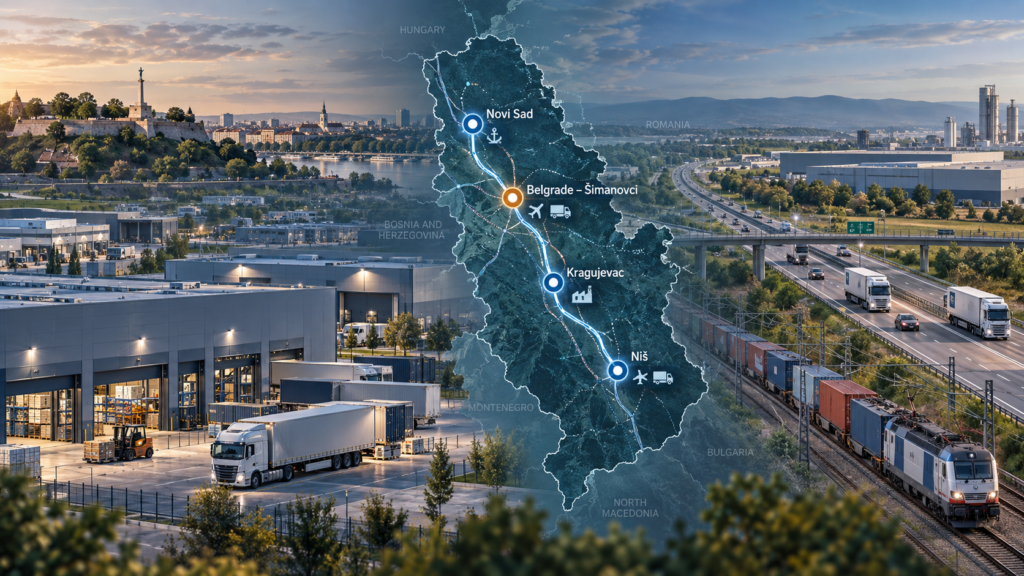
For shippers assessing Danube Inland Ports in Serbia, Croatia and Bosnia and Herzegovina, the available evidence supports a shipment-specific decision rather than a league table. Serbia provides the strongest comparable throughput data; Vukovar documents rail access and specialist handling assets; and Brčko has completed terminal modernisation but retains a material Sava navigation caveat. The practical choice is the gateway that can confirm cargo acceptance, the required customs procedure, an executable rail or road connection and a priced fallback. No supplied dataset establishes a common current ranking, route-price benchmark, transit time or berth-availability comparison across all five gateways.
What the Danube Inland Ports data can compare
The latest annual evidence now comes from the Danube Commission’s 2025 market observation, published in 2026. Its port-level table reports 3.068 million tonnes at Smederevo, 787,000 tonnes at Novi Sad and 142,000 tonnes at Belgrade in 2025. The Serbia section contains an internal total mismatch: the narrative states 13.313 million tonnes and 104% of 2024, while Table 3.11 records 12.280 million tonnes. This comparison therefore uses the explicit port-level figures in Table 3.12 and does not derive a national growth rate from the conflicting total.
The same 2025 report lists Serbia’s cargo structure as 31% construction materials, 18% crude oil and petroleum products, 10% iron ore, 10% coal and 4.8% grain. These system-wide shares identify relevant cargo families, but they do not prove that an individual port can accept a particular commodity, vessel, customs procedure or delivery window.
At port level, the 2025 data strengthen Smederevo’s position as the leading Serbian volume screen in this comparison: 3.068 million tonnes, versus 787,000 tonnes at Novi Sad and 142,000 tonnes at Belgrade. These are turnover figures, not design capacities or evidence of available berths. They should be used to prioritise operator checks, not to infer price, spare capacity or shipment feasibility. Belgrade’s lower turnover still does not make a shipment infeasible if its location, customs arrangement or final-mile connection better fits the movement.
Vukovar and Brčko cannot be inserted into the same volume ranking. Vukovar’s supplied figures mainly describe facilities and stated annual capacity, not recent throughput. Brčko’s latest supplied cargo volume is for 2023 and carries a warning that the underlying turnover sources are not fully consistent. A five-port ranking would consequently mix turnover, technical capacity and different reporting years.
Facility signals point to different cargo candidates
| Gateway | Documented signal | Shipment-specific test | Main evidence limit |
|---|---|---|---|
| Smederevo | 3.068 million tonnes of reported 2025 turnover | Can the operator accept the proposed steel, ore or bulk-industrial specification? | Turnover does not establish spare capacity, price or berth access. |
| Novi Sad | 787,000 tonnes of reported 2025 turnover | Can handling, customs and the required inland connection be combined? | No common route-cost or transit-time evidence is supplied. |
| Belgrade | 142,000 tonnes of reported 2025 turnover | Does location or customs execution offset the lower volume signal? | Lower turnover does not determine shipment feasibility. |
| Vukovar | Four berths, three operational rail tracks, storage and specialist equipment | Can it operate as a rail-water-road interchange for the cargo? | Stated capacity is not current throughput. |
| Brčko | Modernised crane, operational plateau and rebuilt rail and road access | Can the sailing window and a rail or road fallback be secured? | Dependable river access remains conditional. |
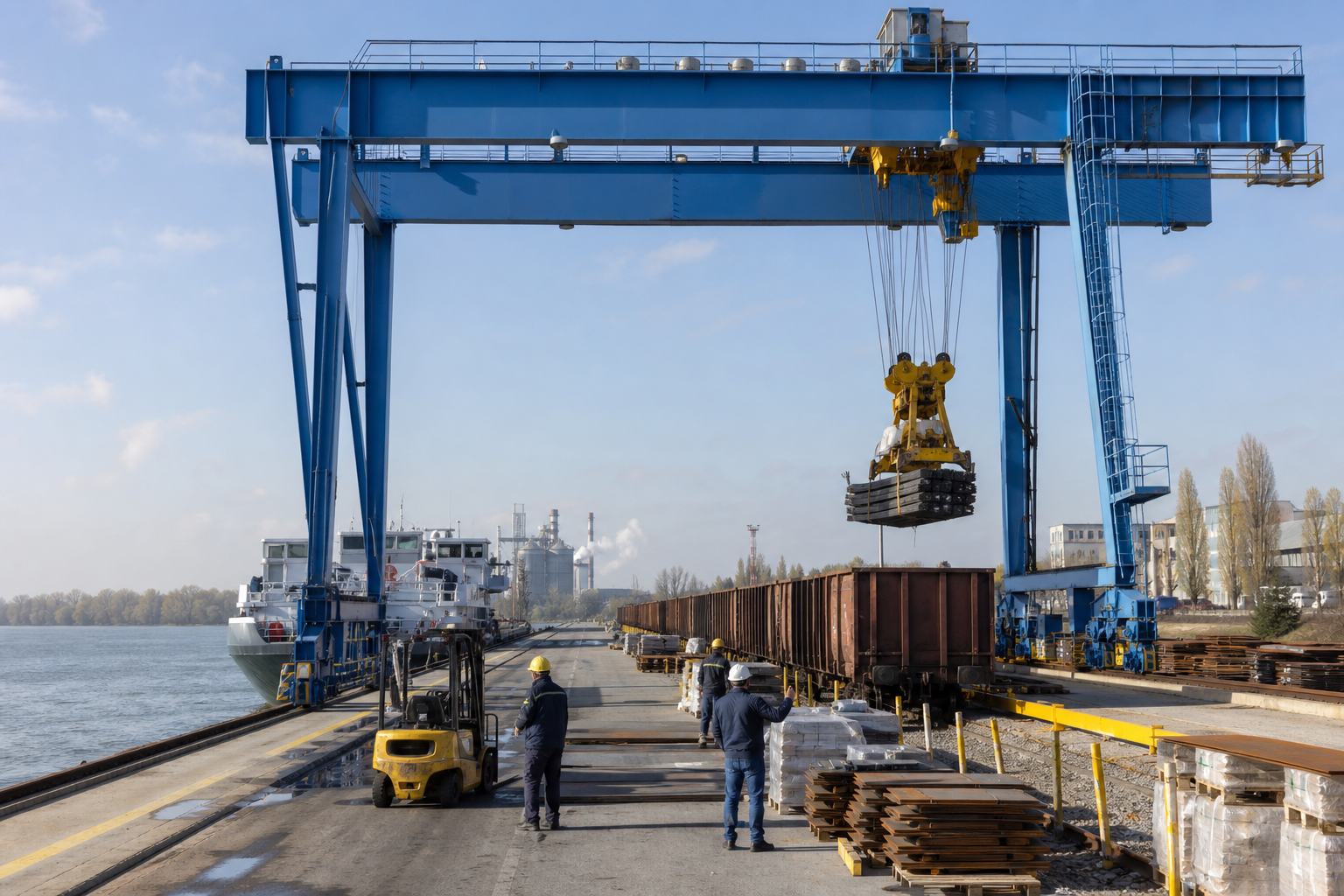
Luka Vukovar describes a 38.5-hectare facility with 450 metres of operational quay across four berths and three operational rail tracks. It states annual handling capacity of approximately 1.2–1.5 million tonnes, depending on cargo. The operator also lists general- and bulk-cargo handling, container spreaders, bulk grabs, a 25-tonne coil and sheet-metal hook, locomotives, 10,000 square metres of open storage and 3,000 square metres of covered storage.
Those assets make Vukovar a candidate for selected bulk, steel, general-cargo, container and project movements, especially where rail transfer matters. They do not establish equipment availability for a particular date, cargo acceptance, safe working loads for a proposed lift, storage availability or train-path capacity. A shipper should request a written lift and handling plan rather than infer operational feasibility from the equipment list.
Brčko presents the opposite data pattern: completed terminal works alongside unresolved corridor reliability. Documented modernisation includes a 16/27.5-tonne portal crane with stated handling performance of 150–200 tonnes per hour, a 4,500-square-metre operational plateau, rebuilt rail access towards Brčko Novo and a rehabilitated 900-metre access road. Its recorded turnover rose from 41,000 tonnes in 2022 to 61,000 tonnes in 2023, although the source warns that the underlying data are not fully consistent. The 2023 cargo profile included coal at 34%, rail-logistics coke at 17% and two Mittal-related pulley and roller categories totalling 37%, indicating an industrial cargo orientation without supporting a precise market-share claim.
Customs presence is not customs clearance certainty
A customs-enabled location allows a route to be screened; it does not prove that every commodity or procedure can be handled there. For Serbian gateways, the Serbian Customs Administration’s regulation on competent customs bodies should be checked against the commodity and requested procedure. The operator and customs office should separately confirm competent-office jurisdiction, inspection requirements, guarantees, transit arrangements, storage status and working hours before a tender is awarded.
In Croatia, the Customs Administration maintains a dedicated Vukovar customs service for border procedures and the free zone. This is a useful routing signal, not a guarantee of duty-free economics or rapid clearance. Commodity permissions, origin, guarantees, inspection capacity, bonded or free-zone storage and expected processing times remain shipment-specific. The operating role of Luka Vukovar should also be distinguished from the institutional responsibilities of the Port of Vukovar Authority and Croatian Customs.
For Brčko, the port operator and competent customs office should confirm whether the intended procedure can be completed at the terminal or requires movement under transit. Contracts should identify which party carries the cost of document delays, inspections, missed sailing windows and diversion to rail or road. These terms can matter more than the nominal waterborne rate when a cross-border movement has little schedule flexibility.
Brčko modernisation leaves a navigation condition
The strongest reliability caveat concerns the Sava. An €8 million EU grant and €30 million World Bank loan were announced for demining the river’s right bank. Demining and navigation-channel work were identified as prerequisites for dependable Brčko-linked access. Completion of the terminal modernisation therefore cannot be presented as restoration of reliable Sava navigation.
A 2024 Danube Commission workshop described navigation availability at approximately 180–200 days, against a suggested target of 300 days. This is an indicative workshop assessment, not a guaranteed annual service level. No supplied current dataset confirms water levels, dredging status, lock or convoy constraints, inspection availability or sailing days. Brčko can be tendered as a conditional multimodal option, but the tender should define a latest acceptable loading date, navigation trigger, monitoring responsibility and pre-agreed diversion price.
Tender on reliability-adjusted cost, not river price alone
No verified common dataset supplies route prices, transit times, customs lead times or berth availability across these gateways. The relevant comparison is therefore the total reliability-adjusted cost: barge and terminal charges plus rail or road transfer, storage, demurrage, customs amendments, missed-slot exposure and the cost of activating a fallback.
- Define the cargo envelope. Provide commodity classification, volume, dimensions, weight, hazardous status where relevant, loading method, storage requirement and delivery window. Stable, sizeable lots of aggregates, grain, coal or coke, iron and steel inputs, petroleum-linked cargo and project cargo are the clearest initial screening cases in the supplied evidence.
- Obtain written terminal feasibility. Contact the relevant operators in Smederevo, Novi Sad and Belgrade, Luka Vukovar or the Port of Brčko operator. For port-system responsibilities, use Serbia’s Port Governance Agency or the Port of Vukovar Authority as applicable. Confirm berth, equipment, storage, rail or road interface and cargo-acceptance conditions.
- Validate the customs procedure. Seek confirmation from the Serbian Customs Administration, Croatian Customs’ Vukovar service or the competent Brčko customs office. A free-zone reference or customs presence should never replace procedure-specific confirmation.
- Check corridor conditions. Consult Serbia’s Directorate for Inland Waterways, the relevant Croatian waterway institutions, the International Sava River Basin Commission and the Danube Commission for navigation information. Rail and road providers must separately confirm final-mile capacity and operational windows. For the rail side of the decision, see BalkansNetwork’s Western Balkans Rail Freight in 2026 decision map.
- Price the fallback in the same tender. Compare barge-plus-rail or road with a road-led contingency under the same delivery assumptions. For cross-border road fallbacks, use BalkansNetwork’s 2026 road-freight border-crossing guide. Chambers and freight-forwarder associations can help identify providers, but written confirmation from the operator, carrier and customs body remains decisive.
Smederevo leads the evidenced Serbian volume comparison; Vukovar offers a documented rail-water-road and specialist-equipment proposition; Novi Sad merits screening where its turnover and customs context fit the movement; Belgrade may still work for a location-specific case; and Brčko combines completed terminal assets with the sharpest navigation caveat. The defensible decision is not a universal best port, but the gateway whose cargo handling, customs procedure, inland connection and fallback can be confirmed for the same shipment.
Sources
- Danube Commission — Market Observation 2025
- carina.rs
- link.springer.com
- €8 million EU grant to demine the Sava River announced at ceremony to celebrate the completion of the modernisation of Brcko Port | EEAS
- narodne-novine.nn.hr
- Port today – Luka-Vukovar d.o.o.
- Carinska uprava – CU Vukovar.
- Microsoft Word – 2024_10_17 Bosnia Report_ver02.docx
- Workshop “Promoting Port of Brčko as logistics gateway and its better integration into Rhine-Danube TEN-T core corridor” , Danube Commission – Donaukommission – Commission du Danube – Дунайская Комиссия
- danubecommission.org
- Industrial railways of the Republic of Croatia in railway transport of agricultural goods