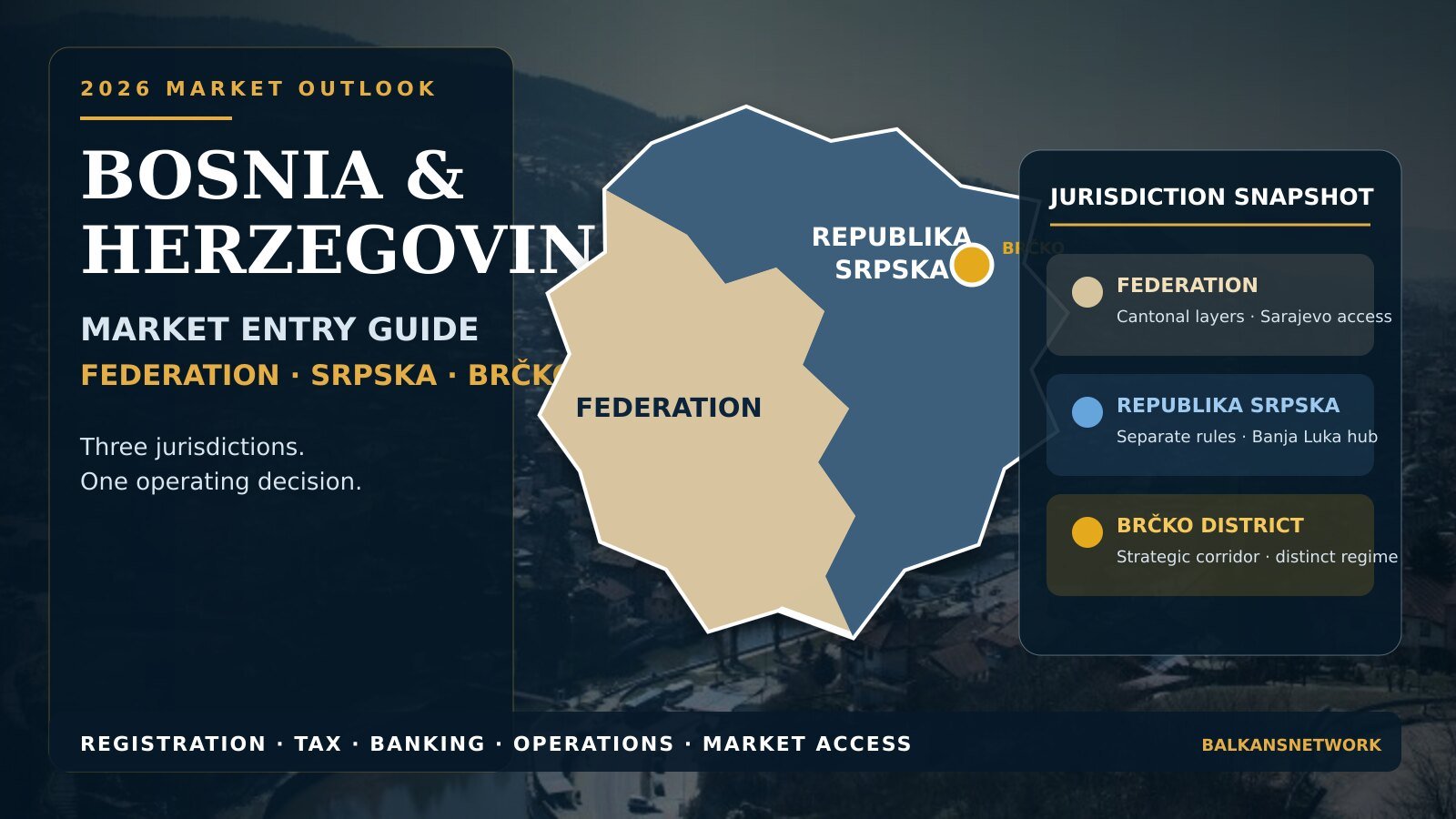
Bosnia and Herzegovina is not one business jurisdiction. It is a state with two entities and the Brčko District, and that constitutional reality reaches directly into company law, tax administration, registration, employment and incentives.
Do not choose “Bosnia and Herzegovina” first. Choose the exact legal and operating location—then test whether it matches customers, labour, logistics and management.
Why the country deserves a serious look
Bosnia and Herzegovina offers competitive labour costs, engineering and manufacturing capability, a stable currency linked to the euro and proximity to Croatia, Serbia and Montenegro. Sarajevo, Banja Luka, Mostar, Tuzla and the northern industrial corridor each serve different business models.
The market is relatively small, but it can work as a production, services or regional-support location. The opportunity is strongest for companies that understand the institutional map before they sign a lease or appoint a director.
The institutional map in plain language
The Federation of Bosnia and Herzegovina and Republika Srpska have their own company laws, tax administrations, labour frameworks and registration procedures. Brčko District has a separate legal and tax system. State-level institutions still matter for VAT, customs, foreign trade and certain regulatory areas.
This means a statement such as “corporate tax in Bosnia is 10%” is only a starting point. Payroll, local fees, incentives, court procedure and administrative practice depend on location.
| Jurisdiction | Typical strengths | Operational cautions |
|---|---|---|
| Federation of BiH | Sarajevo services, international institutions, larger urban markets, industrial centres in Tuzla and Zenica, access toward Croatia | Registration and administration can involve courts, cantons and municipalities; rules and incentives may vary by canton. |
| Republika Srpska | APIF one-stop registration, Banja Luka services, northern logistics and industrial locations, lower administrative complexity in some processes | Separate tax and labour rules; the right location depends heavily on customers and workforce. |
| Brčko District | Strategic position between entity markets, logistics potential on the Sava corridor, separate legal framework | Small local market and a more limited ecosystem; sector fit must be verified carefully. |
Company registration differs by jurisdiction
In the Federation, the standard sequence includes a notarised founding act, payment of capital, registration with the competent municipal court, bank account opening and registration with the tax authority. FIPA states that the court-registration stage is legally expected to take five days, although the full operating process can take longer.
Republika Srpska channels registration through APIF, which coordinates court registration and tax and statistical numbers. FIPA describes the APIF registration process as taking three days after complete documents are submitted.
The Federation has been expanding an electronic business-registration system, initially through selected courts. Foreign founders should confirm whether their chosen court and company structure can use the digital process at the time of filing.
Foreign ownership is allowed, but documentation drives the timetable
Foreign natural and legal persons can establish companies, but documents from abroad may require certification, apostille or legalisation and translation by an authorised court interpreter. The ownership chain must be clear enough for the commercial register, bank and beneficial-owner requirements.
Bank onboarding should be tested early. A company may be registered while its account is delayed because the bank needs additional evidence on shareholders, source of funds, business model or expected international payments.
Tax is simple at the headline level and complex in execution
Corporate income tax is generally 10% in the Federation, Republika Srpska and Brčko District. VAT is administered at state level with a standard rate of 17%. Those figures make the country look straightforward.
The differences appear in payroll, tax incentives, depreciation, local fees, withholding-tax treatment and administration. A manufacturer in Banja Luka, a software company in Sarajevo and a logistics business in Brčko should not use the same tax model simply because the headline corporate rate matches.
The banking and payment question
Before incorporation, give potential banks the real ownership chart, expected countries of payment, currencies, customers and suppliers. A theoretical bank account is not enough; the business needs a bank that accepts its actual transaction profile.
Which location fits which business model
Sarajevo is the natural choice for professional services, international organisations, public-sector engagement, tourism and companies that need the broadest business-services ecosystem.
Banja Luka can offer a more compact administrative environment, strong regional links and access to northern industrial and agricultural areas.
Tuzla and Zenica remain relevant for industry, engineering, energy-linked activities and technical services. Mostar is positioned toward Croatia and the Adriatic economy, with tourism, food, construction and services potential.
Brčko should be evaluated for logistics, distribution and businesses that value its central geographic position more than a large local customer base.
A practical market-entry sequence
- Choose the operating city and jurisdiction together. Do not register in one entity and discover that the workforce or customers are elsewhere.
- Map state, entity, canton and municipal approvals. The exact layers depend on activity and location.
- Pre-screen the bank. Present ownership and payment flows before incorporation.
- Model full employment cost. Compare payroll rules and benefits, not only net salary.
- Verify incentives locally. Many programmes are annual, entity-specific or canton-specific.
- Use a pilot phase. Test hiring, customers, logistics and administration before committing to a large fixed-cost structure.
The bottom line
Bosnia and Herzegovina can be competitive precisely because it is not a standardised market. Different jurisdictions and cities create different operating advantages. The same complexity that deters an unprepared investor can protect a well-positioned company from crowded competition.
The country rewards specificity. Choose the entity, canton, municipality, bank, workforce and logistics route as one integrated decision.
Considering Bosnia and Herzegovina as a market or operating base?
Before establishing a local entity, appointing a partner or committing to hiring, Inspira’s Market Validation Sprint tests demand, buyers, competition, route to market, operational feasibility and the conditions required for a sound go / refine / stop decision in Bosnia and Herzegovina or the wider Western Balkans.
Continue reading on BalkansNetwork
Official sources
- FIPA — Steps for establishing a business in Bosnia and Herzegovina
- FIPA — Types of companies in Bosnia and Herzegovina
- FIPA — Electronic registration in the Federation
- FIPA — Bosnia and Herzegovina at a glance
- Financial-Intelligence Agency of the Federation of BiH
- Brčko District Directorate of Finance