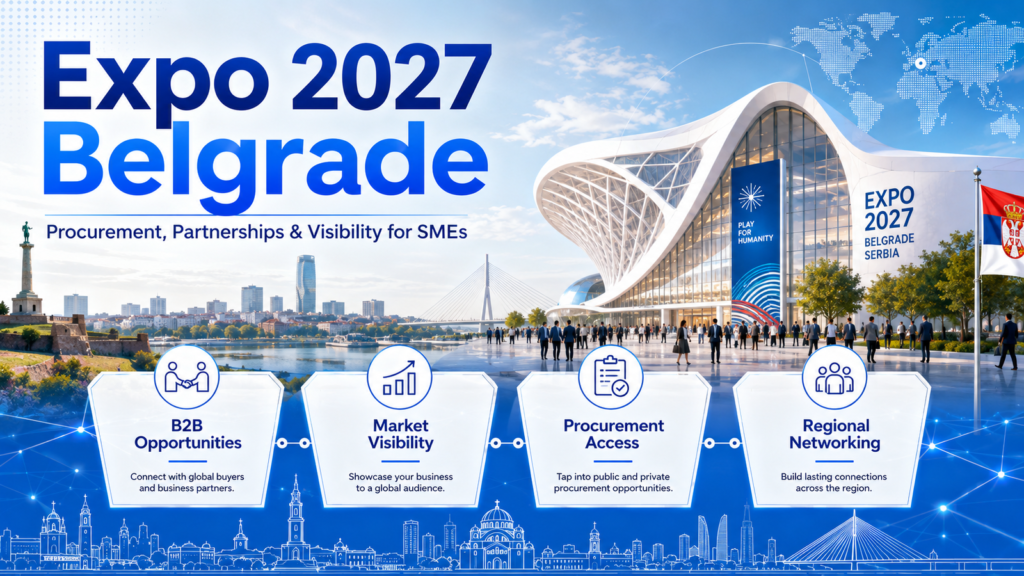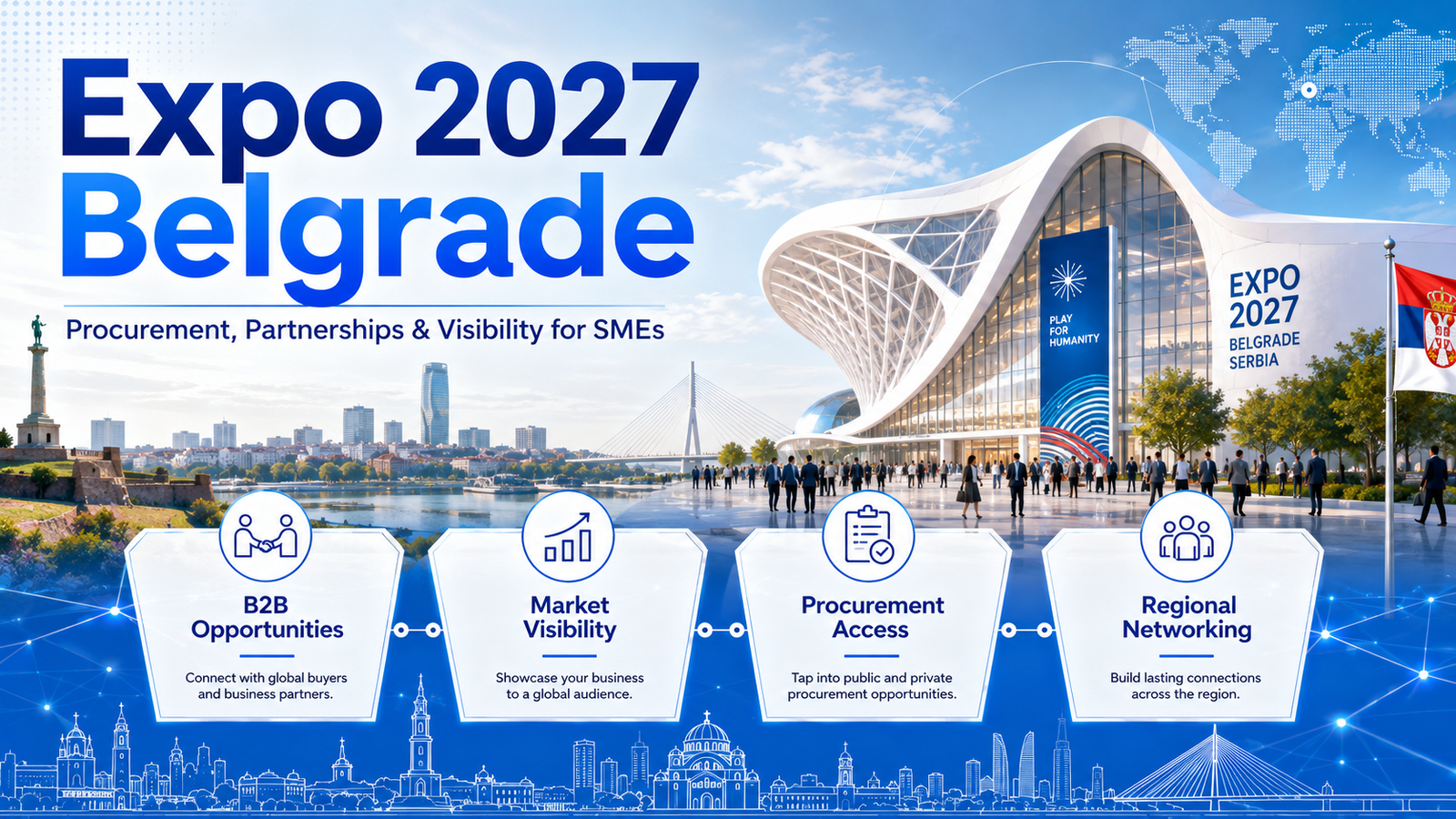
Expo 2027 Belgrade will not be one tender, one sponsor list or one three-month event. It is a network of public procurement, participant-country projects, commercial partnerships, hospitality demand, events and business relationships that will form before the gates open on 15 May 2027.
SMEs are unlikely to win by waiting for a single “Expo supplier application.” They need to identify the right route: organiser procurement, consortium work, country pavilions, partner programmes or the surrounding visitor economy.
Start with the scale—and the structure
The Specialised Expo runs from 15 May to 15 August 2027. The organiser reports 139 confirmed international participants as of August 2026, while the event is designed to attract millions of visitors over 93 days.
That scale creates demand across construction, fit-out, technology, security, logistics, catering, cleaning, translation, event production, marketing, transport, accommodation and professional services. But the demand is fragmented across different buyers and contracting routes.
| Route to opportunity | Who buys | What SMEs should prepare |
|---|---|---|
| Organiser procurement | EXPO 2027 d.o.o. and contracting authorities | Procurement monitoring, eligibility documents, references, financial capacity and consortium options. |
| Country pavilions | Participating governments, commissioners and appointed contractors | Country-specific outreach, multilingual proposals and relevant cultural or technical experience. |
| Official partnerships | Expo organiser and commercialisation team | A partnership concept with monetary or in-kind value and measurable audience benefit. |
| Prime-contractor supply chain | Large construction, event, technology and logistics contractors | Prequalification, subcontractor capacity, safety and quality systems, and fast quotation discipline. |
| Visitor and business economy | Hotels, venues, DMCs, restaurants, mobility providers and corporate delegations | Packages, capacity planning, multilingual service and clear B2B sales channels. |
Procurement is already active
The organiser has already completed major procedures, including a framework agreement for artists and performers with a maximum estimated value of RSD 1.24 billion excluding VAT. In June 2026, it launched procurement for the design, construction, fit-out, operation and maintenance of collective and individual pavilions.
These examples show two things. First, the commercial cycle is happening well before 2027. Second, many opportunities are too large for a small company to pursue alone. SMEs should look for consortium, subcontracting and specialist-supplier positions.
The partner route is different from public procurement
Expo 2027 has published an invitation for commercial partners. Interested organisations can submit a letter of intent describing the desired partner category, the value and form of the contribution and the strategic reason for participating.
The invitation can include monetary or non-monetary partnerships. A company with technology, mobility, food, communications, sustainability or visitor-experience capability may have more value as an in-kind partner than as a conventional sponsor.
This route is not a public-procurement procedure. Companies must understand the commercial benefits, exclusivity, category rights, activation costs and internal resources needed to use the partnership effectively.
Country pavilions create a second market
Every participating country needs some combination of design, content, exhibits, digital systems, logistics, staffing, hospitality and business programming. Some governments will use national procurement systems. Others will appoint agencies, architects or general contractors.
A Serbian or regional SME should therefore monitor embassies, chambers, export agencies and the appointed commissioners of participating countries. The most credible pitch is specific: a local partner for permits and production, a specialist in interactive exhibits, a regional logistics provider or a multilingual event operator.
A common mistake
“We want to work with Expo” is not a commercial proposition. A useful approach identifies the buyer, procurement route, deliverable, evidence of capacity and the deadline by which the service is needed.
Hospitality and business travel will be a separate economy
The event will bring delegations, exhibitors, media, suppliers, performers and corporate guests to Belgrade for periods ranging from one day to several months. Demand will extend beyond hotel rooms.
Companies can build services around long-stay accommodation, airport transfers, translation, executive transport, temporary offices, meeting venues, catering, staffing, protocol support, regional excursions and post-event corporate programmes.
The strongest offers will be designed for a specific customer group. A government delegation does not buy the same service as a multinational sponsor, a pavilion construction team or a family visiting the Expo.
A six-step preparation plan for SMEs
- Choose one opportunity route. Procurement, subcontracting, country pavilions, partnerships or hospitality.
- Create an Expo capability statement. One page with services, references, capacity, certifications, languages and contact person.
- Monitor procurement weekly. Track the Expo website, Serbian public-procurement channels and prime contractors.
- Build consortium relationships now. Large tenders require financial, technical and reference capacity that one SME may not have.
- Prepare multilingual sales material. English and Serbian are the minimum; target-country language can differentiate a supplier.
- Plan the legacy. Use Expo relationships to create customers and regional partnerships that continue after August 2027.
Visibility is valuable only when connected to a business objective
Expo can offer brand exposure, but exposure alone is easy to overpay for. A company should define whether it wants distributors, government relationships, recruitment, investor access, customer demonstrations or regional reputation.
The activation plan matters as much as the partnership or event fee. Meetings, content, follow-up, data capture and post-Expo sales activity should be budgeted from the beginning.
The bottom line
Expo 2027 is becoming a large temporary market and a long-term relationship platform. The easy contracts will not simply appear in front of small companies.
SMEs need to enter through the correct door, document their capacity and become visible to buyers before procurement and pavilion supply chains are fully allocated.
Planning to use Expo 2027 Belgrade as a business-development opportunity?
Inspira supports companies, SMEs and international organisations with Expo 2027 positioning, local partner and supplier identification, business-development outreach, meetings, events and market-entry execution in Serbia and Southeast Europe.