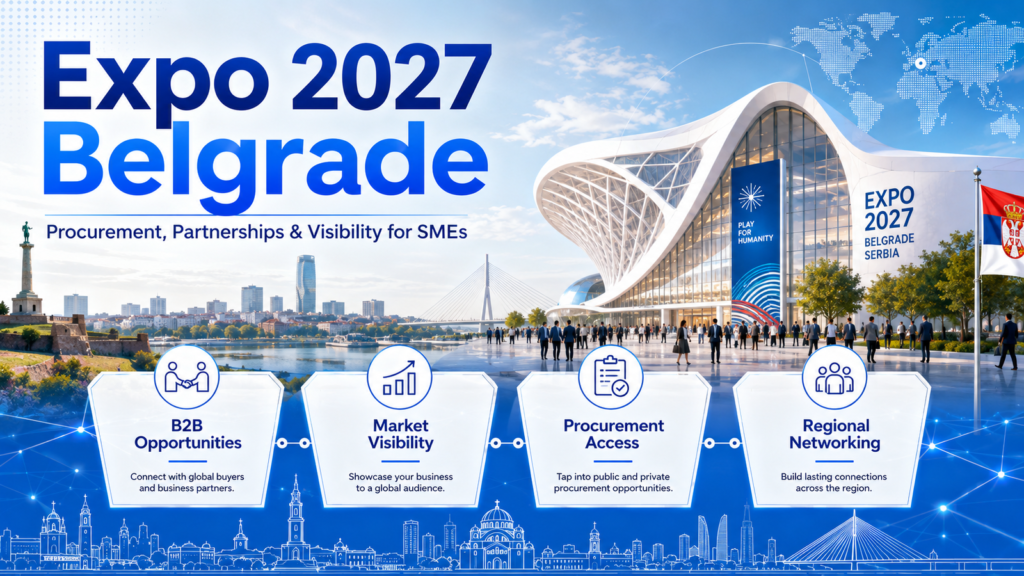
Turkey Expo 2027 Belgrade is now a more concrete business-development case than it was in mid-August, but it is still not an open supplier tender. Turkey’s participation is confirmed, the Ministry of Trade continues to describe a 648m² pavilion on plot A5.1, and the delivery timetable is unusually specific. At the same time, the technical information package was updated on 11 August, the Turkish concept-submission deadline passed on 17 August, and the organiser’s wider collective-pavilion procurement has moved from tender to contract award. For Turkish and Serbian companies, the practical question is therefore no longer simply whether Expo 2027 creates opportunities, but which route is still realistic, what is verified, and which future signal should trigger commercial action.
Status checked: 3 September 2026. The Expo organiser currently describes participation as exceeding 140 international participants and lists Turkey among them. Expo 2027 Belgrade runs from 15 May to 15 August 2027 under the theme “Play for Humanity: Sport and Music for All.”
What is confirmed for Turkey’s pavilion
Türkiye’s Ministry of Trade remains the key public source for the national pavilion plan. Its published market-research and concept brief describes a medium-type pavilion of 648m², measuring 27 x 24 metres, on plot A5.1. The Expo administration is expected to hand the structure to Turkey in shell condition on 15 October 2026. Construction is planned to be completed by 31 March 2027, with the pavilion ready for operation by 15 April 2027. Turkey’s national day is planned for 19 May 2027.
These dates are commercially useful because they define the mobilisation window. They do not, however, identify a Turkey-specific prime contractor, final design, approved supplier list, exhibitor roster or open SME procurement mechanism. Public confirmation of participation and a technical pavilion plan should therefore not be read as proof that a contract is currently available to bid.
| Milestone | Published position | Commercial meaning |
|---|---|---|
| 11 Aug 2026 | Türkiye’s Ministry of Trade reports that the Expo Technical Information Package (TIP) was updated. | Any design, engineering or fit-out preparation should use the latest technical pack, not an earlier download. |
| 17 Aug 2026 | Deadline in the Ministry’s concept/project market-research exercise. | The initial concept-input window is closed; it should not be promoted as a live tender. |
| 15 Oct 2026 | Planned shell handover to Türkiye. | A key trigger for monitoring contractor mobilisation, package definition and local execution partners. |
| 31 Mar 2027 | Planned construction completion. | Late-entry suppliers may face a compressed production and installation window. |
| 15 Apr 2027 | Planned operational readiness. | Hospitality, content, AV, staffing and programme suppliers may need to mobilise before this date. |
| 15 May 2027 | Expo opens. | Programme, delegation and business-networking activity becomes the dominant route. |
| 19 May 2027 | Türkiye national day is planned. | A potential focal point for institutional and business programming, subject to final programme confirmation. |
Two August changes alter the supplier map
The first change is technical. On 11 August, the Ministry of Trade published a notice stating that Expo 2027 had updated construction-related requirements in the Technical Information Package. That matters for architects, exhibition contractors, MEP specialists, fit-out companies and equipment suppliers because an outdated technical pack can invalidate assumptions about interfaces, loads, services, dimensions or delivery responsibilities. Companies preparing capability material should reference the current documents and make clear which revision they have used.
The second change is procedural. The Ministry’s 17 August deadline for concept and project submissions has now passed. That exercise was a market-research/concept input process, not evidence of an ongoing public supplier tender. The next high-value signal would be a Turkey-specific announcement identifying the chosen concept, delivery consortium, prime contractor, supplier briefing or procurement route.
The wider Expo procurement picture has also moved. On 31 July, Tanjug reported, citing EXPO 2027 d.o.o., that contracts for the organiser’s collective pavilions were awarded to South Korea’s Sigong Tech Co., Ltd, with BAUMEISTER d.o.o. Beograd as subcontractor. Those contracts cover design, construction, operational management, maintenance and dismantling of collective pavilions. This is an important contractor signal for the Expo ecosystem, but the public sources reviewed do not establish that Turkey’s separate 648m² A5.1 pavilion belongs to that package. BalkansNetwork therefore does not attribute the Turkish pavilion to Sigong or BAUMEISTER without a Turkey-specific source.
Where Turkish and Serbian companies can still position
For companies selling physical pavilion inputs, the strongest near-term strategy is partner mapping before bid spending. Relevant capabilities can include exhibition design, interior fit-out, lighting, audiovisual and interactive systems, electrical and mechanical packages, signage, furniture, branded environments, logistics, installation, hospitality infrastructure, cultural production, promotional materials, operations support and dismantling. These categories come from the Ministry’s published scope; they are opportunity areas, not advertised contracts.
A Turkish supplier with a strong product or specialist capability but no Serbian delivery base should identify local counterparts now: contractors, installers, logistics partners, engineering firms and compliance advisers capable of executing in Belgrade. Conversely, Serbian firms can position as local delivery partners for Turkish companies that may enter through a future Turkey-specific contractor or programme route. The commercial value is in being technically ready and locally connected before the final package structure becomes public.
Turkey and Serbia already have a substantial business base for this type of cooperation. Türkiye’s Ministry of Foreign Affairs reports 2025 bilateral goods trade of about US$3.467 billion, with a medium-term target of US$5 billion. It also records about 1,381 active Turkish firms in Serbia and roughly US$2 billion of work undertaken by Turkish contractors in the country. Those figures do not guarantee Expo work, but they make Turkish–Serbian project combinations commercially credible rather than hypothetical.
Business networks can open doors, but they do not award contracts
The Ministry of Trade, the Turkish Embassy in Belgrade’s Trade Counsellor, the DEİK Türkiye–Serbia Business Council, TOBB-linked bilateral chamber channels and the Chamber of Commerce and Industry of Serbia are useful for current information, counterpart identification and introductions. DEİK identifies the Serbian Chamber as its counterpart and highlights fields including construction and building materials, automotive supply, food, textiles and wood products—several of which overlap with Expo-related supply chains.
The distinction is important: network access is not procurement authority. A useful outreach message should ask whether a contractor or procurement channel has been formally disclosed, whether supplier briefings are planned, who controls the technical package, and whether a qualified local partner is required. It should not claim official Expo endorsement or imply that a chamber can allocate contracts.
Pavilion supply and programme participation are separate routes
Not every company needs to enter through construction or fit-out. Expo 2027’s programme is designed around business, cultural, educational, technology, sport and music activity. Exporters, professional-services firms, startups, tourism operators and sector associations may find more value in national programming, thematic events, B2B meetings and Turkey’s national-day activity than in trying to enter the physical pavilion supply chain.
That route is not yet a guaranteed SME programme either. No public Turkish exhibitor roster or final business-delegation calendar was identified in the sources reviewed on 3 September. The correct approach is to monitor the Ministry, Expo organiser and Turkish institutional channels for programme calls while preparing a concise market-facing offer: what the company sells, which Serbian or regional buyers it targets, and what meeting or demonstration format would justify participation.
Decision map: what to do now
| Company profile | Action now | Trigger to escalate |
|---|---|---|
| Design / fit-out / AV / MEP specialist | Update technical pack, map Turkish and Serbian delivery partners, prepare references and capacity data. | Turkey-specific contractor, concept or technical-package announcement. |
| Building-product manufacturer | Identify products that fit pavilion scope; prepare Serbian delivery/compliance route and samples. | Bill of quantities, approved-specification or subcontractor inquiry. |
| Logistics / installation company | Model the October-to-April delivery window and local site capability. | Confirmed construction sequence and package owner. |
| Hospitality / events / cultural supplier | Prepare programme and national-day offer separately from construction supply. | Official Turkish programme calendar or operator appointment. |
| Exporter / SME / service firm | Prioritise buyer mapping, business councils and programme channels rather than speculative tendering. | Delegation, B2B, thematic-week or exhibitor call. |
What to monitor between now and the October handover
- Final Turkish concept or design: a public decision would clarify the visual and technical demand profile.
- Prime contractor or consortium: this is the most important missing link for companies targeting physical supply work.
- Supplier eligibility or briefing: any official criteria would convert broad opportunity areas into an actionable pipeline.
- Updated TIP documents: technical revisions should be checked before quoting or engineering work.
- Programme calendar and Turkey national-day planning: essential for exporters and non-construction participants.
- 15 October shell handover: if the published date holds, it becomes a practical checkpoint for delivery mobilisation.
Companies should also verify the contracting entity, payment chain, applicable procurement rules, technical responsibility and insurance/compliance requirements before committing bid or production costs. Expo-related procurement in Serbia is politically and commercially visible, so documented authority matters more than informal claims of access.
BalkansNetwork assessment: Turkey’s participation is confirmed and the pavilion plan is sufficiently defined to justify early partner mapping. What is not yet publicly established is the Turkey-specific contractor and supplier-access mechanism. The best commercial posture in September 2026 is therefore to prepare, map counterparties and monitor decisive triggers—not to treat the pavilion as an open tender.
BalkansNetwork reports independently and is not affiliated with EXPO 2027, BIE, Türkiye’s Ministry of Trade or the business organisations referenced in this article.
Sources
- Türkiye Ministry of Trade — Expo 2027 Belgrade market-research / pavilion brief
- Türkiye Ministry of Trade — Technical Information Package update, 11 August 2026
- EXPO 2027 Belgrade — International participants
- EXPO 2027 Belgrade — Collective-pavilion procurement notice
- Tanjug — Collective-pavilion contract awards, 31 July 2026
- Türkiye Ministry of Foreign Affairs — Türkiye–Serbia relations and trade
- DEİK — Türkiye–Serbia Business Council
- TOBB — Türkiye–Serbia Chamber of Commerce and Industry Forum