Factory electricity in Serbia is a site-specific infrastructure decision, not a tariff comparison. Before closing on industrial land or committing to a lease, an investor should obtain written evidence covering the relevant connection route, approved capacity, connection point, required works, property constraints, estimated cost and allocation of delivery responsibilities. That evidence should be tested against the opening load, commissioning sequence and planned expansion.
Connection, electricity supply, network access, balancing and renewable procurement are separate workstreams. Serbia offers distribution and transmission routes, licensed suppliers, an organised power exchange, guarantees of origin and active-customer generation, but each option imposes different contractual, technical and implementation burdens. None substitutes for verified capacity at the selected site.
Factory electricity in Serbia starts with a property decision
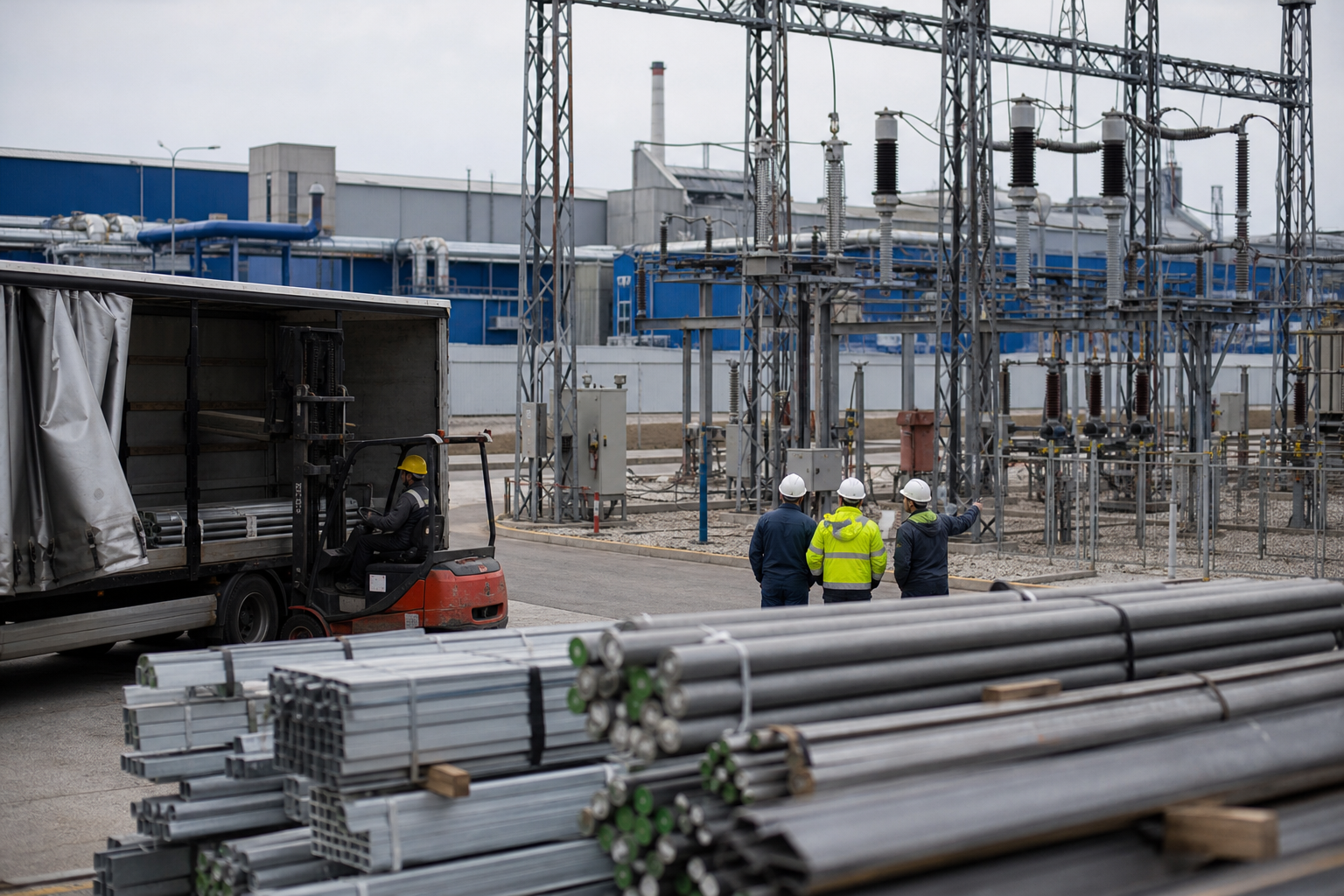
The first decision is whether the proposed factory can be served through the distribution system operated by Elektrodistribucija Srbije, or EDS, or whether its demand and technical configuration require engagement with transmission-system operator Elektromreža Srbije, or EMS. That distinction affects the studies, property rights, permits, infrastructure and counterparties required before the factory can operate.
No official municipality-level dataset supplied for this guide establishes immediately available industrial capacity across Serbia. Investors therefore should not treat a business-zone brochure, nearby substation or existing power line as evidence that the required load can be delivered. Connection feasibility has to be established for the particular parcel, facility, requested power, consumption profile and connection configuration.
For a land acquisition, the connection approval should be treated as a property-risk document alongside title, easements, utility corridors and planning conditions. EDS states that approval cannot be issued when connection conditions are absent, including cases involving missing infrastructure, unprepared land or unresolved property rights. A commercially attractive parcel can consequently remain unusable for an electricity-intensive project if the network route or land needed for connection infrastructure is unavailable.
The diligence emphasis changes for a leased building. The tenant should verify the facility’s approved capacity, metering arrangement, access status and evidence of historic peak demand. It should also establish whether landlord consent is needed for reinforcement, a new transformer, changes to internal electrical infrastructure or rooftop generation. A landlord’s statement that a building has “industrial power” does not quantify the capacity available to the incoming production line.
A prudent property contract should therefore make closing, lease effectiveness or a withdrawal right conditional on satisfactory written connection evidence. The threshold should reflect the factory’s actual operating case rather than only its initial commissioning load. If phased expansion is expected, both the opening requirement and later capacity increase should be tested because a subsequent increase may follow a different procedure.
Distribution connection: EDS, CEOP and capacity changes
EDS is the distribution-level gatekeeper. Its procedures distinguish construction projects handled through Serbia’s unified permitting process from applications outside that process, including changes to an existing connection. Investors need to identify the correct route before relying on a procedural deadline.
For construction handled through the unified procedure, the investor initiates the distribution-connection process through the Central Register of Integrated Procedures, commonly referred to as CEOP, when filing the relevant construction documentation. The EDS unified-procedure guidance describes the connection steps and the relationship between the permitting process, approval and physical connection.
For a valid final connection request through CEOP, EDS states an eight-day approval milestone and connection within 15 days. These are procedural milestones for the stated process; they should not be interpreted as a guarantee that wider network reinforcement, third-party land access or substantial project-specific infrastructure will be designed, permitted and built within the same period. The investor should ask EDS to identify explicitly what must already exist or be completed before the connection stage can occur.
Outside the unified procedure, including a request to increase capacity at an existing facility, EDS states a 15-day decision period. The resulting approval identifies the connection conditions, cost, deadline and required documentation. That decision period is not a universal construction-delivery timetable.
The distinction matters to both acquisitions and leases. A brownfield facility may already have a connection, but the planned machinery can still require a capacity increase, metering changes or reinforcement. The buyer or tenant should compare approved power with the electrical engineer’s load schedule, including simultaneous demand, starting loads and the proposed commissioning sequence. Installed transformer ratings or historic electricity bills are useful inputs, but they do not replace the formal approval applicable to the intended use.
Transmission connection adds study, land and permitting exposure
A transmission-level project follows a more extensive route with EMS. According to the EMS connection procedure, the process requires a Facility Connection Study and then proceeds through land-rights, planning, technical-documentation and permitting steps. This creates materially different development exposure from a standard distribution connection.
The EMS approval specifies the connection point and method, technical conditions, connection cost, required tests, installed and approved power, metering point and the deadline for physical connection. On its published procedure page, EMS lists a 30-day decision period for a completed customer-facility connection application (60 days for generation facilities). That is an administrative decision deadline, not a promise that new transmission infrastructure will be delivered in 30 days. For an investor, these are not only engineering details. They determine which party must secure land, develop the connection infrastructure, coordinate tests and carry schedule risk.
The Facility Connection Study should therefore precede irreversible commitments where transmission connection may be required. The property package must account for the factory parcel and any additional land or rights needed for lines, substations, access and the connection point. A site can be suitable for production buildings while remaining unsuitable for the route required to energise them.
| Decision variable | EDS distribution route | EMS transmission route |
|---|---|---|
| Primary operator | Elektrodistribucija Srbije | Elektromreža Srbije |
| Initial diligence | Site-specific capacity, applicable EDS procedure and connection conditions | Facility Connection Study and proposed connection configuration |
| Property focus | Prepared land, existing infrastructure, property rights and reinforcement requirements | Connection point, line or substation land, access rights and permitting route |
| Cost basis | Regulated methodology, with non-standard works remaining project-specific | Project-specific infrastructure and approval terms |
| Main sequencing risk | Treating a procedural deadline as a reinforcement-delivery guarantee | Committing to the site before study, land and permitting requirements are understood |
The table is a decision framework rather than a capacity test. Neither route provides a universal Serbian connection price or guaranteed greenfield timetable. The investor should obtain the current operator documents for the precise facility and have them reviewed by a Serbian electrical engineer and energy counsel.
Supply, network access and balancing require separate contracts
Physical connection does not itself procure electricity. After establishing the viable network route, the factory must choose how supply, distribution access and balancing responsibility will be organised. These arrangements should be mapped before issuing a supplier tender because an apparently attractive commodity quote may exclude risks or services that another bid includes.
Under the EDS framework, a customer using full supply can organise the supply relationship through its supplier. A customer operating outside full supply also requires balancing responsibility with EMS and a distribution-system access contract with EDS. The practical tender question is therefore not only the quoted EUR/MWh price, but also who carries forecasting, nomination, imbalance, network-access and administrative obligations.
Licensed suppliers and traders are the initial comparison set for most industrial entrants. A tender should use the same verified demand dataset for all bidders: expected annual volume, monthly profile, working shifts, hourly or interval load where available, planned shutdowns, commissioning ramp-up and material expansion phases. Bids should state clearly whether the price is fixed, indexed or hybrid and how volume deviations, profile changes, imbalance, network charges and contract termination are treated.
A fixed-price product transfers a defined amount of commodity-price risk to the supplier, but its commercial value depends on the contracted volume and shape assumptions. An indexed structure passes more market movement to the buyer. A hybrid can divide exposure, but it is not comparable across bids unless fixed and indexed tranches, reference prices, adjustment periods and volume tolerances are stated consistently.
Direct access to the Serbian power exchange should not be treated as routine industrial-buyer onboarding. SEEPEX membership requirements include an AERS licence and balancing-responsible-party status with EMS, or the transfer of balancing responsibility. The SEEPEX membership schedule lists an entry fee of EUR 18,000 and an administration fee of EUR 1,000, plus market-specific recurring, systems, clearing and transaction costs; the schedule states that listed items are subject to VAT. These figures are not industrial retail tariffs and discounts or updated exchange terms should be rechecked before applying. Licensing, clearing and balancing requirements must also be assessed, so exchange membership is not equivalent to simply opening a procurement account. Most factories should first compare supply offers from licensed counterparties rather than assume direct exchange membership is the cheapest or simplest route.
Balancing allocation is commercially material. In its 2024 annual report, the Agency for Energy of the Republic of Serbia, or AERS, reported a weighted average imbalance settlement price of EUR 96.753/MWh, with EUR 146.679/MWh when short and EUR 31.925/MWh when long. These historical figures are not a 2026 price forecast and do not establish what an individual factory will pay. They demonstrate why a supply or PPA contract must identify the party bearing deviations between forecast and actual consumption or generation.
October 2026 market update: SEEPEX reports that the common ADEX Intraday Continuous Market went live on 20 October 2026 for the Serbian, Slovenian and Hungarian intraday markets, with BSP taking over related operational activities. This is a wholesale-market development, not an automatic reduction in industrial electricity bills. For prospective intraday exchange members, SEEPEX has also announced a membership/setup freeze from 9 October through 3 November 2026. The announced restrictions apply specifically to intraday membership admissions, extensions and certain trader/user/portfolio changes—not necessarily to ordinary industrial supply contracts or the day-ahead market. Ask the exchange or supplier for current implementation terms.
Renewable procurement: GOs, PPAs and on-site generation
Three renewable routes need to be evaluated separately: a supply product supported by guarantees of origin, a physical or sleeved power purchase agreement, and generation at the factory site. They can be combined, but they do not provide the same renewable claim, price exposure, hourly match or delivery arrangement.
Guarantees of origin
EMS operates Serbia’s guarantees-of-origin framework. A GO-backed product concerns renewable attributes. It does not, by itself, create a physical PPA, reserve network capacity or establish an hourly physical match between a named renewable plant and the factory’s consumption. Buyers should request contractual detail on the origin, technology, production period, cancellation and evidence supporting any intended renewable-electricity claim.
Physical and sleeved PPAs
A physical or sleeved PPA requires a workable supply and balancing architecture in addition to agreement with a renewable generator. The parties need to define delivery point, contracted profile, settlement, volume deviations, grid-use arrangements, balancing allocation, credit support and the supplier or trader role where sleeving is required. The factory’s load shape and the generator’s production shape must be assessed rather than compared only through annual totals.
Legal possibility should not be confused with routine availability. Independent regional reporting describes corporate PPAs as emerging in the Balkans. This is a market-practice observation, not a finding by AERS, and it does not prove that a bankable structure is available for every Serbian factory or renewable project.
Accordingly, a buyer should approach renewable developers only after defining its demand profile, desired tenor, price mechanism, balancing model, credit parameters and treatment of guarantees of origin. Otherwise, offers may use the term “PPA” for materially different structures that cannot be compared on price alone.
On-site active-customer generation
On-site solar should be tested as a load-management and renewable-claims tool, not presented as eliminating grid dependency. Production schedules, daytime load, available roof or land, connection configuration and treatment of surplus generation determine its operating value. Backup supply and the underlying grid connection remain relevant whenever generation does not coincide with factory demand.
EDS maintains a specific active-customer procedure requiring a connection study and applying route-specific application timing. A no-export configuration should not be assumed to follow the same implementation path as exporting generation. The current EDS rules should be checked before equipment procurement, and the electrical design should state whether export is technically prevented or contractually permitted.
For wider regional context on renewable auctions, grids and storage constraints, readers can consult BalkansNetwork’s analysis of Western Balkans renewable energy in 2026. That regional overview is navigation and context, not evidence of capacity or PPA availability at a Serbian site.
Costs, documentation and failure modes
AERS sets the connection-cost methodology, while charges for typical connections are established annually. Non-standard industrial works remain project-specific. Investors should separate the regulated connection-cost methodology from commercially negotiated expenditure for reinforcement, substations, internal installations, land rights, easements, design work and other project infrastructure.
The same separation is needed between connection expenditure and ongoing electricity cost. The latter can include the commodity price and, depending on the contractual architecture, network access, balancing exposure, renewable attributes, sleeving or trading services. A single blended number can obscure which elements are fixed, indexed, regulated, estimated or subject to later reconciliation.
The verified official material used for this guide does not establish a special tax or customs package for industrial electrical equipment. A project importing transformers, switchgear, control systems or generation equipment should therefore obtain separate written Serbian advice on applicable tax, customs and product-conformity treatment rather than place unverified exemptions in the investment case. This diligence can run in parallel with the connection process.
The principal failure modes are sequencing errors rather than lack of procurement options:
- Closing on land before written connection evidence: the site may lack infrastructure, prepared land, clear property rights or a viable utility corridor.
- Reading an operator deadline as a construction guarantee: EDS decision and connection milestones do not assure completion of wider reinforcement or third-party works.
- Assuming an existing connection is sufficient: a brownfield factory or lease may require an outside-unified-procedure capacity increase.
- Using installed equipment as evidence of approved power: transformer ratings and legacy operations do not replace current operator documentation.
- Comparing supply bids on headline price: imbalance, volume tolerances, indexation and network responsibilities may be allocated differently.
- Treating GOs as a physical PPA: renewable attributes do not establish physical delivery, price hedging or hourly matching.
- Starting PPA discussions before defining balancing: the commercial structure cannot be assessed without clear responsibility for forecast and production deviations.
- Assuming rooftop solar removes connection risk: on-site generation still requires a compliant connection route and does not necessarily coincide with industrial demand.
Cost and schedule models should include decision gates rather than one unsupported energisation date. At minimum, the model should distinguish operator feasibility or study, connection approval, land and easement resolution, design and permitting, infrastructure construction, testing, physical connection, supply commencement and production ramp-up.
Pre-investment data room: request these seven records
Before signing for industrial land, request a compact evidence package rather than relying on a marketing brochure. Keep copies of the operator correspondence and ensure the same demand assumptions appear in each document.
- Parcel and building: cadastral details, land title or lease, easements, planning status and available utility corridors
- Electrical load: electrical engineer’s maximum-demand estimate in kW/MW, connection voltage, starting currents, power factor, working shifts and expansion stages
- Existing connection: operator-approved capacity, metering-point documentation, latest measured demand and any limitations or arrears relevant to transfer
- Operator response: written EDS conditions or the applicable EMS connection-study/approval route, including the connection point and network reinforcement assumptions
- Connection budget: identify which party funds studies, transformers, lines, land rights, internal works, tests and contingencies
- Project critical path: permitting, reinforcement, commissioning and production start with assigned owners; distinguish administrative decision periods from construction lead times
- Electricity tender sheet: monthly/interval profile, fixed versus index-linked prices, network charges, balancing, green attributes, security deposits and termination conditions
Go/no-go rule: if the essential connection point, capacity or delivery responsibilities cannot be confirmed in writing, leave the investment conditional. An engineer and Serbian energy counsel should review the file for the exact site. For a broader site and logistics comparison, see Serbia industrial logistics in 2026.
A 2026 commitment sequence for investors and manufacturers
The appropriate sequence begins with the factory rather than the electricity product. The project team should define the production process, load schedule, power-quality needs, opening demand and expansion case before comparing sites. A Serbian electrical engineer should translate that operating case into a connection requirement that EDS or EMS can assess.
- Screen the property: collect title, planning, utility-corridor, existing connection, metering and landlord information. Do not use nearby infrastructure as proof of capacity.
- Select the network route: approach the relevant EDS regional distribution branch for a distribution case or the EMS connection-study team where transmission connection may be required.
- Obtain written site-specific evidence: identify approved power, connection point, required works, estimated cost basis, documents, property rights and responsibilities. For EMS projects, incorporate the Facility Connection Study and subsequent land and permitting steps.
- Condition the property commitment: make the land purchase or lease dependent on an acceptable connection outcome, or price the reinforcement and schedule exposure explicitly. Landlord consent should cover any required upgrade or on-site generation.
- Build the electrical delivery plan: allocate responsibility for network works, internal installations, easements, tests and commissioning. Distinguish operator milestones from construction delivery.
- Tender electricity supply: invite licensed suppliers and traders using a common hourly or interval demand case. Compare fixed, indexed and hybrid structures on consistent assumptions.
- Allocate access and balancing: confirm whether full supply is used or whether separate EDS access and EMS balancing arrangements are required. Record imbalance responsibility in every relevant contract.
- Select the renewable layer: choose among GO-backed supply, an on-site active-customer project and a physical or sleeved PPA only after testing claims, load matching, grid use, balancing and credit terms.
- Revalidate before commitment: check current AERS cost acts and supplier licences, EDS and EMS procedures, SEEPEX fees and market rules before signing final documents.
The core go-or-no-go question is not whether Serbia has multiple electricity-procurement routes. It is whether the selected site has a documented and deliverable connection route compatible with the factory’s schedule and load. Only after that point can supplier competition, balancing allocation and renewable procurement be evaluated on a comparable basis.
For most entrants, the working team should include the relevant network operator, a licensed supplier or trader, Serbian energy counsel and an electrical engineer. EMS, AERS, SEEPEX, the Ministry of Mining and Energy and renewable counterparties become relevant according to the chosen route. Their roles should remain distinct: operator approval establishes connection conditions, regulatory methodology governs defined cost and licensing matters, and commercial contracts allocate supply, price, balancing and renewable-product risk.
Frequently asked questions
Does a nearby power line prove the site can support the factory?
No. Capacity and permitted connection conditions depend on the specified parcel, consumption profile and operator assessment; physical proximity alone is not an approval.
Can a factory buy directly from SEEPEX?
Not as a simple retail account. Direct exchange participation requires licensing, balancing and clearing arrangements and fees. A licensed supplier is normally the practical first tender counterpart.
Does a renewable PPA eliminate network and balancing charges?
No. A PPA’s commercial structure must allocate physical delivery, grid access, imbalance and guarantees-of-origin treatment explicitly; a renewable claim and a reliable connection are distinct matters.
What changed at SEEPEX in October 2026?
The ADEX group’s common intraday continuous market started on 20 October, while a temporary intraday membership/setup freeze runs from 9 October to 3 November. Neither fact creates an automatic electricity-price advantage for factories.
Checked: 23 October 2026. Technical procedures, rates and participation terms should be reconfirmed with the relevant Serbian authorities before commitment.
Related commercial support: international investors can use InspiraBusiness services for market validation or local counterparty identification. This is a separate commercial service, not a substitute for licensed electrical engineering, grid approval or Serbian legal advice.
Sources
- elektrodistribucija.rs
- balkangreenenergynews.com
- Membership | SEEPEX
- Електродистрибуција Србије
- Connection to the transmission grid – Elektromreža Srbije
- Troškovi priključenja – АГЕНЦИЈА ЗА ЕНЕРГЕТИКУ РЕПУБЛИКЕ СРБИЈЕ
- ГОДИШЊИ ИЗВЕШТАЈ АЕРС- НАСЛОВИ
- Издавање Гаранција порекла – Електромрежа Србије
- Електродистрибуција Србије
- Corporate PPAs emerging in Balkans – here are options for investors
- SEEPEX — ADEX Intraday Continuous Market goes live, 20 October 2026
- SEEPEX — temporary intraday membership freeze, October–November 2026