Adriatic hotel operations in 2026 cannot be compared on headline tourism growth alone. Croatia, Montenegro and Albania all attract international demand, but they differ materially in seasonality, accommodation structure, air-access constraints, staffing rules, tax treatment and the quality of public data available to an operator or investor.
The useful question is therefore not which country is “best”. It is which operating model fits a specific asset: coastal resort or urban hotel, seasonal or year-round positioning, labour-intensive full service or lean limited service, international chain or independent operator. The comparison below uses official statistics available by 7 September 2026 and separates confirmed market data from assumptions that still require local underwriting.
The three markets have different demand structures, not just different volumes
Croatia recorded about 20.7 million tourist arrivals and 94.8 million nights in commercial accommodation in 2025, with foreign guests generating roughly 85.6 million nights. That scale supports a deep hotel and short-stay ecosystem, but it does not remove seasonality. Eurostat data show that July and August accounted for more than half of Croatia’s 2025 tourism nights, making shoulder-season demand and winter economics critical to underwriting.
Montenegro recorded about 2.73 million arrivals and 15.37 million nights in 2025. Foreign guests generated around 95.8% of nights. The market is especially important to separate by accommodation type: MONSTAT reported more than 10 million nights in individual accommodation, with the overwhelming majority on the coast. In that segment, Serbia and Russia remained major origin markets, increasing the need to model source-market concentration rather than relying only on total visitor growth.
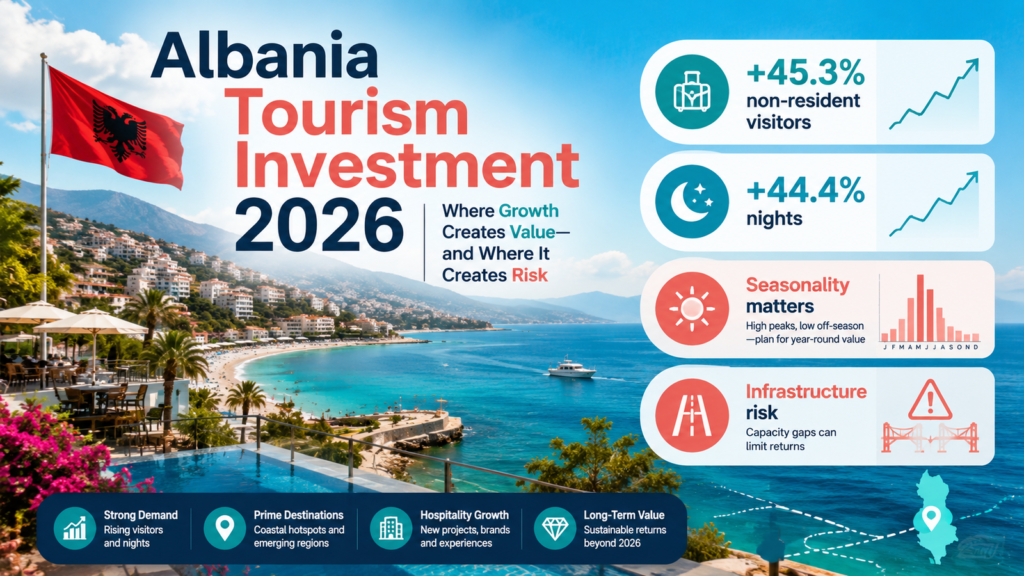
Albania is the least directly comparable because INSTAT’s complete annual 2025 tourism publication is scheduled later in 2026. The monthly accommodation series nevertheless confirms strong momentum. In June 2026, accommodated visitors were 17.0% higher than a year earlier. December 2025 also showed that non-resident accommodation demand was not confined to summer: non-resident visitors rose 47.6% year on year, with Italy accounting for 25% of foreign hotel guests that month, Kosovo 16% and Germany 6%.
| Market | What the data says | Operating implication |
|---|---|---|
| Croatia | Large, mature international market with pronounced summer concentration. | Underwrite shoulder months separately; do not annualise July-August economics. |
| Montenegro | Very high foreign share and a large coastal individual-accommodation segment. | Benchmark hotel pricing against villas/apartments and stress-test source-market exposure. |
| Albania | Fast growth and improving off-season signals, but annual comparable datasets are still catching up. | Use monthly city/region and property-level evidence rather than broad national averages. |
2026 data strengthens the case for Albania and Montenegro — but also exposes infrastructure risk
Albania’s air-access growth is now measurable rather than anecdotal. INSTAT reported 3.86 million airline passengers in Q2 2026, 26.4% more than in Q2 2025, with 33 foreign airlines operating. For hotel underwriting, that is a strong demand-access signal, but route count alone is insufficient: an operator should map seat capacity by origin, month and day of week against the property’s actual target segments.
Montenegro also entered 2026 with record aviation demand, but capacity is becoming a constraint. MONSTAT recorded 3.09 million airport passengers in 2025: about 1.75 million through Podgorica and 1.34 million through Tivat. In September 2026 the government said passenger traffic and network growth had reached historic levels while existing airport infrastructure had exceeded its required capacity, prompting accelerated work on Podgorica and Tivat and a long-term master plan.
That makes air access both a growth driver and an operating risk. Tivat is particularly relevant for coastal resorts because capacity constraints, peak-hour congestion and route seasonality can affect transfer times, guest experience and the practical ability to extend the season. Montenegro’s Tourism Ministry reported record July 2026 volumes of 623,104 arrivals and 3.72 million nights, up 11.3% and 10.1% respectively year on year. Strong peak demand therefore does not remove the need to test transport bottlenecks and off-season route continuity.
Accommodation mix changes the competitive set
A hotel investor should not benchmark only against hotels. In Croatia, June 2026 official capacity data showed substantially more bed places in holiday and other short-stay accommodation than in hotels and similar establishments. In Montenegro, individual accommodation accounts for a large share of total overnight stays and is heavily concentrated on the coast. Albania’s rapid expansion also includes apartments, villas and smaller properties outside conventional branded-hotel reporting.
The competitive set should therefore be built around the guest’s actual alternatives. For a four-star coastal hotel, that can mean comparable hotels, professionally managed apartments, villa products and resort residences within the same drive-time radius. The operator should compare not only ADR, but cancellation rules, parking, breakfast, beach access, minimum stay, transfer cost and review scores. A branded hotel may command a premium while still losing family or long-stay demand to short-stay inventory.
Labour rules and staffing flexibility differ materially
Croatia allows certain third-country seasonal workers in designated activities to work for up to 90 days without a labour-market test, although residence/work-permit and other legal requirements still apply. This can help peak-season staffing, but a hotel should model permit lead times, accommodation for workers, payroll charges and the probability of repeat hiring rather than treating temporary labour as instantly available.
Montenegro’s official labour guidance provides a clearer seasonal window: a temporary residence and work permit for seasonal employment can be issued for up to six months within one year. The employer must conclude the employment contract and register the worker for compulsory social insurance within eight days of permit issuance. For a resort with a long summer season, that is operationally meaningful, but recruitment lead time and worker housing remain property-level cost items.
For Albania, current public English-language material does not provide enough detail for this comparison to state a single equivalent seasonal-work rule with confidence. Any investment model should therefore obtain a local employment memo covering residence/work authorisation, payroll, working time, staff accommodation and termination rules before finalising the labour budget.
VAT should be mapped by revenue stream, not copied from a headline rate
Croatia applies a reduced 13% VAT rate to accommodation services. Montenegro’s Tax Administration confirms a 15% reduced VAT rate for accommodation in hospitality establishments under the current rules. Albania applies a 6% rate to accommodation, while separately invoiced ancillary services can fall under the standard 20% rate depending on the service and structure.
For underwriting, the correct model splits rooms, breakfast, restaurant, alcohol, spa, transfers, parking, events and other ancillary revenue instead of applying one VAT percentage to total revenue. Management agreements, OTA commissions and cross-border services can introduce additional tax questions. A local tax opinion should therefore be attached to the financial model before the investment committee relies on EBITDA or GOP margins.
A better hotel data room for the Adriatic
Before ranking the three markets, an investor should build the same five-part evidence pack for each target asset:
- Monthly demand: arrivals, nights, room occupancy, guest origins, purpose of trip and length of stay for the closest available geography.
- Access: airport and road transfer times, routes and seat capacity by month, plus planned infrastructure works.
- Competitive supply: hotels and short-stay alternatives, pipeline, openings, renovations and pricing by season.
- Operating costs: staffing, worker accommodation, utilities, insurance, property-related taxes, food costs and distribution commissions.
- Legal/tax structure: licence category, ownership or lease terms, VAT by revenue line, employment permits, tourism taxes and any incentives.
The result is a more useful three-market conclusion. Croatia offers the deepest evidence base and established international demand, but a coastal asset must survive strong seasonality and a sophisticated competitive set. Montenegro combines high foreign demand with a large coastal private-accommodation market and improving traffic, while airport capacity and source-market concentration require explicit stress tests. Albania is delivering strong growth in both accommodation and air transport, but faster market development increases the value of local asset-level evidence because national annual datasets and operating benchmarks are still less mature.
For additional context, see BalkansNetwork’s Balkan Hotel Pipeline and its analysis of Albania tourism investment in 2026. Neither market growth nor a reduced tax rate substitutes for asset-level underwriting; the investable opportunity is the property whose monthly demand, staffing model, access and cost structure remain viable outside the headline summer season.
Sources
- Croatian Bureau of Statistics — 2025 tourism results
- MONSTAT — Montenegro tourism statistics
- MONSTAT — airport passenger traffic 2025
- Montenegro Ministry of Tourism — July 2026 tourism results
- Government of Montenegro — airport capacity and 2027 development plan
- Government of Montenegro — seasonal employment of foreign nationals
- Montenegro Tax Administration — 15% accommodation VAT
- INSTAT — Accommodation Establishments, December 2025
- INSTAT — Accommodation Establishments, June 2026
- INSTAT — Air Transport Statistics, Q2 2026